by John Fitzsimmons | The American Folk Experience
There is a house in New Orleans They call the Rising Sun It has been the ruin of many a poor girl And me, oh, God, was one
My mother was a tailor, She sewed them new blue jeans. My lover he was a gambler, Oh Lord Gambled down in New Orleans.
My husband, he was a gambling man He went from town to town; And the only time he was satisfied Was when he drank his liquor down.
Now the only thing a gambling man needs
Is a suitcase and a trunk; And the only time he’s ever satisfied I when he’s on a drunk
Go and tell my baby sister Never do like I have done, But to shun that house in New Orleans That they call the Rising Sun
With one foot on the platform, And one foot on the train I’m goin’ back to New Orleans To wear the ball and chain.
I’m going back to New Orleans My race is almost run; I’m going back to spend the rest of my life Beneath that Rising Sun.
If you have any more information to share about this song or helpful links, please post as a comment.Thanks for stopping by the site!~John Fitz
I am indebted to the many friends who share my love of traditional songs and to the many scholars whose works are too many to include here. I am also incredibly grateful to the collector’s curators and collators of Wikipedia, Mudcat.org, MainlyNorfolk.info, and TheContemplator.com and the many other contributors for their wise, thorough and informative contributions to the study of folk music.
I share this research on my site with humility, thanks, and gratitude. Please cite all referenced work accordingly with your own research. If you have any research or sites you would like to share on this site, please post in the comment box. Thanks!
"The House of the Rising Sun" is an American traditional folk song, sometimes called "Rising Sun Blues". It tells of a person's life gone wrong in the city of New Orleans. Many versions also urge a sibling or parents and children to avoid the same fate. The most successful commercial version, recorded in 1964 by the English rock band The Animals, was a number one hit on the UK Singles Chart and in the US and Canada.[1] As a traditional folk song recorded by an electric rock band, it has been described as the "first folk rock hit".[2][3]
Like many folk songs, "The House of the Rising Sun" is of uncertain authorship. Musicologists say that it is based on the tradition of broadside ballads, and thematically it has some resemblance to the 16th-century ballad "The Unfortunate Rake" (also cited as source material for "St. James Infirmary Blues"), yet there is no evidence suggesting that there is any direct relation.[5] The folk song collector Alan Lomax suggested that the melody might be related to a 17th-century folk song, "Lord Barnard and Little Musgrave", also known as "Matty Groves",[6][7] but a survey by Bertrand Bronson showed no clear relationship between the two songs.[8]
Traditional English
Lomax also noted that "Rising Sun" was the name of a bawdy house in two traditional English songs, and a name for English pubs,[9] and proposed that the location of the house was then relocated from England to the US by Southern performers.[9] In 1953, Lomax met Harry Cox, an English farm labourer known for his impressive folk song repertoire, who knew a song called "She was a Rum One" (Roud 2128) with two possible opening verses, one beginning
If you go to Lowestoft, and ask for The Rising Sun,
There you'll find two old whores and my old woman is one.[10]
The recording Lomax made of Harry Cox is available online.[11] (Cox provides the alternative opening verse with the "Rising Sun" line at 1:40 in the recording.) It is considered extremely unlikely that Cox was aware of the American song.[12] It is also lent credence by the fact that there was a pub in Lowestoft called The Rising Sun and by the fact that the town is the most easterly settlement in the UK (hence "rising sun").[13] Doubt has been expressed as to whether Cox's song has any connection to later versions.[13][14]
"House of the Rising Sun" was said to have been known by American miners in 1905.[6] The oldest published version of the lyrics is that printed by Robert Winslow Gordon in 1925, in a column titled "Old Songs That Men Have Sung" in Adventure magazine.[15] The lyrics of that version begin:[15][16]
There is a house in New Orleans, it's called the Rising Sun
It's been the ruin of many poor girl
Great God, and I for one.
The oldest known recording of the song, under the title "Rising Sun Blues", is by Appalachian artists Clarence "Tom" Ashley and Gwen Foster, who recorded it on September 6, 1933, on the Vocalion label (02576).[6][17] Ashley said he had learned it from his grandfather, Enoch Ashley,[18] who got married around the time of the Civil War,[19] which suggests that the song could have been written years before the start of the 20th century. Roy Acuff, an "early-day friend and apprentice" of Clarence Ashley's, learned it from him and recorded it as "Rising Sun" on November 3, 1938.[6][17]
The narrative of the lyrics has varied between male and female narrators. The earliest known printed version from Gordon's column is about a woman's warning. The earliest known recording of the song by Ashley is about a rounder, a male character. The lyrics of that version begin:[20]
There is a house in New Orleans
They call the Rising Sun
Where many poor boys to destruction has gone
And me, oh God, are one.
On an expedition with his wife to eastern Kentucky, the folklorist Alan Lomax set up his recording equipment in Middlesboro, in the house of the singer and activist Tillman Cadle (husband of Mary Elizabeth Barnicle). There, he recorded a performance by Georgia Turner, the 16-year-old daughter of a local miner. He called it "The Rising Sun Blues".[17] Lomax recorded two other different versions in Eastern Kentucky in 1937, both of which can be heard online: one sung by Dawson Henson[21] and another by Bert Martin.[22] In his 1941 songbook Our Singing Country, Lomax credits the song to Georgia Turner, using Martin's extra lyrics to "complete" the song.[17][23] The Kentucky folk singer Jean Ritchie sang a different traditional version of the song to Lomax in 1949, which can be heard online courtesy of the Alan Lomax archive.[24]Dillard Chandler of Madison County, North Carolina, sang a variant of the song beginning "There was a sport in New Orleans".[25]
Several older blues recordings of songs with similar titles are unrelated, for example, "Rising Sun Blues" by Ivy Smith (1927), but Bluesologist for Texas music Coy Prather has argued that "The Risin' Sun" by Texas Alexander (1928) is an early blues version of the hillbilly song.[26]
Ted Anthony in his research on the song noted a lyrical similarity to versions of an old tune called The Rambling Cowboy.[27]
Early commercial folk and blues releases
In 1941, Woody Guthrie recorded a version. Keynote Records released one by Josh White in 1942,[28] and Decca Records released one also in 1942 with music by White and the vocals performed by Libby Holman.[29] Holman and White also collaborated on a 1950 release by Mercury Records. White is also credited with having written new words and music that have subsequently been popularized in the versions made by many other later artists. White learned the song from a "white hillbilly singer", who might have been Ashley, in North Carolina in 1923–1924.[6]Lead Belly recorded two versions of the song, in February 1944 and in October 1948, called "In New Orleans" and "The House of the Rising Sun", respectively; the latter was recorded in sessions that were later used on the album Lead Belly's Last Sessions (1953, Smithsonian Folkways).
In 1957, Glenn Yarbrough recorded the song for Elektra Records. The song is also credited to Ronnie Gilbert on an album by the Weavers released in the late 1940s or early 1950s. Pete Seeger released a version on Folkways Records in 1958, which was re-released by Smithsonian Folkways in 2009.[17]Andy Griffith recorded the song on his 1959 album Andy Griffith Shouts the Blues and Old Timey Songs. The same year, a version by Judy Collins is released on the compilation Folk Song Festival at Exodus. In 1960, Miriam Makeba recorded the song on her eponymous RCA album.
In late 1961, Bob Dylan recorded the song for his debut album, released in March 1962. That release had no songwriting credit, but the liner notes indicate that Dylan learned this version of the song from Dave Van Ronk. In an interview for the documentary No Direction Home, Van Ronk said that he was intending to record the song and that Dylan copied his version. Van Ronk recorded it soon thereafter for the album Just Dave Van Ronk.
I had learned it sometime in the 1950s, from a recording by Hally Wood, the Texas singer and collector, who had got it from an Alan Lomax field recording by a Kentucky woman named Georgia Turner. I put a different spin on it by altering the chords and using a bass line that descended in half steps—a common enough progression in jazz, but unusual among folksingers. By the early 1960s, the song had become one of my signature pieces, and I could hardly get off the stage without doing it.
Then, one evening in 1962, I was sitting at my usual table in the back of the Kettle of Fish, and Dylan came slouching in. He had been up at the Columbia studios with John Hammond, doing his first album. He was being very mysterioso about the whole thing, and nobody I knew had been to any of the sessions except Suze, his lady. I pumped him for information, but he was vague. Everything was going fine and, "Hey, would it be okay for me to record your arrangement of 'House of the Rising Sun?'" Oh, shit. "Jeez, Bobby, I'm going into the studio to do that myself in a few weeks. Can't it wait until your next album?" A long pause. "Uh-oh". I did not like the sound of that. "What exactly do you mean, 'Uh-oh'?" "Well", he said sheepishly, "I've already recorded it".[31]
The Animals had begun featuring their arrangement of "The House of the Rising Sun" during a joint concert tour with Chuck Berry, using it as their closing number to differentiate themselves from acts that always closed with straight rockers.[35][36] It elicited a tremendous reaction from the audience, convincing initially reluctant producerMickie Most that it had hit potential,[36] and between tour stops the group went to a small recording studio, De Lane Lea Studios on Kingsway in London[36] to capture it. The song was first performed in a concert in Bellingham Town Hall, in Northumberland.[37]
Recording and releases
The song was recorded in just one take on May 18, 1964,[38][39] and it starts with a now-famous electric guitarA minor chordarpeggio by Hilton Valentine.[1][3] According to Valentine, he simply took Dylan's chord sequence and played it as an arpeggio.[40] The performance takes off with Burdon's lead vocal, which has been variously described as "howling",[2] "soulful",[41] and as "...deep and gravelly as the north-east English coal town of Newcastle that spawned him".[1] Finally, Alan Price's pulsating organ part (played on a Vox Continental) completes the sound. Burdon later said, "We were looking for a song that would grab people's attention."[42]
As recorded, "The House of the Rising Sun" ran four and a half minutes, regarded as far too long for a pop single at the time.[38] Producer Most, who initially did not really want to record the song at all,[40] said that on this occasion: "Everything was in the right place ... It only took 15 minutes to make so I can't take much credit for the production."[43] He was nonetheless now a believer and declared it a single at its full length, saying "We're in a microgroove world now, we will release it."[43]
In the US, the original single (MGM 13264) was a 2:58 version. The MGM Golden Circle reissue (KGC 179) featured the unedited 4:29 version, although the record label gives the edited playing time of 2:58. The edited version was included on the group's 1964 US debut album The Animals, while the full version was later included on their best-selling 1966 US greatest hits album, The Best of the Animals. The first American album release of the full version was on a 1965 compilation entitled Mickie Most Presents British Go-Go (MGM SE-4306), the cover of which, under the listing of "House of the Rising Sun", described it as the "Original uncut version". Americans could also hear the complete version in the movie Go Go Mania in the spring of 1965.
Cash Box described the US single version as "a haunting, beat-ballad updating of the famed folk-blues opus that the group's lead delivers in telling solo vocal fashion."[44]
"House of the Rising Sun" was not included on any of the group's British albums, but it was reissued as a single twice in subsequent decades, charting both times, reaching number 25 in 1972 and number 11 in 1982.
The Animals version was played in 6 8 meter, unlike the 4 4 of most earlier versions. Arranging credit went only to Alan Price. According to Burdon, this was simply because there was insufficient room to name all five band members on the record label, and Alan Price's first name was first alphabetically. This meant that only Price received songwriter's royalties for the hit, which has caused bitterness among the other band members ever since.[3][45]
The song is in the public domain and Dave Van Ronk, who intended to sue them, realised that an arrangement cannot be protected by copyright.[citation needed]
"House of the Rising Sun" was a trans-Atlantic hit: after reaching the top of the UK pop singles chart in July 1964, it topped the US pop singles chart two months later, on September 5, 1964, where it stayed for three weeks. Many cite this as the first true classic rock song,[46] and it became the first British Invasion number one unconnected with the Beatles.[47] It was the group's breakthrough hit in both countries and became their signature song.[48] The song was also a hit in Ireland twice, peaking at No. 10 upon its initial release in 1964 and later reaching a brand new peak of No. 5 when reissued in 1982.
According to John Steel, Bob Dylan told him that when he first heard the Animals' version on his car radio, he stopped to listen, "jumped out of his car" and "banged on the bonnet" (the hood of the car), inspiring him to go electric.[49]Dave Van Ronk said that the Animals' version—like Dylan's version before it—was based on his arrangement of the song.[50]
Dave Marsh described the Animals' take on "The House of the Rising Sun" as "the first folk-rock hit", sounding "as if they'd connected the ancient tune to a live wire".[2] Writer Ralph McLean of the BBC agreed that it was "arguably the first folk rock tune" and "a revolutionary single", after which "the face of modern music was changed forever."[3]
In 1969, the Detroit band Frijid Pink recorded a psychedelic version of "House of the Rising Sun", which became an international hit in 1970. Their version is in 4 4 (like Van Ronk's and most earlier versions, rather than the 6 8 used by the Animals) and was driven by Gary Ray Thompson's distorted guitar with fuzz and wah-wah effects, set against the frenetic drumming of Richard Stevers.[80]
According to Stevers, the Frijid Pink recording of "House of the Rising Sun" was done impromptu when there was time left over at a recording session booked for the group at the Tera Shirma Recording Studios. Stevers later played snippets from that session's tracks for Paul Cannon, the music director of Detroit's premier rock radio station, WKNR; the two knew each other, as Cannon was the father of Stevers's girlfriend. Stevers recalled, "we went through the whole thing and [Cannon] didn't say much. Then 'House [of the Rising Sun]' started up and I immediately turned it off because it wasn't anything I really wanted him to hear." However, Cannon was intrigued and had Stevers play the complete track for him, then advising Stevers, "Tell Parrot [Frijid Pink's label] to drop "God Gave Me You" [the group's current single] and go with this one."[81]
Frijid Pink's "House of the Rising Sun" debuted at number 29 on the WKNR hit parade dated January 6, 1970, and broke nationally after some seven weeks—during which the track was re-serviced to radio three times—with a number 73 debut on the Hot 100 in Billboard dated February 27, 1970 (number 97 Canada 1970/01/31), with a subsequent three-week ascent to the top 30 en route to a Hot 100 peak of number seven on April 4, 1970. The certification of the Frijid Pink single "House of the Rising Sun" as a gold record for domestic sales of one million units was reported in the issue of Billboard dated May 30, 1970.
The Frijid Pink single of "House of the Rising Sun" would give the song its most widespread international success, with top 10 status reached in Austria (number three), Belgium (Flemish region, number six), Canada (number three), Denmark (number three), Germany (two weeks at number one), Greece, Ireland (number seven), Israel (number four), the Netherlands (number three), Norway (seven weeks at number one), Poland (number two), Sweden (number six), Switzerland (number two), and the UK (number four). The single also charted in Australia (number 14), France (number 36), and Italy (number 54).
In August 1980, Dolly Parton released a cover of the song as the third single from her album 9 to 5 and Odd Jobs. Like Miller's earlier country hit, Parton's remake returns the song to its original lyric of being about a fallen woman. The Parton version makes it quite blunt, with a few new lyric lines that were written by Parton. Parton's remake reached number 14 on the US country singles chart and crossed over to the pop charts, where it reached number 77 on the Billboard Hot 100; it also reached number 30 on the US Adult Contemporary chart. Parton has occasionally performed the song live, including on her 1987–88 television show, in an episode taped in New Orleans. In Canada it reached number 20.[102]
‡ Sales+streaming figures based on certification alone.
Other charting versions
The song has been widely (more than 300 times[105]) covered and remixed over the ages. Charting versions include:
In 1969, Claude King's version reached number 28 on Canada's country charts, December 20, 1969.[106]
In 1973, Jody Miller's version reached number 29 on the country charts[107] and number 41 on the Adult Contemporary chart.[108] In Canada it reached number 23 on the country charts and number 81 on the AC charts.[109][110]
In 1977, Santa Esmeralda scored a top 20 disco hit with a dance version of the song and number 78 on the Billboard Hot 100.
In 1996, Gary Glitter released a cover version of "House of the Rising Sun" as a single, which reached number 77 on the UK Singles Chart.
The song was covered in French by Johnny Hallyday. His version (titled "Le Pénitencier", pronounced[ləpenitɑ̃sje], meaning "The penitentiary") was released in October 1964 and spent one week at number one on the singles sales chart in France (from October 17 to 23).[111] In Wallonia, Belgium, his single spent 28 weeks on the chart, also peaking at number one.[112]
Colombian band Los Speakers covered the song under the title "La Casa del Sol Naciente", in their 1965 album of the same name.
Agnaldo Timóteo (in Portuguese)
The song is from Agnaldo Timóteo's debut album, Surge Um Astro, released in 1965. The song was recorded and released in 1965, the year of Agnaldo Timóteo's rise to fame. The lyrics were adapted by Fred Jorge, who transformed the American blues into a ballad with a tone of melancholy and hope that deeply connected with the Brazilian audience.
[114]
EAV version and 'Wilbert Eckart und seine Volksmusik Stars' versions (in German)
Two notable German covers/adaptions were created, one by Erste Allgemeine Verunsicherung, which in 1989 recorded a song with lyrics telling the story of an East Germany citizen fleeing East Berlin after the Fall of the Berlin Wall and his following disillusion with Western society.[115] Another one that gained international recognition was created for the soundtrack of Wolfenstein: The New Order in 2014, interpreting the song with Volksmusik instrumentation, fitting the alternate future theme of the game in which Nazi Germany won World War II, as part of a collection of 'adapted' pop hits.[116][117]
Miki Jevremović (in Serbo-Croatian)
Famous Yugoslav singer Miodrag "Miki" Jevremović covered the song and included it in his 1964 EP "18 Žutih Ruža" (eng. "Eighteen Yellow Roses").
Kult version (in Polish)
Polish rock band Kult released a Polish-language version of the song under the title "Dom wschodzącego słońca" in the 1993 reedition of their self-titled debut album from 1987.
Possible real locations
Various places in New Orleans have been proposed as the inspiration for the song, with varying plausibility. The phrase "House of the Rising Sun" is often understood as a euphemism for a brothel, but it is uncertain as to whether the house described in the lyrics was an actual or a fictitious place. One theory is that the song is about a woman who killed her father, an alcoholic gambler who had beaten his wife. Therefore, the House of the Rising Sun may be a jailhouse, from which one would be the first person to see the sunrise (an idea supported by the lyric mentioning "a ball and chain", though that phrase has been slang for marital relationships for at least as long as the song has been in print). Because women often sang the song, another theory is that the House of the Rising Sun was where prostitutes were detained while being treated for syphilis. Since cures with mercury were ineffective, going back was very unlikely.[7][34]
1867 advertisement noting the "Rising Sun Coffee House" building for rent or lease
Only three candidates that use the name Rising Sun have historical evidence—from old city directories and newspapers. The first was a small, short-lived hotel on Conti Street in the French Quarter in the 1820s. It burned down in 1822. An excavation and document search in early 2005 found evidence that supported this claim, including an advertisement with language that may have euphemistically indicated prostitution. Archaeologists found an unusually large number of pots of rouge and cosmetics at the site.[118]
The second possibility was a "Rising Sun Hall" listed in late 19th-century city directories on what is now Cherokee Street, at the riverfront in the uptown Carrollton neighborhood, which seems to have been a building owned and used for meetings of a Social Aid and Pleasure Club, commonly rented out for dances and functions. It also is no longer extant. Definite links to gambling or prostitution (if any) are undocumented for either of these buildings.
A third was "The Rising Sun", which advertised in several local newspapers in the 1860s, located on what is now the lake side of the 100 block of Decatur Street.[119] In various advertisements it is described as a "Restaurant", a "Lager Beer Salon", and a "Coffee House". At the time, New Orleans businesses listed as coffee houses often also sold alcoholic beverages.
Dave Van Ronk wrote in his biography The Mayor of MacDougal Street that at one time when he was in New Orleans someone approached him with a number of old photos of the city from the turn of the century. Among them "was a picture of a foreboding stone doorway with a carving on the lintel of a stylized rising sun ... It was the Orleans Parish women's prison".[120]
Bizarre New Orleans, a guidebook on New Orleans, asserts that the real house was at 1614 Esplanade Avenue between 1862 and 1874 and was said to have been named after its madam, Marianne LeSoleil Levant, whose surname means "the rising sun" in French.[34]
Another guidebook, Offbeat New Orleans, asserts that the real House of the Rising Sun was at 826–830 St. Louis St. between 1862 and 1874, also purportedly named for Marianne LeSoleil Levant. The building still stands, and Eric Burdon, after visiting at the behest of the owner, said, "The house was talking to me".
There is a contemporary B&B called the House of the Rising Sun, decorated in brothel style. The owners are fans of the song, but there is no connection with the original place.[121][122]
Not everyone is convinced that the house actually ever existed. Pamela D. Arceneaux, a research librarian at the Williams Research Center in New Orleans, is quoted as saying:
I have made a study of the history of prostitution in New Orleans and have often confronted the perennial question, "Where is the House of the Rising Sun?" without finding a satisfactory answer. Although it is generally assumed that the singer is referring to a brothel, there is actually nothing in the lyrics that indicate that the "house" is a brothel. Many knowledgeable persons have conjectured that a better case can be made for either a gambling hall or a prison; however, to paraphrase Freud: sometimes lyrics are just lyrics.[7]
References
Notes
^ abcYork, Barry (July 9, 2004). "House of worship". The Age. Retrieved January 12, 2014.
^ abSteve Sullivan, Encyclopedia of Great Popular Song Recordings, Volume 1, Scarecrow Press (2013) ISBN 0810882965, 9780810882966, p. 98.
^The same opening lyrics are in the early recorded version in 1933: Robert B. Waltz and David G. Engle, "House of the Rising Sun, TheArchived October 5, 2020, at the Wayback Machine", The Traditional Ballad Index, 4.0, Fresno State University, (2016) (accessed October 19, 2016)
^Miller, Michael (June 26, 2013). "'House of the Rising Sun' to set on Costa Mesa". Los Angeles Times. Archived from the original on November 30, 2020. Retrieved November 22, 2020. The band's 1964 hit "House of the Rising Sun," which cast a traditional ballad in a hard, bluesy arrangement, is considered a folk-rock milestone, and hits like "We Gotta Get Out of This Place" and "Don't Let Me Be Misunderstood" remain classic rock radio staples.
^Van Ronk, Dave. The Mayor of MacDougal Street. Then, sometime in 1968, Eric Burdon and the Animals made a number-one chart hit out of the damn thing. Same arrangement. I would have loved to sue for royalties, but I found that it is impossible to defend the copyright on an arrangement.
^Lester Bangs, The British Invasion, in The Rolling Stone Illustrated History of Rock & Roll, 1980, p. 176.
^Kent, David (2009). Australian Chart Book: Australian Chart Chronicles (1940–2008). Turramurra: Australian Chart Book. p. 205. ISBN 9780646512037.
^ abSalaverri, Fernando (September 2005). Sólo éxitos: año a año, 1959–2002 (1st ed.). Spain: Fundación Autor-SGAE. ISBN 84-8048-639-2.
^Hallberg, Eric (1993). Eric Hallberg presenterar Kvällstoppen i P 3: Sveriges radios topplista över veckans 20 mest sålda skivor 10. 7. 1962 – 19. 8. 1975. Drift Musik. ISBN 9163021404.
^Hallberg, Eric; Henningsson, Ulf (1998). Eric Hallberg, Ulf Henningsson presenterar Tio i topp med de utslagna på försök: 1961 - 74. Premium Publishing. ISBN 919727125X.
Historians have not been able to definitively identify The House Of The Rising Sun, but here are the two most popular theories:
1) The song is about a brothel in New Orleans. “The House Of The Rising Sun” was named after Madame Marianne LeSoleil Levant (which means “Rising Sun” in French) and was open for business from 1862 (occupation by Union troops) until 1874, when it was closed due to complaints by neighbors. It was located at 826-830 St. Louis St.
2) It’s about a women’s prison in New Orleans called the Orleans Parish women’s prison, which had an entrance gate adorned with rising sun artwork. This would explain the “ball and chain” lyrics in the song.
The melody is a traditional English ballad, but the song became popular as an African-American folk song. It was recorded by Texas Alexander in the 1920s, then by a number of other artists including Leadbelly, Woody Guthrie, Josh White and later Nina Simone. It was her version The Animals first heard. No one can claim rights to the song, meaning it can be recorded and sold royalty-free. Many bands covered the song after it became a hit for The Animals.
The folk music historian Alan Lomax recorded a version in 1937 by a 16-year-old girl named Georgia Turner. In this context, it is sung in the first person, present tense with the singer lamenting how the House of the Rising Sun has ruined her life. In this traditional folk version, the main character is either a prostitute or a prisoner. The Animals changed it to a gambler to make their version more radio-friendly.
The Animals performed this song while touring England with Chuck Berry. It went over so well that they recorded it between stops on the tour. In our 2010 interview with Animals lead singer Eric Burdon, he explained: “‘House of the Rising Sun’ is a song that I was just fated to. It was made for me and I was made for it. It was a great song for the Chuck Berry tour because it was a way of reaching the audience without copying Chuck Berry. It was a great trick and it worked. It actually wasn’t only a great trick, it was a great recording. The best aspect of it, I’ve been told, is that Bob Dylan, who was angry at first, turned into a rocker. Dylan went electric in the shadow of The Animals classic ‘House of the Rising Sun.'”
Bob Dylan recorded this on his first album. The Animals version was one of the first songs to put a rock rhythm to a rolk song, something Dylan did a lot soon after.
This was the first song since 1962 by a British band to hit #1 in America that was not written by John Lennon and Paul McCartney.
This was the first international hit Mickie Most produced. An Englishman, Most went to South Africa in 1959 and formed a band called Mickie Most and his Playboys. Since rock music had not come to the country, Most recorded popular songs like “Johnny B. Goode” and “Shake, Rattle And Roll,” running up a string of hits. Upon returning to England in 1962, he turned to production work, since he had honed his songcraft skills in South Africa.
After seeing The Animals perform at Club A-Go-Go in Newcastle, he began producing the band; their first recording was “Baby Let Me Take You Home,” which was released as the group’s first single and made UK #21. Next was “The House of the Rising Sun.”
Most quickly became the top producer in England, adding Herman’s Hermits, Donovan, Lulu and Jeff Beck to his roster.
The Animals recorded this in one take, as they had perfected the song from years of performing it on the road. The Animals’ drummer John Steel recalls in 1000 UK #1 Hits by Jon Kutner and Spencer Leigh, “We Played Liverpool on May 17 1964 and then drove to London where Mickie (Most) had booked a studio for ITV’s Ready Steady Go! Because of the reaction we were getting to ‘Rising Sun,’ we asked to record it and he said, ‘Okay we’ll do it at the same session.’ We set up for balance, played a few bars for the engineer – it was mono with no overdubs – and we only did one take. We listened to it and Mickie said, ‘That’s it, it’s a single.’ The engineer said it was too long, but instead of chopping out a bit, Mickie had the courage to say, ‘We’re in a microgroove world now, we will release it.’ A few weeks later it was #1 all over the world. When we knocked The Beatles off the top in America, they sent us a telegram which read, ‘Congratulations from The Beatles (a group)’.” The producer Mickie Most recalls, “Everything was in the right place, the planets were in the right place, the stars were in the right place and the wind was blowing in the right direction. It only took 15 minutes to make so I can’t take much credit for the production. It was just a case of capturing the atmosphere in the studio.”
The Animals had 13 more Top 40 hits in the US, becoming one of the most successful British Invasion bands in the United States. They split up in 1968 over various music and business issues. Burdon told us: “I don’t think that The Animals got a chance to evolve. We were the first to admit that we took Blues songs from American artists, but if the Animals had stuck together and worked together instead of worrying about who was getting all the money, we could have evolved more and come out with more music to be proud of.”
Alan Price was the only band member given credit for arranging the track, meaning he is paid almost all the royalties. Their record company told the other members that there was not enough room to list them as arrangers.
The organ solo was inspired by jazzman Jimmy Smith’s hit “Walk on the Wild Side.” Alan Price performed the solo on a Vox Continental.
Here is The Animals iconic and widely popular version…
Here is Dave Van Ronk’s haunting and soulful version…
Performances, Workshops,Resources & Recordings
The American Folk Experience is dedicated to collecting and curating the most enduring songs from our musical heritage. Every performance and workshop is a celebration and exploration of the timeless songs and stories that have shaped and formed the musical history of America. John Fitzsimmons has been singing and performing these gems of the past for the past forty years, and he brings a folksy warmth, humor and massive repertoire of songs to any occasion.
““Beneath the friendly charisma is the heart of a purist gently leading us from the songs of our lives to the timeless traditional songs he knows so well…”
Globe Magazine
Join Fitz at The Colonial Inn
“The Nobel Laureate of New England Pub Music…”
Scott Alaric
Adventures in the Modern Folk Underground
On the Green, in Concord, MAEvery Thursday Nightfor over thirty years…
“A Song Singing, Word Slinging, Story Swapping, Ballad Mongering, Folksinger, Teacher, & Poet…”
Theo Rogue
Songcatcher Rag
Fitz’s Recordings
& Writings
Songs, poems, essays, reflections and ramblings of a folksinger, traveler, teacher, poet and thinker…
I am surprised sometimesby the suddenness of November:beauty abruptly shedto a common nakedness--grasses deadenedby hoarfrost,persistent memoriesof people I’ve lost.It is left to those of us dressed in the hard barky skin of experienceto insist on a decorumthat rises...
Every Thursday Night at The Colonial Inn On the Green, in Concord, Massachusetts This is my first attempt at trying to record a night at the inn, so please forgive my engineering errors as a producer. I simply used the Bose Tonematch into Garageband and called it good...
Rain’s falling outside of Boston—
Thank God I’m not working tonight.
I’ve got six of my own,
And a stepdaughter at home,
And a momma keeping things right.
I wonder if they’re at the table
With their puzzles, their papers and pens?
When I get off the highway
And pull in that driveway,
Will they run to the window again?
Just because no one understands you, it doesn’t mean you are an artist ~Bumper Sticker I sometimes wonder why when you give a group of teenagers a video camera, the first impulse is to shoot something stupid. It’s as if there is some jackass switch...
Stories are a communal currency of humanity. ― Tahir Shah, In Arabian Nights The most powerful and enduring connection we share as a human race is our desire and need to share stories. We engage in the art of storytelling more than most of us ever realize; whether we...
Sometimes, like right now, I long for a pile of papers on my lap that I could speed through, grade with a series of checks and circles, a few scribbled lines of praise or condemnation, and drop into a shoebox on my desk and say, "Here are your essays!" But I...
When you find yourself in the majority, it's time to join the minority ~Mark Twain I have to admit, Google is pretty impressive. The whole set of features that are offered to the public and to educators for free is pretty astounding: email, document creation and...
Here I am out on the road again
and it feels longer than it was back then;
when I was younger, man, it saw me through—
now it don’t do
what I want it to—
Too ra loo ra loo ra lady I—
I’m just out searching for an alibi
Too ra loo ra loo ra lady I
I’m just out searching for an alibi.
Like birds of a feather, we gather together, 'Cuz they're feeling exactly like you... ~John Prine I am not afraid of being a white minority. I had lunch today with a Jamaican drummer, a Ugandan farmer, and a Senagalese potter. I don’t say this out of...
The only way out is through... Damn! Another long post... For better and worse--and through thick and thin--I keep piling on rubric after rubric to help guide the content, flow, and direction of my students' writing pieces. The greater irony is that I never set out...
I wonder if God is testing me, giving Me some affable warning Or, perhaps, a more Stern rebuke, replaying A foolish mistake, Rehashing and reminding me Of a harsher possibility. It is only a small 10 mm wrench tightening A loose bolt on the throttle body, slipping...
It’s not like a poem to come curl by my feet on this morning too beautiful to describe, though I am looking and listening and waiting: A rooster crows above the low hum of morning traffic; the trash truck spills air from brakes and rattles empties into bins; my...
Maybe it is time to be less forgiving. I have rarely agreed with our president, but I held on to the shreds of truth that shore up his arguments: we can’t welcome every immigrant who makes it to our border; we cannot bow to the audacity of corrupt governments in...
Opinie na temat kasyna online Vavada w roku 2026 Opinie o kasynie online Vavada w roku 2026 Decydując się na rozrywkę w wirtualnym świecie gier, warto zwrócić uwagę na Vavada. Ta platforma przyciąga entuzjastów hazardu z wielu powodów. Wysoka jakość gier oraz...
by Fitz | September 23, 2014 | Journal | 0 Comments
When Cool Was Really Cool Life is not counted by the amount of breaths we take, but of the moments that leave us breathless. ~Unknown We were coming home from church one morning and Jimmy Glennon pulled up beside us as we approached the Sudbury road...
I have an old lobster buoy Hanging dully from A wrought-iron basket hook— A rough cutaway Filled with suet, Clabbered in wire mesh. . I had imagined chickadees Squabbling with angry jays And occasional sparrows, finches— Maybe even cedar waxwings tired of scrounging...
Wisdom starts in non-action… The doing and non-doing are the equal balance. Without the luxury of contemplation there would not be a prioritizing of need versus want. Wisdom balances physical reality… Wisdom does not shuffle tasks out of view but finds a way to...
I realized that in all my years of writing and journal keeping, I seldom, if ever, write about "The Inn," which is and has been, the biggest and most enduring constant in my life for the past thirty plus years. Every Thursday night I load up my car, truck, bus...
It has been a long time since I wrote a simple old "this is what I am going to do today" post. So this is what I am going to do today: [and trust me, it will have nothing--absolutely nothing--to do with school work:)] Before the true winter settles in, I am going to...
has dropped a seamlessness before the plows and children can patch it back to a jagged and arbitrary quilting putting borders to design and impulse. I imagine myself falling everywhere softly, whispering, I am here, and I am here.
Who forgets to rinse his hair? Me, I guess, for that was the start of my day. I smelled something like coconut oil on my way to school, and then I realized, dang, my hair is still pretty wet. Wet with hair conditioner. And then I get sot school all coconutty smelling...
A lot of things in life fall short of the mark, but thoughtfulness has never let me down. For some forty years I have faithfully kept journals of the wanderings of my mind—most of which is lost in some way or another, but the effect hangs on like a sailor...
I, on my side, require of every writer, first or last, a simple and sincere account of his own life, and not merely what he has heard of other men's lives; some such account as he would send to his kindred from a distant land... ~Henry David Thoreau, Walden I’ve...
It is not where you go. It is how you go. ~Fitz Is there any value in coming to the page this late at night after three hours of singing in a pub, just because I said I would? I expect you to go to the empty page and pry tired and stubborn thoughts and lay them on the...
I've been somewhat lax about posting in here of late, but I have been giving myself a bit of a break from writing. In fact, I spent the last month or so just living--and that has been just fine with me. I set a simple goal for myself this summer to get in shape. PJ...
The rain falls;The grass grows:Nothing is done.Nothing is left undone~Buddha Sometimes you just do what you got to do, and that never changes from the first time you take out the trash as a kid until the time in life where you are taking care of little chores...
Every heart sings a song, incomplete, until another heart whispers back. Those who wish to sing always find a song. At the touch of a lover, everyone becomes a poet. ~Plato Writing a song is not just an exercise in seeking some kind of future fame. It is...
Good intentions are easily hobbled by inaction. There has always been a murky and muddied No Mans Land in every war where the evil and the righteous trade the moral high ground. This is not the case in Ukraine. Putin’s actions are evil--pure, unmitigated, unprovoked...
I am not sure what Christmas really is anymore. I am almost afraid to think of what Christians are going through in the lands of the original Christian faith. By dint of place and time, I grew up in the Catholic faith, and try as I might, I can’t ever escape the...
I guess this is a good thing. I showed up five minutes late for class, and my classroom was empty. I walked the hallways of the school and could not find any of them. I sheepishly asked the assistant headmaster if he "happened to see a class of wandering boys?"No, he...
“My teachers could have written with Jesse James for all time they stole from us...” ~Richard Brautigan, “Trout Fishing in America” My classroom is often a bit of a mess—a mass of sprawled bodies scattered around like casualties of battle, ensconced in various...
This house makes funny noises
When the wind begins to blow.
I should have held on and never let you go.
The wind blew loose the drainpipe.
You can hear the melting snow.
I’ll fix it in the morning when I go.
I’ll fix it in the morning when I go.
There are thousand hacking at the branches of evil to one striking at the root. ~Henry David Thoreau I just spent a long day deconstructing our backyard. EJ sold his alpacas, and so our fenced in pasture and barn can now return to its suburban origins as a shed...
In fifth grade my mother finally let me go to the Concord Music store and buy a "45" single. I bought Johnny Cash’s version of “Ring of Fire” written by his future wife June Carter and Merle Kilgore, a noted country songwriter of his day. There was no doubt in my...
It’s not just a couch; it’s a sofa, too ~Fitz I remember my first year teaching at Fenn—and it was really my first stint as a true worker with responsibilities outside of what I already had in my wheelhouse—and on this day, some twenty something years ago, I...
I've been spending a lot of time lately writing sketches of songs—some more complete than others. I have found that it takes time for a song to evolve into its final form, so what I have posted here is more the end of the beginning, not the end. Denise gave me the...
Leave the fog stillness
of a cold harbor town;
cup our hands
in the warm diesel sound—
leave while the children
are calmed in their dreams
by light buoys calling:
“Don’t play around me.”
1. The Allure of Chicken RoadChicken Road has taken the online casino world by storm with its quirky premise—helping a plucky bird navigate a perilous street while chasing a golden egg prize. Players love the game’s bright, cartoonish visuals and the fact that every...
A literary reflection to my students... The lowering for whales, the appearance of Fedallah's crew, the vivid descriptions of the first chase in a sudden and unrelenting gale, the fatalistic joy of resigning oneself to fate, the awesome poetic intensity of Melville's...
by Fitz | September 17, 2014 | Journal | 0 Comments
The start of the school year, and I have literally spent every free moment working on what is ostensibly pretty cool stuff, methinks...but it is work in every sense of the word, so I do miss those long summer mornings when could literally write to my heart and heads...
by John Fitzsimmons | The American Folk Experience
Come all ye jolly lumbermen, and listen to my song But do not get discouraged, the length it is not long; Concerning of some lumbermen, who did agree to go To spend one pleasant winter up in Canada-I-O.
It happened late one season in the fall of fifty-three A preacher of the gospel one morning came to me; Says he, “My jolly fellow, how would you like to go To spend one pleasant winter up in Canada-I-O?”
To him I quickly made reply, and unto him did say, “In going out to Canada depends upon the pay. If you will pay good wages, my passage to and fro, I think I’ll go along with you to Canada-I-O.”
“Yes, we will pay good wages, and will pay your wages out, Provided you sign papers that you will stay the route; But if you do get homesick and swear that home you’ll go We never can your passage pay from Canada-I-O.”
“And if you get dissatisfied and do not wish to stay, We do not wish to bind you, no, not one single day, You just refund the money we had to pay, you know, Then you can leave that bonny place called Canada-I-O.
It was by his gift of flattery he enlisted quite a train, Some twenty-five or thirty, both well and able men; We had a pleasant journey o’er the road we had to go, Till we landed at Three Rivers, up in Canada-I-O.
But there our joys were ended, and our sorrows did begin, Fields, Phillips and Norcross they then came marching in. They sent us all directions, some where I do not know, Among those jabbering Frenchmen up in Canada-I-O.
After we had suffered there some eight or ten long weeks, We arrived at headquarters, up among the lakes; We thought we’d find a paradise, at least they told us so, God grant there may be no worse hell than Canada-I-O.
To describe what we have suffered is past the art of man; But to give a fair description I will do the best I can: Our food the dogs would snarl at, our beds were on the snow, We suffered worse than murderers up in Canada-I-O.
Our hearts were made of iron and our souls were cased with steel, The hardships of that winter could never make us yield; Fields, Phillips and Norcross they found their match, I know Among the boys that went from Maine to Canada-I-O.
But now our lumbering is over and we are returning home, To greet our wives and sweethearts and never more to roam; To greet our friends and neighbors; we’ll tell them not to go To that forsaken G—- D— place called Canada-I-O.
If you have any more information to share about this song or helpful links, please post as a comment.Thanks for stopping by the site!~John Fitz
I am indebted to the many friends who share my love of traditional songs and to the many scholars whose works are too many to include here. I am also incredibly grateful to the collector’s curators and collators of Wikipedia, Mudcat.org, MainlyNorfolk.info, and TheContemplator.com for their wise, thorough and informative contributions to the study of folk music.
I share this scholarly research on my site with humility, thanks, and gratitude. Please cite sources accordingly with your own research. If you have any research or sites you would like to share on this site, please post in the comment box.
"Canada-I-O" (also known as "Canadee-I-O" or "The Wearing of the Blue") is a traditional English folkballad (Roud 309).[1] It is believed to have been written before 1839.[2]
When her love goes to sea, a lady dresses as a sailor and joins (his or another's) ship's crew. When she is discovered, (the crew/her lover) determine to drown her. The captain saves her and they marry.
The Scottish song "Caledonia/Pretty Caledonia" is quite different in detail — so much so that it is separate from the "Canada-I-O" texts in the Roud Folk Song Index ("Canaday-I-O" is #309;[3] "Caledonia" is #5543). The plot, however, is too close for scholars to distinguish.
Broadsides
Bodleian, Harding B 11(1982), "Kennady I-o," J. Catnach (London), 1813-1838; also Firth c.12(329), Harding B 11(2039), "Lady's Trip to Kennedy"; Harding B 25(1045), "The Lady's Trip to Kennady"; Firth c.12(330), "Canada Heigho";[4] Firth c.13(240), Firth c.12(331), Harding B 11(2920), 2806 c.16(72), "Canada I, O"
The ballad Canadee-I-O was printed in Leach, Folk Ballads & Songs of the Lower Labrador Coast.
Harry Upton of Balcombe, Sussex, sang Canadee-I-O to Peter Kennedy on September 5, 1963. This recording was included in 2012 on the Topic anthology of songs by Southern English singers, You Never Heard So Sweet (The Voice of the People Volume 21), and the song was included in 1970 in Ken Stubb’s book of English folk songs from the Home Counties, The Life of a Man. Another recording made by Mike Yates in 1974 was included in 1975 on the Topic collection of traditional songs from Sussex, Sussex Harvest, and in 2001 on the Musical Traditions anthology of songs from the Mike Yates Collection, Up in the North and Down in the South. Mike Yates commented in the latter’s booklet:
Canadee-I-O is something of a hybrid folksong, combining, as it does, two separate motifs; namely the girl who follows her truelove abroad, and the myth of the shipboard Jonah. As in many broadsides, however, there is a happy ending.
According to Frank Kidson, Canadee-I-O is a song which first appeared during the 18th century. In form, it is related to the Scots song Caledonia—versions of which were collected by Gavin Greig—although exactly which song came first is one of those ‘chicken and egg’ questions that so frequently beset folkmusic studies.
Harry Upton recalled singing this song in a Balcombe pub in 1940, and remained puzzled as to how a visiting Canadian soldier could join in a song which he believed to be known only to himself and his father. It could be argued that the Canadian might have more reasonably asked the question, since Harry is the sole English singer named among Roud’s 28 instances of the song.
Canadee-I-O is arguably Nic Jones’ best known song, recorded in 1980 for his Topic album Penguin Eggs. Bob Dylan recorded it also for his 1992 album,Good as I Been to You, John Wesley Harding for his Nic Jones tribute album, Trad Arr Jones, and Éilís Kennedy recorded Canadee-I-O in 2001 for on her debut CD Time to Sail.
Hannah Sanders sang Canadee-I-O in 2013 on her EP Warning Bells. She commented in her liner notes:
A beautiful traditional ballad, about a cross dressing sailor gal. This is how all good stories should begin! I doff my cap to Nic Jones’s version here.
Andy Turner sang Canadee-I-O as the September 6, 2014 entry of his project A Folk Song a Week.
The Outside Track sang Canadee-I-O in 2015 on their CD Light Up the Dark. They commented in their liner notes:
No album from a band with this many x-chromosomes in it would be complete without a story about a feisty girl on a mission. Nor only does she avoid walking the plank, but she arrives at her destination triumphant, ascending from stowaway to Captain’s Wife! One of the rarer cases where the song doesn’t end in death and destruction!
Matt Quinn learned Canadee-I-O from the singing of Harry Upton and recorded it for his 2017 CD The Brighton Line. He commented:
A girl escapes being thrown overboard by the ship’s crew when the captain falls in love with her. Well that’s one way to thwart death… Harry sang this to Mike Yates in the mid 1970s and he remains one of the [few] English traditional singers from whom it has been collected.
Lyrics
Nic Jones sings Canadee-I-O
It’s of a fair and handsome girl, she’s all in her tender years:
She fell in love with a sailor boy, it’s true that she loved him well,
For to go off to sea with him like she did not know how,
She longed to see that seaport town called Canadee-I-O.
So she bargained with a young sailor boy, it’s all for a piece of gold.
Straightway then he led her all down into the hold,
Saying, “I’ll dress you up in sailor’s clothes, your jacket shall be blue,”
You’ll see that seaport town called Canadee-I-O.
Now when the other sailors heard the news, well they fell into a rage
And with all the whole ship’s company they were willing to engage,
Saying, “We’ll tie her hands and feet me boys, overboard we’ll throw her.
She’ll never see that seaport town called Canadee-I-O.”
Now when the captain he’s heard the news, well he too fell in a rage
And with all of his whole ship’s company he was willing to engage,
Saying, “She’ll stay all in sailor’s clothes, her collar shall be blue.
She’ll see that seaport town called Canadee-I-O.”
Now when they came down to Canada, scarcely ’bout half a year
She’s married this bold captain who called her his dear.
She’s dressed in silks and satins now, and she cuts a gallant show,
She’s the finest of the ladies down Canadee-I-O.
Come you fair and tender girls wheresoever you may be,
I’ll have you to follow your own true love, when he goes out on the sea.
For if the sailors prove false to you, well the captain he might prove true,
You see the honour that I have gained by the wearing of the blue.
Digital Tradition version
It’s of a gallant lady, just in the prime of youth.
She dearly loved a sailor; in fact, she loved to wed,
And how to get to sea with him the way she did not know,
All for to see this pretty place called Canadee-I-O.
She bargained with a sailor all for a purse of gold,
And straightway he had taken her right down into the hold,
“I’ll dress you up in sailor suit; your colours shall be blue
And you soon will see that pretty place, called Canadee-I-O,”
When our mate had heard this, he fell into a rage,
Likewise our ship’s company was willing to engage:
“I’ll tie your hands and feet, my love, and overboard you’ll go,
And you’ll never see the pretty place called Canadee-I-O.”
And when the captain heard this: “This thing shall never be,
For if you drown that fair maid, hanged sure you’ll be;
I’ll take her to my cabin, her colours shall be blue,
And she soon will see that pretty place called Canadee-I-O.”
They had not arrived in Canada more than the space of half a year,
Before the Captain married her, and called her his very dear.
She can dress in silk or satin; she caught a gallant show;
She was one of the fairest ladies in Canadee-I-O.
Come all ye, young ladies, whoever you may be,
To be sure and follow your true love, if ever he goes to sea,
And if your mate, he do prove false, you’re captain he’ll prove true,
And you’ll see the honour I have gained by wearing of the blue
Acknowledgements
Thanks to Garry Gillard for transcribing Nic Jones’ lyrics.
Performances, Workshops,Resources & Recordings
The American Folk Experience is dedicated to collecting and curating the most enduring songs from our musical heritage. Every performance and workshop is a celebration and exploration of the timeless songs and stories that have shaped and formed the musical history of America. John Fitzsimmons has been singing and performing these gems of the past for the past forty years, and he brings a folksy warmth, humor and massive repertoire of songs to any occasion.
Festivals & Celebrations CoffeehousesSchool
Assemblies Library Presentations Songwriting Workshops Artist in ResidenceHouse
ConcertsPub Singing Irish & Celtic
Performances Poetry Readings
Campfires Music Lessons Senior Centers Voiceovers & Recording
““Beneath the friendly charisma is the heart of a purist gently leading us from the songs of our lives to the timeless traditional songs he knows so well…”
Globe Magazine
Join Fitz at The Colonial Inn
“The Nobel Laureate of New England Pub Music…”
Scott Alaric
Adventures in the Modern Folk Underground
On the Green, in Concord, MAEvery Thursday Nightfor over thirty years…
“A Song Singing, Word Slinging, Story Swapping, Ballad Mongering, Folksinger, Teacher, & Poet…”
Theo Rogue
Songcatcher Rag
Fitz’s Recordings
& Writings
Songs, poems, essays, reflections and ramblings of a folksinger, traveler, teacher, poet and thinker…
I always had in my mind a song about a woman named Ginny who lives (or lived) on an island off the coast of Maine. I want her to somehow represent someone who is willing to wait for something to return to her. What that something is I am not really sure. I was hoping...
My life is the poem I could have writ, But I could not both live and utter it ~Henry David Thoreau The common man goes to an orchard to taste the fruit. The rich man man learns how to plant his own orchard. The poet, however, grows an even better fruit and gives...
Trying to pull a final day Back into the night, execute Some stay of time, Some way to wrap The fabric of Summer Around the balky, frame of Fall, sloughing My skin, unable to stop This reptilian ecdysis— This hideous morphing Into respectability. My students, tame As...
Gambloria casino has carved a niche for players who crave instant thrills without the commitment of a marathon session. Whether you’re on a coffee break or waiting for a bus, the platform delivers a punchy gaming experience that satisfies the itch for quick...
The house is quiet earlier than usual. I can hear Margaret playing her guitar and singing in her bedroom—door closed as she would have it, but still beautiful to hear. It reminds me of Kaleigh when she was younger singing her heart out, as if the world didn't really...
One good cigar is better than two bad cigars, or so it seems right now. It is a beautiful and stormy night--pouring rain and howling wind, and I thought a good smoke would be a fitting end to a busy and over-booked week. As it goes, I bought a couple of cheap...
I wrote this poem, Thanksgiving, as a tribute to three older teachers from my school: Walter Birge, Read Albright, and Jim Carter--all men of tradition, celebration and commitment to community.
Not many more nights like this, warm enough to sit outside on the back porch. The kids and Denise long asleep. Usually, during the school year, this is my "time" to catch up on schoolwork--grading, posting the assignments for the week and playing the general catchup...
I wonder what the years have really taught me about writing and music. I have gotten so used to preaching and teaching that I am a bit looped by the thought of writing—as in how I wrote before (or how I will claim I wrote) before settling into this somewhat...
by Fitz | September 17, 2014 | Journal | 0 Comments
The start of the school year, and I have literally spent every free moment working on what is ostensibly pretty cool stuff, methinks...but it is work in every sense of the word, so I do miss those long summer mornings when could literally write to my heart and heads...
The coyotes and fisher cats seem intent on striking some new deal with each other to toy with our fears in this gentleman's wilderness— patches of dense woods dotted with overgrown fields, riven and intersected by highways, powerlines and quiet, suburban...
It has been a long time since I wrote a simple old "this is what I am going to do today" post. So this is what I am going to do today: [and trust me, it will have nothing--absolutely nothing--to do with school work:)] Before the true winter settles in, I am going to...
I have been following a Facebook thread about the movement in my beloved hometown of Concord to ban plastic water bottles, plastic bags and styrofoam cups. I am trying to discern whether or not my initial responses are pure and true and not simply reactionary and...
I see it in your eyes
and in the ways you try to smile;
in the ways you whisper—I don’t know—
and put it all off for a while;
then you keep on keeping on
in the only way you know:
you’re scared of where you’re going
and who’ll catch you down below.
Poetry without form is like tennis without a net. ~Robert Frost Free verse poetry is not, as many assume, poetry without rules. It is a measured and thoughtful crafting of an idea into lines, spaces, and breaks intentionally and willfully crafted to heighten and...
Black Pond is not as deepas it is dark, dammedsome century agobetween ledges of granite and an outcropping of leaning fir, huckleberry, and white pine. For years I have paddled and trolled;swam, fished, sailed and sometimessimply tread water in the night trying to...
Opinie na temat kasyna online Vavada w roku 2026 Opinie o kasynie online Vavada w roku 2026 Decydując się na rozrywkę w wirtualnym świecie gier, warto zwrócić uwagę na Vavada. Ta platforma przyciąga entuzjastów hazardu z wielu powodów. Wysoka jakość gier oraz...
It’s not like a poem to come curl by my feet on this morning too beautiful to describe, though I am looking and listening and waiting: A rooster crows above the low hum of morning traffic; the trash truck spills air from brakes and rattles empties into bins; my...
I am constantly asking my students (and myself) to reflect on the literature they, and I, read. As I have grown older—and not necessarily wiser—I find myself only reading literature that I am sure will prod me out of my intellectual and emotional torpor, like a lizard...
Somewhere locked in this choke of weeds spread like a mangy carpet is the hardened vine of Pipo’s Concord Grape he planted in an eager spring three years ago. Gasping for air and sun and water perhaps it has found some way to hide from my flailing hoe and the...
“Classic' - a book which people praise and don't read.” ~Mark Twain A note to my 8th grade class: All of you are supposedly reading a classic book, but what Twain says is true: few of us go thirsty to the well and willingly read the greatest works of literature...
This shift from fall to winterIs the cruelest month:Long days and nightsIn a blather of responsibility’s I hoist from a murky holeAnd sort and siftOn a messy desk. I pity my students who trembleMy red pen of vengeance;Who wait with fetid thoughtsFreighted by what they...
I, on my side, require of every writer, first or last, a simple and sincere account of his own life, and not merely what he has heard of other men's lives; some such account as he would send to his kindred from a distant land... ~Henry David Thoreau, Walden I’ve...
In fifth grade my mother finally let me go to the Concord Music store and buy a "45" single. I bought Johnny Cash’s version of “Ring of Fire” written by his future wife June Carter and Merle Kilgore, a noted country songwriter of his day. There was no doubt in my...
Maybe there is a God. I just came home and sat down in the kitchen to grade some papers and input some grades, but the internet is buggy and slow, and I thought, "maybe this is the message" that I am trading my soul for work. I even remember myself pontificating in...
Maybe it is time to be less forgiving. I have rarely agreed with our president, but I held on to the shreds of truth that shore up his arguments: we can’t welcome every immigrant who makes it to our border; we cannot bow to the audacity of corrupt governments in...
“My teachers could have written with Jesse James for all time they stole from us...” ~Richard Brautigan, “Trout Fishing in America” My classroom is often a bit of a mess—a mass of sprawled bodies scattered around like casualties of battle, ensconced in various...
The day sometimes slip away from me, a huge pine half-bucked in the backyard, the kids old tree fort cut into slabs, a ton of coal waiting to be moved in a train of buckets to the bin. Sipping cold water on the back deck, sharpening the dulled teeth of a worn...
Sometimes yeah.
Sometimes no.
Sometimes it’s somehow somewhere in between.
Sometimes it’s somewhere that no one has been–
no, nobody, nowhere, no nothing can end.
So don’t you let go and hope you’ll find it again.
Don’t you ever let go–
Kun olet liikkeellä—kokousten välillä tai odottaessasi junaa—Lunubet antaa sinun sukeltaa suoraan jännittävään kasinotoimintaan ilman vaivaa desktop-asetuksen kanssa.Aloita matkasi https://lunubetpelata.fi/fi-fi/, jossa mobiili‑keskeinen käyttöliittymä toivottaa sinut...
For the past twenty years this night has always been a bittersweet moment. I have never been hobbled by boredom or a lack of "things I love to do," so whatever supposed free time I have is rewarding in whatever I choose to do. The flip side is that I am teacher, and I...
Words matter. Words carefully crafted and artfully expressed matter infinitely more. There is something compelling in a turn of phrase well-timed, arresting image juxtaposed on arresting images; broad ideas distilled into clear, lucid singular thought. For the...
I have had a go0d read so far reading your haiku. I have a couple of thoughts... I never quite know how to teach how to use specific imagery. When I say "specific" maybe I "real." I--and every reader--wants to "see" what you are seeing. avoid anything generic that...
Last night the August supermoon reminded me of the fickleness of time and how substance becomes shadow and memories begin to etch themselves immutably into the hardness of what is already lost.
There is seldom a red-carpet celebration when a book of poetry is released, so I will keep this a quiet and humble affair. My newest book of poetry, “Crows & Swallows” is now on iBooks, so fresh you can almost smell the ink. My business model is unchanged: It is a...
Nothing became something else; No thoughts filled my head With wonder or wisdom. Listless sky. Jumbled frames. Fleeting images: Chattering squirrels, Distant rumbling Of rush hour traffic. Today I am more determined, But all that is left Is the promise Of tomorrow.
I am You, and You are me... Give a damn & figure it out I feel like one of my students: it’s the night before my big presentation at All-school-meeting, and I still don’t know what I am going to talk about. I just know I am supposed to talk about me......
I know your name. It’s written there.
I wonder if you care.
A six-pack of Narragansett beer,
Some Camels and the brownie over there.
Every day I stop by like I
Got some place I’ve got to go;
I’m buying things I don’t really need:
I don’t read the Boston Globe.
But I, I think that I
Caught the corner of your eye.
But why, why can’t I try
To say the things I’ve got inside
To you ….
When you find yourself in the majority, it's time to join the minority ~Mark Twain I have to admit, Google is pretty impressive. The whole set of features that are offered to the public and to educators for free is pretty astounding: email, document creation and...
by John Fitzsimmons | The American Folk Experience
~Traditional
Stagolee was a bad man,
Ev'rybody knows.
Spent one hundred dollars
Just to buy him a suit of dothes.
     He was a bad man
     That mean old Stagolee

Stagolee shot BiUy de Lyons
What do you think about that?
Shot him down in cold blood
Because he stole his Stetson hat;
     He was a bad ma@
     That mean old Stagolee

Billy de Lyons said, Stagolee
Please don't take my life
I've got two little babes
And a darling, loving wife;
     You are a bad man
     You mean old Stagolee.

What do I care about your two little babes,
Your darling loving wife?,
You done stole my Stetson hat
I'm bound to take your life;
     He was a bad man,
     That mean old Stagolee.

The judge said, Stagolee,
What you doing in here?,
You done shot Mr. Billy de Lyons,
You going to die in the electric chair;
     He was a bad man
     That mean old Stagolee.

Twelve o'clock they killed him
Head reached up high
Last thing that poor boy said,
"My six-shooter never lied."
     He was a bad man,
     That mean old Stagolee.
If you have any more information to share about this song or helpful links, please post as a comment.
Thanks for stopping by the site!~John Fitz
I am indebted to the many friends who share my love of traditional songs and to the many scholars whose works are too many to include here. I am also incredibly grateful to the collector’s curators and collators of Wikipedia, Mudcat.org, MainlyNorfolk.info, and TheContemplator.com for their wise, thorough and informative contributions to the study of folk music.
I share this scholarly research on my site with humility, thanks, and gratitude. Please cite sources accordingly with your own research. If you have any research or sites you would like to share on this site, please post in the comment box.
"Stagger Lee" (Roud 4183), also known as "Stagolee" and other variants, is a popular American folk song about the murder of Billy Lyons by "Stag" Lee Shelton, in St. Louis, Missouri, on Christmas 1895. The song was first published in 1911 and first recorded in 1923, by Fred Waring's Pennsylvanians, titled "Stack O' Lee Blues". A version by Lloyd Price reached number one on the Billboard Hot 100 in 1959.
The historical Stagger Lee was Lee Shelton, an African-American pimp living in St. Louis, Missouri, in the late 19th century. He was nicknamed Stag Lee or Stack Lee, with a variety of explanations being given: he was given the nickname because he "went stag" (attended social events unaccompanied by a person of the opposite sex); he took the nickname from a well-known riverboat captain called Stack Lee; or, according to John and Alan Lomax, he took the name from a riverboat owned by the Lee family of Memphis called the Stack Lee, which was known for its on-board prostitution.[2] Shelton was well known locally as one of the Macks, a group of pimps who attracted attention through their flashy clothing and appearance.[3] In addition to those activities, he was the captain of a black Four Hundred Club, a social club with a dubious reputation.[4]
On Christmas night in 1895, Shelton and his acquaintance William "Billy" Lyons were drinking in the Bill Curtis Saloon. Lyons was also a member of St. Louis' underworld, and may have been a political and business rival to Shelton. Eventually, the two men got into a dispute, during which Lyons took Shelton's Stetson hat.[5] Subsequently, Shelton shot Lyons, recovered his hat, and left.[6] Lyons died of his injuries, and Shelton was charged, tried, and convicted of the murder in 1897. He was paroled in 1909, but returned to prison in 1911 for assault and robbery. He died incarcerated in 1912.[7]
The crime quickly entered into American folklore and became the subject of song, as well as folktales and toasts. The song's title comes from Shelton's nickname—Stag Lee or Stack Lee.[8] The name was quickly corrupted in the folk tradition. Early versions were called "Stack-a-Lee" and "Stacker Lee", while "Stagolee" and "Stagger Lee" also became common. Other recorded variants include "Stackerlee", "Stack O'Lee", "Stackolee", "Stackalee", "Stagerlee", and "Stagalee".[9]
Early versions
A song called "Stack-a-Lee" was first mentioned in 1897, in the Kansas City Leavenworth Herald, as being performed by "Prof. Charlie Lee, the piano thumper".[10] The earliest versions were likely field hollers and other work songs performed by African-American laborers, and were well known along the lower Mississippi River by 1910. That year, musicologist John Lomax received a partial transcription of the song,[11] and in 1911, two versions were published in the Journal of American Folklore by the sociologist and historian Howard W. Odum.[12]
The song was first recorded by Waring's Pennsylvanians in 1923 and became a hit. Another version was recorded later that year by Frank Westphal & His Regal Novelty Orchestra, and Herb Wiedoeft and his band recorded the song in 1924.[13] Also in 1924, the first version with lyrics was recorded, as "Skeeg-a-Lee Blues", by Lovie Austin. Ma Rainey recorded "Stag O'Lee Blues", a different song based on the melody and words of "Frankie and Johnnie", the following year, with Louis Armstrong on cornet, and a version was recorded by Frank Hutchison on January 28, 1927, in New York, and is included in Harry Smith's famous Anthology of American Folk Music (Song 19 of 84).[10]
Before World War II, the song was commonly known as "Stack O'Lee". W.C. Handy wrote that it probably was a nickname for a tall person, comparing him to the tall smokestack of the famous steamboat Robert E. Lee.[14] By the time W.C. Handy wrote that explanation in 1926, "Stack O' Lee" was already familiar in United States popular culture, with recordings of the song made by pop singers of the day, such as Cliff Edwards.
The version by Mississippi John Hurt, recorded in 1928, is regarded by many as definitive.[10] In his version, as in all such pieces, there are many (sometimes anachronistic) variants on the lyrics. Several older versions give Billy's last name as "De Lyons" or "Delisle". Other notable pre-war versions were recorded by Duke Ellington (1927), Cab Calloway (1931), Woody Guthrie (1941),[10] and Sidney Bechet (1945).[15]
Lloyd Price recorded an R&B rendition of the song as "Stagger Lee" in 1958, and it rose to the top of both the R&B and US pop charts in early 1959.[18] Although his version uses similar lyrics to previous versions of the song, his rendition features a different melody and has no lyrical refrain, making it shorter than previous recordings of the song. Price's version of the song was ranked number 456 on Rolling Stone's 500 Greatest Songs of All Time list, and also reached number 7 on the UK singles chart. Price also recorded a lyrically toned-down version of the song that changed the shooting to an argument between two friends for his appearance on Dick Clark's American Bandstand.[10]
The Grateful Dead frequently played and eventually recorded a version of the tale which focuses on the fictionalized hours after the death of "Billy DeLyon", when Billy's wife Delia tracks down Stagger Lee in a local saloon and "she shot him in the balls" in revenge for Billy's death.[24]
Christian Rock musician Larry Norman wrote new lyrics using a bluesy version of the song "Nightmare #97" about a religious experience where the narrator is caught up to heaven. It was recorded in 1977 but not published until 1981 on the album Something New Under the Son.
The Clash used some lyrics for their intro to their cover of the Jamaican rocksteady group the Rulers song "Wrong 'em Boyo" from the 1979 album London Calling.
In 1996, Nick Cave and the Bad Seeds included a song called "Stagger Lee" on their album Murder Ballads. Not a cover version of the classic song, but instead an alternative and darker version of the tale itself, the references are evident: set in 1932, a still alive Stagger Lee now owns a Colt .45 (instead of the 'original' .44) and carries a deck of cards; he also still has his Stetson hat, which is now, of course, "old". Also Stagger Lee still has problems in bars, and ends up shooting not only a bartender, but also another rival also called Billy. This version retakes a street "toast poem" on Stagolee.[25]
In 2005, Chris Whitley and Jeff Lang recorded their own arrangement of the song, called "Stagger Lee", ultimately released on their 2006 CD Dislocation Blues.
In the 2007 film Black Snake Moan, Samuel L. Jackson's character sings a boastful version of the song from Stagger Lee's perspective, titled "Stackolee". This version is based on R. L. Burnside's rendition which can be heard on the album Well, Well, Well.
Josh Ritter recorded a version of the tale titled "Folk Bloodbath" on the album So Runs the World Away. In his version, Stagger Lee kills Louis Collins, the subject of a murder ballad by Mississippi John Hurt, and 'Hangin' Billy Lyons is the judge who sentences Stagger to die.
Neil Diamond released a version in 1979 on the album titled September Morn.
Justin Townes Earle released a version titled "Same Old Stagolee" on his 2017 album Kids In The Street.
In 2011 Snakefarm included song called "Staggerlee" in their album My Halo In Half-light.
Popular culture
The song is sung by an African-American prisoner in Jack Black's autobiography You Can't Win.[26]
The song "Wrong 'Em Boyo" by the Jamaican rocksteady group the Rulers begins with a quotation from "Stagger Lee": "Stagger Lee met Billy and they got down to gambling / Stagger Lee throwed seven, Billy said that he throwed eight." The song was notably covered by the Clash on their 1979 album London Calling with an additional lyric to finish the verse: "So Billy said, 'Hey Stagger! I'm gonna make my big attack / I'm gonna have to leave my knife in your back.'"
Stagger Lee was the masked persona of wrestler Junkyard Dog, who donned the name and mask in 1982 due to an angle where he was forced to leave his wrestling territory for 90 days.
Blues musician Keb' Mo' performs his version in a scene from the 2007 film Honeydripper.
In Percival Everett's 2001 novel Erasure and its 2023 film adaptation American Fiction, black literature professor Thelonious "Monk" Ellison becomes frustrated with the success of books that exploit and sensationalize Black American poverty, violence, and crime, and writes a satire of these books, first titled My Pafology and then retitled Fuck, under the pseudonym "Stagg R. Leigh", and must then deal with the effects of his book being taken seriously by everyone and becoming wildly successful.
^Brown, Cecil (2004). Stagolee Shot Billy. Boston: Harvard University Press. pp. 43–45. ISBN 978-0674028906.{{cite book}}: CS1 maint: publisher location (link)
^Brown, Cecil (2004). Stagolee Shot Billy. Boston: Harvard University Press. p. 23. ISBN 0674028902.{{cite book}}: CS1 maint: publisher location (link)
^Brown, Cecil (2004). Stagolee Shot Billy. Boston: Harvard University Press. p. 43. ISBN 978-0674028906.{{cite book}}: CS1 maint: publisher location (link) Brown summarizes what little is known about the club as follows: "The Four Hundred Club was a 'social club,' but such clubs always had a moral front. (...) The Four Hundred Club may have been a type of black-and-tan club, catering to an interracial clientele, and as such would have been under pressure from reform policies." Brown cites a contemporary source from the newspaper St. Louis Star-Sayings, in which a member of the club states: "Mr. [Stack] Lee was our captain."
^Brown, Cecil (2004). Stagolee Shot Billy. Boston: Harvard University Press. p. 23. ISBN 978-0674028906.{{cite book}}: CS1 maint: publisher location (link) Based on the statements of witnesses, Cecil Brown retells the incident as follows: "Then Lyons grabbed Shelton's Stetson. When Shelton demanded it back, Lyons said no."
^Brown, Cecil (2004). Stagolee Shot Billy. Boston: Harvard University Press. pp. 21–29. ISBN 0674028902.{{cite book}}: CS1 maint: publisher location (link)
^Brown, Cecil (2004). Stagolee Shot Billy. Boston: Harvard University Press. pp. 34–36. ISBN 0674028902.{{cite book}}: CS1 maint: publisher location (link)
^Breihan, Tom (January 29, 2018). "The Number Ones: Lloyd Price's "Stagger Lee"". Stereogum. Retrieved June 3, 2023. And in 1959, the New Orleans R&B singer and former Army serviceman Lloyd Price took one of those versions to #1....Instead, it's a total blast of a song, a spirited New Orleans rumble...
^Black, Jack (2021). You Can't Win. Vancouver, BC: Must Have Books. ISBN 978-1-77323-797-8. OCLC1301911524.
^MacDonald, J. Fred, ed. (1989). Richard Durham's Destination Freedom. New York: Praeger. p. x. ISBN 0275931382. Also see OCLC1323028307, 44432637 for cassette and audio CD availability of the episode
[ Roud 4183 ; Laws I15 ; Ballad Index LI15 ; trad.]
John Gibbon sang Stakolee in 1957 on his Topic album John Gibbon’s Disc.
Trevor Lucas sang Stagger Lee accompanied by guitar and mouth-organ in full early Dylan mode from the 1963 Folk Attick recordings in Sydney—plenty of suck and blow braced harmonica playing between the verses, and very typical of that protest folk singer period. This recording was included in 1994 on the Friends of Fairport cassette Together Again – The Attic Tracks Vol. 4.
Jesse Fuller sang Stackolee in a recording made by Peter Kennedy at Cecil Sharp House on March 19, 1965. This track was included in the same year on Fuller’s Topic album Move On Down the Line. Joe Boyd commented in the album’s sleeve notes:
Of all the hero or villain legends in American folk music, Stackolee ‘that bad man’ appears in both white and Negro ballads, often with references to the supernatural powers of his ‘Five Dollar Stetson Hat’. There was a notorious family named Lee in Memphis during the late nineteenth century, and a longshoreman (stevedore) was often known as a stacker. The song was part of Ma Rainey`s repertoire long before she recorded it in 1925. There are several recorded melodies for the song, of which I think Jesse’s is the most interesting.
Martin Simpson sang Stagolee in 2007 on his Topic album True Stories. He commented in his liner notes:
I first learned Stagolee from Mississippi John Hurt and recorded it when I was 17. The origins of the story were long guessed at, but it was widespread amongst blues singers, songsters, old timey musicians, R&B singers and rock and rollers throughout the 20th century. In 2003, Harvard University Press published Cecil Brown’s book, Stagolee shot Billy, a superbly written account of the facts. Lee Shelton shot Billy Lyons on Christmas Night, in 1859. I’ve attempted to put some of the facts back into the song without losing the poetry. Facts aren’t everything, but these are all true stories in one way or another.
Today we’re bringing you another entry in American Blues Scene’s exclusive “Brief History of a Song” series.
The feud between Stagger Lee and Billy Lyons is as legendary as the one between the Hatfields and the McCoys; a truly American folk tale, retold countless times, about Stagger shooting Billy Lyons over, varyingly, a Stetson hat, a woman, a gambling debt, politics, or simply because Stagger was that mean of a man. Amazingly enough, the song may be the most re-recorded in history, with well over four hundred separate recordings to it’s name. A brief search of the Stagger Lee name could reveal recordings from Mississippi John Hurt, Furry Lewis, Lloyd Price, Professor Longhair, The Black Keys, Samuel L. Jackson, The Fabulous Thunderbirds, Wilson Picket, Taj Mahal, Fats Domino, Bob Dylan, Beck, Elvis Presley, Ike Turner, and a great many others.
Who was Stagger Lee, who goes by different names depending on the storyteller; Stagger, Stack-O-Lee, Stackalee, etc.? Was there a real Stagger Lee? Did he really run with Jesse James, have a magical Stetson, or take hell away from the devil when he died, as has been suggested?
The origins of this tale begin with a Christmas Eve bar fight in Saint Louis in 1895. The events of the murder were fairly commonplace; two friends, Billy Lyons and “Stagger” Lee Shelton, were drinking at Bill Curtis’s saloon and became enthralled in a conversation about politics. Billy grabbed Shelton’s hat in anger, and when he refused to return it, Shelton shot Billy in the gut, picked up his hat, and left. Lyons died from his wound shortly afterwards. That same night alone, five murders were committed in Saint Louis, but only one shot to world-wide infamy through a tangled web of politics, folklore, and raw persistence. The story was first covered in the St. Louis Globe-Democrat on December 28th, 1895. In 1896, the political scene was extremely tense, and with Saint Louis being one of the largest cities in the country, it was necessary for politicians to get every vote, including the black vote. This was increasingly relevant because the republicans were losing their stronghold, and because Shelton was a democratic organizer, and Lyons a Republican one, according to StaggerLee.com. The murder received significant exposure and political scrutiny, and resulted in a hung jury trial, after Stagger Lee had hired one of the most prominent lawyers in the state. Shelton’s case was retried in 1897, and Stagger Lee was found guilty of murder and sentenced to the notorious Jefferson penitentiary in Jefferson City, Missouri. It only took until 1902 or 1903, depending on the source, for the first printed lyrics referring to the Stagger Lee murder.
In 1909, then-Missouri governor Joseph Wingate Folk gave Shelton a full pardon on Thanksgiving day. By this time, folk versions of the Stagger Lee song were cropping up all across the South. The next year, legendary Library of Congress musicologist John Lomax received a partial transcription of what was called “The Ballad of Stagalee”, from a woman in Texas. She claimed that “this song is sung by the Negroes on the levee while they are loading and unloading the river freighters.” In 1911, Shelton broke into a man’s home, murdered him, and was sent to prison, but by 1912, Shelton received yet another pardon from another governor, apparently due to political pressure. Before he could be released, the infamous Stack-O-Lee died in prison of tuberculosis.
In the 1920s, a number of varieties of “Stagger Lee” began to be recorded. Ma Rainey and her band, (including a young Louis Armstrong on cornet), recorded Stack O’Lee Blues in 1925. Duke Ellington recorded a version in 1927, and in 1928 Mississippi John Hurt recorded what is perhaps the most famous and most definitive version of Stagger Lee’s song in history.
Police officer, how can it be?
You can ‘rest everybody but cruel Stack O’ Lee
That bad man, oh, cruel Stack O’ Lee
Billy de Lyon told Stack O’ Lee, “Please don’t take my life,
I got two little babies, and a darlin’ lovin’ wife”
That bad man, oh, cruel Stack O’ Lee
“What I care about you little babies, your darlin’ lovin’ wife?
You done stole my Stetson1 hat, I’m bound to take your life”
That bad man, cruel Stack O’ Lee
…with the forty-four
When I spied Billy de Lyon, he was lyin’ down on the floor
That bad man, oh cruel Stack O’ Lee
“Gentleman’s of the jury, what do you think of that?
Stack O’ Lee killed Billy de Lyon about a five-dollar Stetson hat”
That bad man, oh, cruel Stack O’ Lee
And all they gathered, hands way up high,
at twelve o’clock they killed him, they’s all glad to see him die
That bad man, oh, cruel Stack O’ Lee
In 1931, folk great Woodie Guthrie sang a rendition of the song, likely adapted from John Hurt’s version, as the lyrics are very similar. During his field recordings, John Lomax often recorded the Stagger Lee song by various groups in the American South, from Texas to the Appalachia, often times in prisons. Some of these recordings can be found at the Library of Congress. Later, in 1941 and ’42, John’s son Alan recorded a number of versions during his own field recording trips for the Library of Congress. The song continued to capture the imaginations of singers and poets everywhere until 1958, when Lloyd Price released a version simply called “Stagger Lee”. The song exploded in popularity and became #1 on the Billboard Pop Charts. From there, dozens and eventually hundreds of recorded renditions of Stack’s story were spawned. In the 1960s, when Mississippi John Hurt was re-discovered, he would often play a folk-style story called “Stagolee” in which Stag and, interestingly enough, Jesse James, rob a card game in a coal mine. In 2007, Samuel L. Jackson played “Stack-O-Lee” in the movie Black Snake Moan, backed by Cedrick Burnside and Kenny Brown. Cedric is the grandson of legendary bluesman R.L. Burnside, who also sang popular versions of Stagger Lee’s song.
Stagger Lee has been sang about nearly countless times. His story has appeared in movies, poems, and even as it’s own comic book. Through every generation and nearly every musical style, Stagger Lee has made an appearance. Punk, Hawaiian, Heavy Metal, Disco, Rock, Blues, Folk, Bluegrass, Country, and Soul have all seen recorded versions, often with great popularity and by names as wildly famous as Elvis and the Isley Brothers. The story of bad Stagger Lee has continued to capture American’s, and then the world’s, imaginations for over 100 years.
The American Folk Experience is dedicated to collecting and curating the most enduring songs from our musical heritage. Every performance and workshop is a celebration and exploration of the timeless songs and stories that have shaped and formed the musical history of America. John Fitzsimmons has been singing and performing these gems of the past for the past forty years, and he brings a folksy warmth, humor and massive repertoire of songs to any occasion.
Festivals & Celebrations Coffeehouses School Assemblies Library Presentations Songwriting Workshops Artist in Residence House Concerts Pub Singing Irish & Celtic Performances Poetry Readings Campfires Music Lessons Senior Centers Voiceovers & Recording
““Beneath the friendly charisma is the heart of a purist gently leading us from the songs of our lives to the timeless traditional songs he knows so well…”
Globe Magazine
Join Fitz at The Colonial Inn
“The Nobel Laureate of New England Pub Music…”
Scott Alaric
Adventures in the Modern Folk Underground
On the Green, in Concord, MAEvery Thursday Nightfor over thirty years…
“A Song Singing, Word Slinging, Story Swapping, Ballad Mongering, Folksinger, Teacher, & Poet…”
Theo Rogue
Songcatcher Rag
Fitz’s Recordings
& Writings
Songs, poems, essays, reflections and ramblings of a folksinger, traveler, teacher, poet and thinker…
There is seldom a red-carpet celebration when a book of poetry is released, so I will keep this a quiet and humble affair. My newest book of poetry, “Crows & Swallows” is now on iBooks, so fresh you can almost smell the ink. My business model is unchanged: It is a...
I am constantly asking my students (and myself) to reflect on the literature they, and I, read. As I have grown older—and not necessarily wiser—I find myself only reading literature that I am sure will prod me out of my intellectual and emotional torpor, like a lizard...
I am surprised sometimes by the suddenness of November: beauty abruptly shed to a common nakedness— grasses deadened by hoarfrost, persistent memories of people I’ve lost. It is left to those of us dressed in the hard barky skin of experience to insist on a decorum...
I've been somewhat lax about posting in here of late, but I have been giving myself a bit of a break from writing. In fact, I spent the last month or so just living--and that has been just fine with me. I set a simple goal for myself this summer to get in shape. PJ...
I guess this is a good thing. I showed up five minutes late for class, and my classroom was empty. I walked the hallways of the school and could not find any of them. I sheepishly asked the assistant headmaster if he "happened to see a class of wandering boys?"No, he...
One good cigar is better than two bad cigars, or so it seems right now. It is a beautiful and stormy night--pouring rain and howling wind, and I thought a good smoke would be a fitting end to a busy and over-booked week. As it goes, I bought a couple of cheap...
How do I know what I know? The sharp angles of this simple cottage perfected in every board sawn, shingle split and beam hewn into place goes together placed, splined, slid together, bound more by intuition than knowing.
Not many more nights like this, warm enough to sit outside on the back porch. The kids and Denise long asleep. Usually, during the school year, this is my "time" to catch up on schoolwork--grading, posting the assignments for the week and playing the general catchup...
I always had in my mind a song about a woman named Ginny who lives (or lived) on an island off the coast of Maine. I want her to somehow represent someone who is willing to wait for something to return to her. What that something is I am not really sure. I was hoping...
I trace her charging through the cornfield shaking the timbers of the ready crop startling up the blackbirds, and surprisingly, a jay. It’s the jay who startles me— who with two quick pulls wrests itself from the transient green, screaming back from its familiar scrub...
I wonder why Trump is not flipping me out? I wonder if there is some bigoted, ignorant and right-wing element that lurks inside this folk-singing, poem writing, neo-socialist shell of mine. Maybe it is not that hard for me to make the empathetic reach to feel at least...
These trees have driven so many friends batty, wedged in unstable crotches, embracing hollow, heart-rotted limbs, reaching tentatively, maddened with indecision. From a distance your gestures are very lobsterlike— waving a last embattled claw, as if dueling some...
I know your name. It’s written there.
I wonder if you care.
A six-pack of Narragansett beer,
Some Camels and the brownie over there.
Every day I stop by like I
Got some place I’ve got to go;
I’m buying things I don’t really need:
I don’t read the Boston Globe.
But I, I think that I
Caught the corner of your eye.
But why, why can’t I try
To say the things I’ve got inside
To you ….
Come on over here
and I’ll buy the next round:
cold beer and some shooters
for the boys on the town;
Darby ain’t drinkin’
so let’s live it up
‘cause he’ll drive us all home
in his company truck
Jesus Christ, Jimmy,
man you say that you’re well;
I say we drive into Boston
and stir up some hell;
put a cap on the weekend,
a stitch in the night,
watch the Pats play on Sunday
and the welterweight fight.
That’s all she wrote boys,
there ain’t any more;
that’s why we’re standing here;
that’s what it’s for.
That’s why we all go on working all day
busting our ass for short pay:
~Hey…
Wisdom starts in non-action… The doing and non-doing are the equal balance. Without the luxury of contemplation there would not be a prioritizing of need versus want. Wisdom balances physical reality… Wisdom does not shuffle tasks out of view but finds a way to...
There is something about coming hometo this empty house, yesterday'sheavy downpours scouringclean the alreadyweathered deckwhere I sitwishing for,wanting,you.
*God casts the die, not the dice. ~Alfred Einstein I am cold down the neck, turtling my head to showers of ice that fall dancing and skidding on skins of crusted snow. I hold my breath when I step, inflating hopes of a weightlessness, and so be undetected to the play...
1. The Allure of Chicken RoadChicken Road has taken the online casino world by storm with its quirky premise—helping a plucky bird navigate a perilous street while chasing a golden egg prize. Players love the game’s bright, cartoonish visuals and the fact that every...
Gambloria casino has carved a niche for players who crave instant thrills without the commitment of a marathon session. Whether you’re on a coffee break or waiting for a bus, the platform delivers a punchy gaming experience that satisfies the itch for quick...
It has been a long time since I wrote a simple old "this is what I am going to do today" post. So this is what I am going to do today: [and trust me, it will have nothing--absolutely nothing--to do with school work:)] Before the true winter settles in, I am going to...
Black Pond is not as deepas it is dark, dammedsome century agobetween ledges of granite and an outcropping of leaning fir, huckleberry, and white pine. For years I have paddled and trolled;swam, fished, sailed and sometimessimply tread water in the night trying to...
As is often the case, I sit here with good intent to write my end-of-term comments--a dry litany of repeated phrases dulled by. obligation--and find myself instead writing poetry, the stuff I would rather share with my students who already know that I care dearly...
I lost the time I hardly knew you,
half-assed calling:
“How you doing?
Laughing at my hanging hay field;
I never knew the time
that tomorrow’d bring,
until it brung to me.
Yuan lai jui shuo: “Zenmoyang ni?”
Xianzai chang shu: “Dou hai keyi”;
Xiexie nimen, dou hen shang ni.
Xiwang wo men dou hen leyi
Dou hen leyi
The house is quiet earlier than usual. I can hear Margaret playing her guitar and singing in her bedroom—door closed as she would have it, but still beautiful to hear. It reminds me of Kaleigh when she was younger singing her heart out, as if the world didn't really...
Sometimes I start writing without knowing where I stand—unsure of even where I stand. I have to trust some innate wisdom or audacity will cull through the bullshit we are all heir to in what Hamlet laments is “this earthly coil” we are forced to face when we wake...
When you find yourself in the majority, it's time to join the minority ~Mark Twain I have to admit, Google is pretty impressive. The whole set of features that are offered to the public and to educators for free is pretty astounding: email, document creation and...
It’s not like a poem to come curl by my feet on this morning too beautiful to describe, though I am looking and listening and waiting: A rooster crows above the low hum of morning traffic; the trash truck spills air from brakes and rattles empties into bins; my...
There is a soldier dressed in ancient English wool guarding the entrance to the inn. He is lucky for this cool night awaiting the pomp of the out of town wedding party. He is paid to be unmoved by the bride's stunning beauty or her train of lesser escorts. He will not...
Every Thursday Night at The Colonial Inn On the Green, in Concord, Massachusetts This is my first attempt at trying to record a night at the inn, so please forgive my engineering errors as a producer. I simply used the Bose Tonematch into Garageband and called it good...
There’s a little blonde boy in a superman cape
Racing around the back yard;
Sayin’, “Daddy don’t you know I can fly to the moon;
I’m gonna bring you back some stars.
And after that I’m gonna save the world”
Cause I’m superman today.”
I scoop that boy right into my arms,
And this is what I say:
You don’t need a cape to be a hero
You’ve got all the special powers that you need
Your smile’s enough to save the world from evil
And you’ll always be superman to me
The rain falls;The grass grows:Nothing is done.Nothing is left undone~Buddha Sometimes you just do what you got to do, and that never changes from the first time you take out the trash as a kid until the time in life where you are taking care of little chores...
The day grew warm today, as did my mood. I did a couple of shows at my school’s diversity day. It was good to see girls there and the obvious racial differences. It was comforting to see a sea of color with a smattering of white instead of the other way around. My...
Stories are a communal currency of humanity. ― Tahir Shah, In Arabian Nights The most powerful and enduring connection we share as a human race is our desire and need to share stories. We engage in the art of storytelling more than most of us ever realize; whether we...
It is not where you go. It is how you go. ~Fitz Is there any value in coming to the page this late at night after three hours of singing in a pub, just because I said I would? I expect you to go to the empty page and pry tired and stubborn thoughts and lay them on the...
I've been spending a lot of time lately writing sketches of songs—some more complete than others. I have found that it takes time for a song to evolve into its final form, so what I have posted here is more the end of the beginning, not the end. Denise gave me the...
Goat house In reaching for the scythe I’m reminded of the whetstone and the few quick strokes by which it was tested-- the hardness of hot August; the burning of ticks off dog backs. It’s winter now in this garage made barn, and the animals seem only curious that I’d...
I wrote this song back in the winter of 1989, in the dining car of a steam driven train, somewhere along the Trans-Siberian railway, after meeting a group of Russian soldiers fresh from battle in Afghanistan—that poor country that has been a battleground for way too long.
We stare together hours the snow whipped Russian plain—
rolling in the ghetto of your eye.
We share a quart of vodka
and some cold meat on the train—
you know too much to even wonder why;
I see it in the ghetto of your eye.
Last night the August supermoon reminded me of the fickleness of time and how substance becomes shadow and memories begin to etch themselves immutably into the hardness of what is already lost.
The people, the music filledness of rush hour traffic skirting puddles work crews packing in laughswearingmudyellowed slickers lighting candle bombs. My sadness the euphoric detachment. I love this town. It breathes me.
by John Fitzsimmons | The American Folk Experience
Hang down your head, Tom Dooley Hang down your head and cry You killed poor Laura Foster And now you’re bound to die
You took her on the hillside, As God almighty knows You took her on the hillside And there you hid her clothes
You took her by the roadside Where you begged to be excused You took her by the roadside Where there you hid her shoes
You took her on the hillside To make her be your wife You took her on the hillside There you took her life
Hand me down my banjo I’ll pick hit on my knee This time tomorrow, It’ll be no use to me
They had my trial in Wilkesboro To reckon what I done They had my trial in Wilkesboro That’s where I’ll be hung
This time tomorrow I reckon where I’ll be Down in some lonesome hollow Hanging from a white oak tree
Tom Dula was hanged for the murder of Laura Foster in Wilkes County, NC in 1868
If you have any more information to share about this song or helpful links, please post as a comment.Thanks for stopping by the site!~John Fitz
I am indebted to the many friends who share my love of traditional songs and to the many scholars whose works are too many to include here. I am also incredibly grateful to the collector’s curators and collators of Wikipedia, Mudcat.org, MainlyNorfolk.info, and TheContemplator.com for their wise, thorough and informative contributions to the study of folk music.
I share this scholarly research on my site with humility, thanks, and gratitude. Please cite sources accordingly with your own research. If you have any research or sites you would like to share on this site, please post in the comment box.
"Tom Dooley" (Roud 4192) is a traditional North Carolinafolk song based on the 1866 murder of a woman named Laura Foster in Wilkes County, North Carolina by Tom Dula (whose name in the local dialect was pronounced "Dooley"). One of the more famous murder ballads, a popular hit version recorded in 1958 by The Kingston Trio reached No. 1 on the BillboardHot 100 singles chart, was in the top 10 on the Billboard R&B chart, and appeared in the Cashbox Country Music Top 20.
"Tom Dooley" fits within the wider genre of Appalachianmurder ballads. A local poet named Thomas Land wrote a song about the tragedy, titled "Tom Dooley", shortly after Dula was hanged.[2][3] In the documentary Appalachian Journey (1991), folklorist Alan Lomax describes Frank Proffitt as the "original source" for the song, which was misleading in that he did not write it.[4] There are several earlier known recordings, notably one that G. B. Grayson and Henry Whitter made in 1929, approximately 10 years before Proffitt cut his own recording.
The Kingston Trio took their version from Frank Warner's singing. Warner had learned the song from Proffitt, who learned it from his aunt, Nancy Prather, whose parents had known both Laura Foster and Tom Dula.[5] In a 1967 interview, Nick Reynolds of the Kingston Trio recounted first hearing the song from another performer and then being criticized and sued for taking credit for the song.[6] Supported by the testimony of Anne and Frank Warner, Frank Proffitt was eventually acknowledged by the courts as the preserver of the original version of the song, and the Kingston Trio were ordered to pay royalties to him for their uncredited use of it.
In 1866, Laura Foster was murdered. Confederate veteran Tom Dula, Foster's lover and the father of her unborn child, was convicted of her murder and hanged May 1, 1868. Foster had been stabbed to death with a large knife, and the brutality of the attack partly accounted for the widespread publicity the murder and subsequent trial received.
Anne Foster Melton, Laura's cousin, had been Dula's lover from the time he was twelve and until he left for the Civil War – even after Anne married an older man named James Melton. When Dula returned, he became a lover again to Anne, then Laura, then their cousin Pauline Foster. Pauline's comments led to the discovery of Laura's body and accusations against both Tom and Anne. Anne was subsequently acquitted in a separate trial, based on Dula's word that she had nothing to do with the killing. Dula's enigmatic statement on the gallows that he had not harmed Foster but still deserved his punishment led to press speculation that Melton was the actual killer and that Dula simply covered for her. (Melton, who had once expressed jealousy of Dula's purported plans to marry Foster, died either in a carting accident or by going insane a few years after the homicide, depending on the version.[citation needed])
Thanks to the efforts of newspapers such as The New York Times and to the fact that former North Carolina governor Zebulon Vance represented Dula pro bono, Dula's murder trial and hanging were given widespread national publicity. A local poet, Thomas C. Land, wrote a song titled "Tom Dooley" about Dula's tragedy soon after the hanging. Combined with the widespread publicity the trial received, Land's song further cemented Dula's place in North Carolina legend.[2][3]
A man named "Grayson", mentioned in the song as pivotal in Dula's downfall, has sometimes been characterized as a romantic rival of Dula's or a vengeful sheriff who captured him and presided over his hanging. Some variant lyrics of the song portray Grayson in that light, and the spoken introduction to the Kingston Trio version[6] did the same. Col. James Grayson was actually a Tennessee politician who had hired Dula on his farm when the young man fled North Carolina under suspicion and was using a false name. Grayson did help North Carolinians capture Dula and was involved in returning him to North Carolina but otherwise played no role in the case.[citation needed]
Dula was tried in Statesville, North Carolina as it was believed he could not get a fair trial in Wilkes County. He was given a new trial on appeal but he was again convicted and hanged on May 1, 1868. On the gallows, Dula reportedly stated, "Gentlemen, do you see this hand? I didn't harm a hair on the girl's head."[7]
Dula's last name was pronounced "Dooley", leading to some confusion in spelling over the years. The pronunciation of a final "a" like "y" (or "ee") is an old feature in Appalachian speech, as in the term "Grand Ole Opry".[citation needed] The confusion was compounded by the fact that Dr. Tom Dooley, an American physician known for international humanitarian work, was at the height of his fame in 1958 when the Kingston Trio version became a major hit.[citation needed]
Recordings
Many renditions of the song have been recorded, most notably:
Frank Warner, Elektra, 1952. Warner, a folklorist, unaware of the 1929 recording, in 1940 took down the song from Frank Proffitt and passed it to Alan Lomax who published it in Folk Song: USA.[12]
On March 30, 1953, the CBS radio series Suspense broadcast a half-hour "Tom Dooley" drama loosely based on the song, which was sung during the program by actor Harry Dean Stanton. While not issued as a commercial recording, transcription discs of the broadcast eventually were digitized and circulated by old time radio collectors.[13][better source needed]
The Folksay Trio, which featured Erik Darling, Bob Carey and Roger Sprung, issued the first post-1950 version of the song for American Folksay-Ballads and Dances, Vol. 2 on the Stinson label in 1953. Their version was noteworthy for including a pause in the line "Hang down your head Tom...Dooley". The group reformed in 1956 as The Tarriers, featuring Darling, Carey and Alan Arkin, and released another version of "Tom Dooley" for The Tarriers on the Glory label in 1957.[14]
Neil Young and Crazy Horse recorded an eight-minute version on their 2012 album Americana, on which they retitled the song to the proper spelling "Tom Dula".
The French group Les Compagnons de la Chanson recorded a French version titled "Tom Dooley (Fais ta priere)", which reached No. 1 on the Belgian chart and No. 4 on the French chart in 1959.[17][18]
The third and final verse of country music singer Stonewall Jackson's 1958 crossover hit "Waterloo" referenced Tom Dooley with the lyrics, "Now he swings where the little birdie sings, and that's where Tom Dooley met his Waterloo."
"Tom Dooley" prompted a number of parodies, either as part of other songs or as entire songs. For example:
The Smothers Brothers did a version of the song on their 1961 debut album, The Smothers Brothers at the Purple Onion, which referenced the lawsuit against The Kingston Trio by claiming that Dickie Smothers had written it and The Kingston Trio had stolen it.
The Four Preps used this song and "Worried Man Blues" to make fun of The Kingston Trio in their song "More Money For You and Me".
The Incredible Bongo Band recorded the song "Hang Down Your Head Tom Dooley, Your Tie's Caught In Your Zipper" (1972).
The Kingston Trio's hit song was the inspiration for the 1959 film The Legend of Tom Dooley, starring Michael Landon as Dooley, and co-starring Richard Rust. A Western set in the immediate aftermath of the Civil War, it was not about traditional Tom Dula legends or the facts of the case, but a fictional treatment tailored to fit the lyrics of the song.
"Tom Dooley" is the name of a season 5 episode of Ally McBeal, in which John Cage sings a version of the song with his Mexican band.
Glada Barn's version of Land's song closes Rectify season 2 episode "Mazel Tov".[30]
In the 1980 film Friday the 13th, the campers in the opening scene start to sing the song. The opening scene is set in 1958, the year the Kingston Trio version of the song debuted.
Episode 10 of Santo, Sam and Ed's Total Football Podcast is titled "Hang Down Your Head Tom Dula". This naming was in reference to a sample of the song generated by Santo Cilauro whereby he jokingly claimed Tiziano Crudeli had performed a version of Tom Dooley with "The Kingstown Trio". Crudeli's bombastic commentary style on Diretta Stadio afforded him celebrity status in Italy, and audio of Crudeli's pronunciation of various footballers' names was a constant running gag throughout the Total Football Podcast.
Irish comedian Dave Allen did a sketch in which two cowboys with guitars sit by a hangman's gallows, trying to compose a ballad. They try to think of a name to incorporate into their song, but have no success. Then Tom Dooley walks past, and they sing, "Hand down your head, Tom Dooley" and think that sounds great, so they hang him.
Song books
Blood, Peter; Patterson, Annie (1992). Rise Up Singing. Amherst, Ma: Sing Out Publications. p. 104. ISBN 978-1-881322-13-9.
Lomax, Alan; John A., Lomax (1947). Folk Song U.S.A.. Best Loved American Folk Songs (1 ed.). New York: Duell, Sloan and Pearce.
^ abLopresti, Rob (January 17, 2010). "Boy Kills Girl". Tom Dooley. Criminal Brief. Retrieved February 21, 2010.
^John Lomax; Alan Lomax, eds. (1947). Folk Song USA. Duell, Sloan and Pearce. ISBN 978-0452253070. {{cite book}}: ISBN / Date incompatibility (help)
^"G.B. Grayson and Henry Whitter". Our Musical Heritage– Biographies. Bristol, Tn: Birthplace of Country Music Alliance. September 30, 2007. Archived from the original on June 3, 2011.
^"Grayson & Whitter". Artist Biography. CMT. October 18, 2009. Archived from the original on September 25, 2008. Retrieved February 23, 2010.
The stories behind murder ballads are never as pretty as the songs. The story behind “Tom Dooley” – the 1866 murder of Laura Foster by Tom Dula in Elkville, North Carolina – is particularly ugly. Tom Dula was having an affair with Mrs. Ann Foster Melton and when her cousin Pauline Foster came to work at the Melton home, Tom Dula took her to bed as well. Another cousin, Laura Foster, came to town and Tom had her too. One member of this group contracted syphilis and soon they were all infected. Tom Dula blamed Laura Foster and threatened revenge. Laura’s body was found in a shallow grave and Tom Dula had left for Tennessee. Might have gotten away, “Hadn’t been for Grayson.”
Confederate Soldier
Date: June 18, 1866
Location: Elkville, NC
Victim: Laura Foster
Cause of Death: Stabbing
Accused: Tom Dula
Recording:
“Tom Dooley” – The Kingston Trio
Synopsis:
A good storyteller never lets the facts get in the way. When an event is preserved in song and story, the tale will change at the whim of the teller. The sordid tale of Laura Foster’s murder in 1866 has changed through more than 140 years of telling to the point where those involved would hardly recognize it. Mythical villains have emerged, love triangles have sprung from thin air, vengeance and cowardice have been recast as honor.
In the traditional story, Laura Foster was a beautiful young girl with blue eyes and chestnut hair who was being courted by Bob Cummings (some say Bob Grayson) a Yankee schoolteacher. When Laura met Tom Dula, a tall handsome Confederate soldier returning from the war she instantly fell in love. Ann Melton also fell in love with Tom Dula. She was a wealthy, married woman who was even more beautiful than Laura. Ann Melton stabbed Laura Foster to death out of jealousy and Tom Dula was blamed. Dula was hunted relentlessly with Cummings in the lead. He was captured and brought to trial. A witness who could have provided an alibi for Dula was paid by Cummings not to testify. Tom Dula was found guilty and sentenced to hang. Before his execution he confessed to the murder and exonerated Ann Melton. Years later when Ann Melton died people heard the sizzling of cooking meat and saw a black cat climb the wall as the devil came to take her to hell.
That’s the storyteller’s version, but newspapers and the transcripts of Tom Dula’s trials tell a different tale.
The section of North Carolina known as Happy Valley was marked by sharp class distinctions in the 1860’s. The town of Elkville and the fertile lands along the Yadkin River were home to merchants and gentleman farmers. But in the ridges of the mountains a lower class of people lived in squalid cabins on subsistence farms. In an 1868 article, the New York Herald described conditions there:
“A state of immorality unexemplified in the history of any country exists among these people, and such a general system of freeloveism prevails that it is ‘a wise child that knows its father.’”
Tom Dula was born and raised in these mountains and became sexually active at a tender age. Ann Foster married James Melton, a successful cobbler, when she was 14 or 15. Almost immediately she began an affair with Tom Dula who was about the same age as she was. At age 17 Tom joined the 42nd Regiment North Carolina Infantry (not 26th Regiment as is sometimes reported) and fought for the Confederacy in the Civil War. When he returned from the war he picked up his relationship with Ann Melton where it had left off. James Melton, who no longer slept with his wife, didn’t seem to mind when Tom shared his wife’s bed in their one-room cabin.
There were three beds in the Melton cabin. The third was occupied by Pauline Foster, a distant cousin of Ann’s who was hired to do house and farm work. Tom would sometimes share her bed as well, and sometimes Ann, Pauline, Tom would all sleep together. Unbeknownst to Tom and the Meltons, Pauline Foster had come to Elkville seeking treatment for syphilis.
In March of 1866, when Tom Dula was 21, he began to visit Laura Foster, another cousin of Ann Melton, about the same age, who lived with her father Wilson Foster. Laura was described by the newspaper as “frail but beautiful.” She had large front teeth with a large gap between them. Laura had been with many men, but there is no record of a Bob Cummings or a schoolteacher of any name courting her.
Tom Dula frequently spent the night with Laura in her father’s house and, though Wilson Foster was well aware of this, it didn’t seem to bother him. Not long after he started seeing Laura, Tom went to Dr. George N. Carter in Elkville and was diagnosed with syphilis. Tom blamed the disease on Laura Foster and told a friend that he intended to “put through” the woman who gave it to him.
The date of Laura Foster’s disappearance is uncertain – three separate trials recorded three different dates – but from trial testimony, it can be deduced that the date was Friday, May 25, 1866. When Wilson Foster woke up that morning his daughter was gone and so was the mare he kept tied to a tree. The following day the mare returned to Foster’s cabin alone. It was assumed that Laura had died and men in the community spent weeks looking for her body. On June 24, in a spot in the woods near Tom Dula’s place, they found the rope used to tie the mare to a tree and a spot on the ground presumed to be blood.
As Rumors began to spread that Tom Dula had killed Laura Foster, Tom left for Tennessee. Around the same time Pauline Foster also went to Tennessee for some undisclosed reason. When she returned, a friend said she must have gone because she killed Laura Foster. Jokingly Pauline replied “Yes, I and Dula killed her, and I ran away to Tennessee.” Two or three weeks after the remark, Pauline was arrested as an accessory to murder and taken to Wilkesboro Jail. Pauline decided to tell all she knew. She said that Tom Dula and Ann Melton had killed Laura Foster and on September 1 she led a search party to a spot Ann Melton had pointed out as the place they buried Laura. At the spot, one of the horses snorted at a foul order coming out of the ground. The men dug there and found a woman’s body, badly decomposed but identified as Laura Foster by the dress she wore and the gap in her teeth. She had been stabbed through the ribs under the left breast.
In Tennessee, Tom Dula had already been captured. He had changed his name to Hall and was working as a farm hand for Col. James Grayson when deputies from Wilkes County, NC came to arrest him. Dula had left Grayson’s farm by the time deputies arrived. After hearing the story, Col. Grayson joined the deputies in the search for Tom Dula. They caught up with him in Pandora, Tennessee and Col. Grayson persuaded him to surrender. He spent the night under guard at Grayson’s farm before being taken back to Elkville.
Trial: 1. October 1, 1866 2. January 20, 1868
In a move that surprised everyone involved, Tom Dula’s defense was handled, pro bono, by Zebulon B. Vance, former Governor of North Carolina and Colonel of the 26th North Carolina Regiment who fought valiantly for the Confederacy. Tom Dula is often incorrectly identified as a member of the 26th Regimentan – attempt to explain why Governor Vance took the case.
The trial opened in Wilkesboro, NC on October 1, 1866. The defense requested a severance – that Tom Dula and Ann Melton be tried separately- and a change of venue. Both were granted and the trial was moved to Statesville, NC.
The case against Tom Dula was circumstantial but compelling. All of the dirty laundry was aired, the promiscuity, the syphilis, and the threats made by Tom against Laura Foster. While there were many witnesses who testified on each of these aspects, the most damaging testimony came from Pauline Foster who held nothing back.
Tom Dula was found guilty of murder but the verdict was thrown out on appeal due to some irregularities in the admission of testimony.
The second trial was delayed twice as each side was granted a continuance when witnesses did not appear. To end the delay, a special court of Oyer and Terminer was convened in Statesville on January 20, 1868. Once again Tom Dula was found guilty of murder. This verdict was appealed as well, but the appeal was declined. Dula was sentenced to death.
Verdict: 1. Guilty of murder – overturned on appeal 2. Guilty of murder
Aftermath:
The legend says that Tom Dula rode to his execution in a wagon, sitting atop his coffin, playing the banjo and writing the song that 90 years later would be recorded by the Kingston Trio. Over the years, a number of people have claimed authorship but after so long it is impossible to give anyone credit. Tom Dula’s banjo playing during the civil war is legendary, but in fact, there is no evidence that he ever played banjo. He did play the fiddle, though. Several people testified to that, and he made one trip to the Melton cabin specifically to retrieve his fiddle.
On May 1, 1868 Tom Dula was taken to the old depot in Statesville to a makeshift gallows with a cart as scaffold. According to the New York Herald he spoke for nearly an hour about his childhood, about politics, and about all the people who had perjured themselves at his trials. He did not confess to the crime or exonerate Ann Melton. Allegedly his last words were, “You have such a nice clean rope, I ought to have washed my neck.”
In on November 22, 1958, the Kingston Trio’s recording of “Tom Dooley” reached #1 on the Billboard charts.
On January 9, 2009, his last day in office, Gov. Mike Easley of North Carolina received a request from the Wilkes County newspaper, The Record, and the Wilkes Playmakers, to pardon Tom Dula. The request was denied. The group claimed that Laura Foster was pregnant when she died and Tom Dula was planning to marry her. A good storyteller never lets the facts get in the way.
West, John Foster. The Ballad of Tom Dula: The Documented Story Behind the Murder of Laura Foster and the Trials and Execution of Tom Dula. New York: Parkway, 2002.
Wellman, Manly Wade. Dead and Gone. New York: University of North Carolina, 1980.
“The Unquiet Grave” is both a poem and a song. Intensely sad, and written in the first person singular, the mourner laments the love of his life sitting weeping at her graveside for a year and a day, at which point her ghost rises up and asks who will not allow her to sleep. He identifies himself and asks for “one kiss of your clay-cold lips”. She disavows him of that notion, and tells him to put his grief behind him and enjoy the rest of his life “Till God calls you away”.
Like most traditional songs there are many variations, of the title as well as the lyrics in this case. Extensive research on its origin and development can be found in Volume II of The Traditional Tunes Of The Child Ballads With Their Texts, according to the Extant Records of Great Britain and America, by Bertrand Harris Bronson, which was published by Princeton University Press in 1962. According to this book, none of the extant texts of the ballad is older than the early 19th Century but it probably dates from about the end of the 15th. A version was recorded by [ie sung to] musicologist Cecil Sharp on January 23, 1907 by Mrs Ware of Eley Over Stowey. The same day, Sharp recorded “Cold Blows The Wind” by James Chedgey of Bincombe Over Stowey. Sabine Baring-Gould (who is best known for writing the lyrics to “Onward Christian Soldiers”) collected a version, from J. Woodrich, a blacksmith of Wollacot Moor, Thrushleton, in 1889. Probably the earliest recorded version is “Cold Blows The Wind” which was sung by Elizabeth Doidge, a nurse of Brentnor, and collected by Mrs Gibbons, the daughter of W.L.Trelawney, Bart, c1830. This version had the tune usually associated with “Childe The Hunter”.There is also “How Cold The Winds Do Blow”, sung by Mrs Rugman of Dunsfold, Surrey, 1896; “Cold Blows The Wind To-night, Sweetheart”, sung by Mrs Bowker, of Sunderland Point, Lancashire, in September 1909, and further afield, “The Auld Song From Cow Head” sung by the Reverend Mr Gibbs Bull of Newfoundland in 1929.
Another musicologist who researched “The Unquiet Grave” in some depth was the aforementioned Cecil Sharp. Volume I of the 1994 Oxford University Press edition of his …Collection Of English Folk Songs, Edited by Maud Karpeles records no less than seventeen different versions, the oldest of which was sung to him by Mrs Ree at Hambridge, Somerset, on April 4, 1904.
“The Unquiet Grave” has been recorded by many artists, including Joan Baez and Karen Mall (suitably amended for gender) and by Luke Kelly. >>
Performances, Workshops,Resources & Recordings
The American Folk Experience is dedicated to collecting and curating the most enduring songs from our musical heritage. Every performance and workshop is a celebration and exploration of the timeless songs and stories that have shaped and formed the musical history of America. John Fitzsimmons has been singing and performing these gems of the past for the past forty years, and he brings a folksy warmth, humor and massive repertoire of songs to any occasion.
““Beneath the friendly charisma is the heart of a purist gently leading us from the songs of our lives to the timeless traditional songs he knows so well…”
Globe Magazine
Join Fitz at The Colonial Inn
“The Nobel Laureate of New England Pub Music…”
Scott Alaric
Adventures in the Modern Folk Underground
On the Green, in Concord, MAEvery Thursday Nightfor over thirty years…
“A Song Singing, Word Slinging, Story Swapping, Ballad Mongering, Folksinger, Teacher, & Poet…”
Theo Rogue
Songcatcher Rag
Fitz’s Recordings
& Writings
Songs, poems, essays, reflections and ramblings of a folksinger, traveler, teacher, poet and thinker…
"But he hasn't got anything on!" the whole town cried out at last. The Emperor shivered, for he suspected they were right. But he thought, "This procession has got to go on." So he walked more proudly than ever, as his noblemen held high the train that wasn't there at...
It’s something I‘ve hardly ever thought of:
this simple and rattling old diesel
has always gotten me there and then some;
and so at first I think this sputtering
is just some clog, and easily explained:
some bad fuel maybe, from the new Exxon,
or just shortsightedness on maintenance.
I’ve always driven in the red before,
and these have all been straight highway miles —
Mark Twain once wrote that it is good to be a good person, but it is better to tell people how to be good--"and a damn sight easier!" So much of my life is lived in response to the moment and not in a practiced and cultivated wisdom. I sat here this morning looking...
This shift from fall to winterIs the cruelest month:Long days and nightsIn a blather of responsibility’s I hoist from a murky holeAnd sort and siftOn a messy desk. I pity my students who trembleMy red pen of vengeance;Who wait with fetid thoughtsFreighted by what they...
For the adrenaline‑hungry gambler who wants to hit the jackpot in a matter of minutes, Hugo Casino offers a playground built on speed and excitement. This review dives into the heart of high‑intensity gameplay, showing how you can maximize those brief bursts of...
Trying to pull a final day Back into the night, execute Some stay of time, Some way to wrap The fabric of Summer Around the balky, frame of Fall, sloughing My skin, unable to stop This reptilian ecdysis— This hideous morphing Into respectability. My students, tame As...
Just because no one understands you, it doesn’t mean you are an artist ~Bumper Sticker I sometimes wonder why when you give a group of teenagers a video camera, the first impulse is to shoot something stupid. It’s as if there is some jackass switch...
One Teacher’s Solution To Everything Years of teaching woodshop at my school has reinforced in me the utility of developing a workflow that works best for the project at hand using the tools and equipment already in the shop. The same can be said of my other life as...
I have an old lobster buoy Hanging dully from A wrought-iron basket hook— A rough cutaway Filled with suet, Clabbered in wire mesh. . I had imagined chickadees Squabbling with angry jays And occasional sparrows, finches— Maybe even cedar waxwings tired of scrounging...
I am You, and You are me... Give a damn & figure it out I feel like one of my students: it’s the night before my big presentation at All-school-meeting, and I still don’t know what I am going to talk about. I just know I am supposed to talk about me......
I woke today and had my tea
and at the window spent the morning:
the same scene I’ve seen so many times
is each day freshly born;
from the ground I turn each spring and fall
come the flowers sweetly blooming;
you disappear among the weeds—
you are the garden woman.
The day grew warm today, as did my mood. I did a couple of shows at my school’s diversity day. It was good to see girls there and the obvious racial differences. It was comforting to see a sea of color with a smattering of white instead of the other way around. My...
Poetry without form is like tennis without a net. ~Robert Frost Free verse poetry is not, as many assume, poetry without rules. It is a measured and thoughtful crafting of an idea into lines, spaces, and breaks intentionally and willfully crafted to heighten and...
Many men go fishing all of their lives without knowing that it is not fish they are after ~Henry David Thoreau When you need something done, find a busy person to help you get it done. My mother loved repeating that to me all the way to her dying day,...
To cast far is to cast well. I’ve always believed that the biggest fish are just beyond my range and lie in dark water I could never swim to. But experience is the wisdom that has me now casting closer to shore, nearest the reeds and overgrowth — a subtleness geared...
The only way out is through... Damn! Another long post... For better and worse--and through thick and thin--I keep piling on rubric after rubric to help guide the content, flow, and direction of my students' writing pieces. The greater irony is that I never set out...
There are thousand hacking at the branches of evil to one striking at the root. ~Henry David Thoreau I just spent a long day deconstructing our backyard. EJ sold his alpacas, and so our fenced in pasture and barn can now return to its suburban origins as a shed...
II The grass grows. The rain falls Nothing is done. Nothing is left undone ~Buddha A day can be perfect. I have to believe this. Today was. Is. Is was a day in china. The sun breaking through today after yesterday’s typhoon. Lazy walk to the coffee shop....
Trying to only see what is in front of me my eyes are continually drawn away from this page and the work left to be done— my labored words etched and scratched away like fleeting mosaics in dry sand. I need a windowless cell to work the alchemy that shapes the...
Do not mistake the finger pointing at the moon for the moon itself~BuddhaLast night you were so lucky. You didn't have to worry about your grumpy, tired teacher going through hours of journals ands doling out poor grades for what I am sure qualifies for good efforts...
In reaching for the scythe I’m reminded of the whetstone and the few quick strokes by which it was tested— the hardness of hot August; the burning of ticks off dog backs. It’s winter now in this garage made barn, and the animals seem only curious that I’d be here so...
Somewhere locked in this choke of weeds spread like a mangy carpet is the hardened vine of Pipo’s Concord Grape he planted in an eager spring three years ago. Gasping for air and sun and water perhaps it has found some way to hide from my flailing hoe and the...
I am constantly asking my students (and myself) to reflect on the literature they, and I, read. As I have grown older—and not necessarily wiser—I find myself only reading literature that I am sure will prod me out of my intellectual and emotional torpor, like a lizard...
I am always molting; leaving my hollowed skin in awkward places, scaring people and making them jump. They touch me and think I’m real; then laugh and say things like “What a riot.” I’m tired of this changing of skins. I’d rather stumble on myself and be fooled; and...
It has certainly been a long time since wisdom ruled the day. I did get up and run in the rain, and now I am preparing to do some “wrenching” on my motorcycle. I am trying to temper my eagerness to ride with my desire to get everything “right” on the bike--without...
by Fitz | September 23, 2014 | Journal | 0 Comments
When Cool Was Really Cool Life is not counted by the amount of breaths we take, but of the moments that leave us breathless. ~Unknown We were coming home from church one morning and Jimmy Glennon pulled up beside us as we approached the Sudbury road...
Very jealous today of all the folks I see spending time with their respective moms--and sad for those who can't and for those whose wives were taken from their families too early in life... This is my remmebrance of my "mum" who died several years ago. I ran...
At midnight I hear the cuckoo clock chiming from it’s perch in a cluttered kitchen locked in cadence with the tower bell gonging this old mill town at midnight to a deeper sleep, like a call to prayer reminding me that this new day, starting in the dark of a hallowed...
Come on over here
and I’ll buy the next round:
cold beer and some shooters
for the boys on the town;
Darby ain’t drinkin’
so let’s live it up
‘cause he’ll drive us all home
in his company truck
Jesus Christ, Jimmy,
man you say that you’re well;
I say we drive into Boston
and stir up some hell;
put a cap on the weekend,
a stitch in the night,
watch the Pats play on Sunday
and the welterweight fight.
That’s all she wrote boys,
there ain’t any more;
that’s why we’re standing here;
that’s what it’s for.
That’s why we all go on working all day
busting our ass for short pay:
~Hey…
I see it in your eyes
and in the ways you try to smile;
in the ways you whisper—I don’t know—
and put it all off for a while;
then you keep on keeping on
in the only way you know:
you’re scared of where you’re going
and who’ll catch you down below.
A writer without an audience is like an egg without a yolk ~fitz If you'd like to download my book of collected works, simply click the download button and you have a free book of my ramblings, songs, poems, essays, and stories. Enjoy! (I hope) ...
Every Thursday Night at The Colonial Inn On the Green, in Concord, Massachusetts This is my first attempt at trying to record a night at the inn, so please forgive my engineering errors as a producer. I simply used the Bose Tonematch into Garageband and called it good...
Nothing became something else; No thoughts filled my head With wonder or wisdom. Listless sky. Jumbled frames. Fleeting images: Chattering squirrels, Distant rumbling Of rush hour traffic. Today I am more determined, But all that is left Is the promise Of tomorrow.
Not many more nights like this, warm enough to sit outside on the back porch. The kids and Denise long asleep. Usually, during the school year, this is my "time" to catch up on schoolwork--grading, posting the assignments for the week and playing the general catchup...
Wisdom starts in non-action… The doing and non-doing are the equal balance. Without the luxury of contemplation there would not be a prioritizing of need versus want. Wisdom balances physical reality… Wisdom does not shuffle tasks out of view but finds a way to...
I guess this is a good thing. I showed up five minutes late for class, and my classroom was empty. I walked the hallways of the school and could not find any of them. I sheepishly asked the assistant headmaster if he "happened to see a class of wandering boys?"No, he...
Yes, that's me. I am a fraudster, thief, and plagiarizer of the worst magnitude. I copy the very styles of classic poets; I steal from Noble Laureate novelists, and I copy words from every and any source I can. And even worse, I steal from myself. If you even dare to...
There is something about coming hometo this empty house, yesterday'sheavy downpours scouringclean the alreadyweathered deckwhere I sitwishing for,wanting,you.
Rain’s falling outside of Boston—
Thank God I’m not working tonight.
I’ve got six of my own,
And a stepdaughter at home,
And a momma keeping things right.
I wonder if they’re at the table
With their puzzles, their papers and pens?
When I get off the highway
And pull in that driveway,
Will they run to the window again?
by John Fitzsimmons | The American Folk Experience
John Henry was a li’l baby, uh-huh, Sittin’ on his mama’s knee, oh, yeah, Said: “De Big Bend Tunnel on de C & O road Gonna cause de death of me, Lawd, Lawd. Gonna cause de death of me.
John Henry, he had a woman, Her name was Mary Magdalene, She would go to de tunnel and sing for John, Jes’ to hear John Henry’s hammer ring, Lawd, Lawd, Jes’ to hear John Henry’s hammer ring.
John Henry had a li’l woman, Her name was Lucy Ann, John Henry took sick an’ had to go to bed, Lucy Ann drove steel like a man, Lawd, Lawd, Lucy Ann drove steel like a man.
Cap’n says to John Henry, Gonna bring me a steam drill ’round, Gonna take dat steam drill out on de job, Gonna whop dat steel on down, Lawd, Lawd, Gonna whop dat steel on down.
John Henry tol’ his cap’n, Lightnin’ was in his eye; Cap’n, bet yo’ las’ red cent on me, Fo’ I’ll beat it to de bottom or I’ll die, Lawd, Lawd, I’ll beat it to de bottom or I’ll die.”
Sun shine hot an’ burnin’, Wer’n’t no breeze a-tall, Sweat ran down like water down a hill, Dat day John Henry let his hammer fall, Lawd, Lawd, dat day John Henry let his hammer fall.
John Henry went to de tunnel, An’ dey put him in de lead to drive, De rock so tall an’ John Henry so small, Dat he lied down his hammer an’ he cried, Lawd, Lawd, dat he lied down his hammer an’ he cried.
John Henry started out on de right hand, De steam drill started on de lef’— “Before I ‘d let dis steam drill beat me down, I’d hammer my fool self to death, Lawd, Lawd, I’d hammer my fool self to death.” White man tol’ John Henry,
“Nigger, damn yo’ soul, You might beat dis steam an’ dr;ll of mine, When de rocks in dis mountain turn to gol’, Lawd, Lawd, when de rocks in dis mountain turn to gol`.
John Henry said to his shaker, “Nigger, why don’ you sing? I’m throwin’ twelve poun’s from my hips on down, Jes’ listen to de col’ steel ring, Lawd, Lawd, Jes’ listen to de col’ steel ring.”
Oh, de captain said to John Henry, “I b’lieve this mountain’s sinkin’ in, John Henry said to his captain, oh my! “Ain’ nothin’ but my hammer suckin’ win’, Lawd, Lawd, ain’ nothln’ but my hammer suckin’ win.”
John Henry tol’ his shaker, Shaker, you better pray, For if I miss dis six-foot steel, Tomorrow’ll be yo’ buryin’ day, Lawd, Lawd, tomorrow’ll be yo’ buryin’ day.”
John Henry tol’ his captain, “Looka yonder what l see — Yo’ drill’s done broke an’ yo’ hole’s done choke, An’ you cain’ drive steel like me, Lawd, Lawd, an’ you cain’ drive steel like me.”
De man dat invented de steam drill, Thought he was mighty fine. John Henry drove his fifteen feet, An’ de steam drill only made nine, Lawd, Lawd, an’ de steam drill only made nine.
De hammer dat John Henry swung’, It weighed over nine pound ; He broke a rib in his lef’-han’ side, An’ his intrels fell on de groun’, Lawd, Lawd, an’ his intrels fell on de groun’.
John Henry was hammerin’ on de mountain, An’ his hammer was strikin’ fire, He drove so hard till he broke his pore heart, An’ he lied down his hammer an’ he died, Lawd, Lawd, he lied down his hammer an’ he died.
All de womens in de wes’, When dey heared of John Henry’s death, Stood in de rain, flagged de eas’-boun’ train, Goin’ where John Henry fell dead, Lawd, Lawd, goin’ where John Henry fell dead.
John Henry’s lil mother, She was all dressed in red, She jumped in bed, covered up her head, Said she didn’ know her son was dead, Lawd, Lawd, didn’ know her son was dead.
John Henry had a pretty lil woman, An’ de dress she wo’ was blue, An’ de las’ wards she said to him: “John Henry, I’ve been true to you, Lawd, Lawd, John Henry I’ve been true to you.”
“Oh, who’s gonna shoe yo’ lil feetses, An’ who’s gonna glub yo’ han’s, An’ who`g gonna kiss yo’ rosy, rosy lips, An’ who’s gonna be yo’ man, Lawd, Lawd, an’ who’s gonna be yo’ man?”
Dey took John Henry to de graveyard, An’ dey buried him in de san’, An’ every locomotive come roarin’ by, Says, “Dere lays a steel-drivin’ man, Lawd, Lawd, dere lays a steel-drivin’ man.”
From American Ballads and Folk Songs, Lomax
If you have any more information to share about this song or helpful links, please post as a comment.Thanks for stopping by the site!~John Fitz
I am indebted to the many friends who share my love of traditional songs and to the many scholars whose works are too many to include here. I am also incredibly grateful to the collector’s curators and collators of Wikipedia, Mudcat.org, MainlyNorfolk.info, and TheContemplator.com for their wise, thorough and informative contributions to the study of folk music.
I share this scholarly research on my site with humility, thanks, and gratitude. Please cite sources accordingly with your own research. If you have any research or sites you would like to share on this site, please post in the comment box.
John Henry is an American folk hero. A Black American freedman, he is said to have worked as a "steel-driving man"—a man tasked with hammering a steel drill into a rock to make holes for explosives to blast the rock in constructing a railroad tunnel.
The story of John Henry is told in a classic blues folk song about his duel against a drilling machine, which exists in many versions, and has been the subject of numerous stories, plays, books, and novels.[1][2]
According to legend, John Henry's prowess as a steel driver was measured in a race against a steam-powered rock drill, a race that he won only to die in victory with a hammer in hand as his heart gave out from stress. Various locations, including Big Bend Tunnel in West Virginia,[3] Lewis Tunnel in Virginia, and Coosa Mountain Tunnel in Alabama, have been suggested as the site of the contest.
A real hammerman would have needed to work in tandem with a shaker, who would hold a chisel-like drill against mountain rock, wiggling and rotating the drill to optimize its bite. However, John Henry's shaker is seldom if ever mentioned in the tale. As a result, some retellings recast John Henry as a railroad worker driving spikes into railway tracks, and his mechanical opponent as a primitive rail fastening system.[citation needed]
History
The historical accuracy of many of the aspects of the John Henry legend are subject to debate.[1][2] According to researcher Scott Reynolds Nelson, the actual John Henry was born in 1848 in New Jersey and died of silicosis, a complication of his workplace, rather than from exhaustion.[4]
Several locations have been put forth for the tunnel on which John Henry died.
Big Bend Tunnel
Sign outside of the Big Bend Tunnel noting its connection to the legend of John Henry
Sociologist Guy B. Johnson investigated the legend of John Henry in the late 1920s. He concluded that John Henry might have worked on the Chesapeake and Ohio Railway's (C&O Railway) Big Bend Tunnel but that "one can make out a case either for or against" it.[5][3] That tunnel was built near Talcott, West Virginia, from 1870 to 1872 (according to Johnson's dating), and named for the big bend in the Greenbrier River nearby.
Some versions of the song refer to the location of John Henry's death as "The Big Bend Tunnel on the C. & O."[3] In 1927, Johnson visited the area and found one man who said he had seen it.
This man, known as Neal Miller, told me in plain words how he had come to the tunnel with his father at 17, how he carried water and drills for the steel drivers, how he saw John Henry every day, and, finally, all about the contest between John Henry and the steam drill.
"When the agent for the steam drill company brought the drill here," said Mr. Miller, "John Henry wanted to drive against it. He took a lot of pride in his work and he hated to see a machine take the work of men like him.
"Well, they decided to hold a test to get an idea of how practical the steam drill was. The test went on all day and part of the next day.
"John Henry won. He wouldn't rest enough, and he overdid. He took sick and died soon after that."
Mr. Miller described the steam drill in detail. I made a sketch of it and later when I looked up pictures of the early steam drills, I found his description correct. I asked people about Mr. Miller's reputation, and they all said, "If Neal Miller said anything happened, it happened."[6]
When Johnson contacted Chief Engineer C. W. Johns of the C&O Railroad regarding Big Bend Tunnel, Johns replied that "no steam drills were ever used in this tunnel." When asked about documentation from the period, Johns replied that "all such papers have been destroyed by fire."[5]
Talcott holds a yearly festival named for Henry, and a statue and memorial plaque have been placed in John Henry Historical Park at the eastern end of the tunnel.[7]
Lewis Tunnel
John Henry statue in Summers County, West Virginia
In the 2006 book Steel Drivin' Man: John Henry, the Untold Story of an American Legend, historian Scott Reynolds Nelson detailed his discovering documentation of a 19-year-old African-American man alternately referred to as John Henry, John W. Henry, or John William Henry in previously unexplored prison records of the Virginia Penitentiary. At the time, penitentiary inmates were hired out as laborers to various contractors, and this John Henry was noted as having headed the first group of prisoners to be assigned tunnel work. Nelson also discovered the C&O's tunneling records, which the company believed had been destroyed by fire. Henry, like many African Americans, might have come to Virginia to work on the clean-up of the battlefields after the American Civil War. Arrested and tried for burglary, John Henry was in the first group of convicts released by the warden to work as leased labor on the C&O Railway.[8]: 39
According to Nelson, objectionable conditions at the Virginia prison led the warden to believe that the prisoners, many of whom had been arrested on trivial charges, would be better clothed and fed if they were released as laborers to private contractors (he subsequently changed his mind about this and became an opponent of the convict labor system). In the C&O's tunneling records, Nelson found no evidence of a steam drill used in Big Bend Tunnel.[4]
The records Nelson found indicate that the contest took place 40 miles (64 km) away at the Lewis Tunnel, between Talcott and Millboro, Virginia, where prisoners did indeed work beside steam drills night and day.[9] Nelson also argues that the verses of the ballad about John Henry being buried near "the white house," "in the sand," somewhere that locomotives roar, mean that Henry's body was buried in a ditch behind the so-called white house of the Virginia State Penitentiary, which photos from that time indicate was painted white, and where numerous unmarked graves have been found.[10]
Prison records for John William Henry stopped in 1873, suggesting that he was kept on the record books until it was clear that he was not coming back and had died. Nelson stresses that John Henry would have been representative of the many hundreds of convict laborers who were killed in unknown circumstances tunneling through the mountains or who died shortly afterwards of silicosis from dust created by the drills and blasting.
John Henry is a symbol of physical strength and endurance, of exploited labor, of the dignity of a human being against the degradations of the machine age, and of racial pride and solidarity. During World War II his image was used in U.S. government propaganda as a symbol of social tolerance and diversity.[13]
Film
In 1995, John Henry was portrayed in the movie Tall Tale by Roger Aaron Brown. A former slave, John Henry appears to a runaway farmer's son named Daniel to both protect him from ruffians (alongside fellow folk hero figures Daniel's father told his son about, Pecos Bill and Paul Bunyan) and impart life lesson wisdom to him.
In 2020, Terry Crews played a modern-day adaptation of the character in John Henry. The plot centers around a former gang member who takes in two young teens who are on the run from the leader of his past. The film was released by Saban Films.[14]
Animation
In 1946, animator George Pal adapted the tale of John Henry into a short film titled John Henry and the Inky-Poo as part of his theatrical stop-motion Puppetoons series. The short is considered a milestone in American cinema as one of the first films to have a positive view of African-American folklore.[15][16]
In 1974, Nick Bosustow and David Adams co-produced an 11-minute animated short, The Legend of John Henry, for Paramount Pictures.[17]
The character appears in a Walt Disney Feature Animation short film, John Henry (2000). Directed by Mark Henn, plans for theatrical releases in 2000 and 2001 fell through after the short had a limited Academy Award qualifying run in Los Angeles;[18] a shorter version was released as the only new entry in the direct-to-video release Disney's American Legends (2002). It was eventually released in its original format as an interstitial on the Disney Channel, and later as part of the home video compilation Walt Disney Animation Studios Short Films Collection in 2015.
The Grim Adventures of Billy & Mandy Season 6 episode "Short Tall Tales" shows a parody of John Henry's tale with Irwin in the role. Grim decides to sabotage the story by powering up the drilling machine to go faster, and Irwin forces himself to hammer through the mountain faster to surpass it, but by doing so he ends up breaking into the 8th dimension, where aliens feed him to one of their giant monstrous females.
A plot similar to the story of John Henry is featured in season 5 episode 88b of SpongeBob SquarePants, in which Squidward debuts a "patty gadget" in the hopes of replacing SpongeBob's role in the restaurant, leading to a duel of skill between the two. Like many traditional tellings of the story, the episode is presented as a narrated, rhyming ballad.
Henry was the center of an episode of the Nickelodeon game show Legends of the Hidden Temple. The objective on the show saw contestants learn of the legend of John Henry, compete in challenges based on his story, and the winning team attempt to retrieve his hammer from the show's Temple.
John Henry appears in a segment of the short-lived Bill & Ted's Excellent Adventures TV series. In an episode titled "Pocket Watch Full of Miracles", which aired in November 1990, John Henry is portrayed as having the mannerisms of Muhammad Ali. He challenges and beats a steam-powered hammer driven by his boss. His prize is an antique pocket watch owned by Queen Victoria. The watch is given to the titular Bill and Ted, only to be immediately destroyed by a runaway train.
On the Adult Swim series, Saul of the Mole Men, John Henry (voiced by Tommy "Tiny" Lister) has been living at the centre of the Earth since his victory over the steam drill, having become a cyborg at sometime in the intervening centuries. He befriends and later sacrifices himself to save protagonist Saul Malone.[20]
Eben Given illustration of "John Henry—Steel Driving Man" from Here's audacity: American legendary heroes (1930)
The story of John Henry is traditionally told through two types of songs: ballads, commonly called "The Ballad of John Henry", and "hammer songs" (a type of work song), each with wide-ranging and varying lyrics.[2][22] Some songs, and some early folk historian research, conflate the songs about John Henry with those of John Hardy, a West Virginian outlaw.[22] Ballads about John Henry's life typically contain four major components: a premonition by John Henry as a child that steel-driving would lead to his death, the lead-up to and the results of the legendary race against the steam hammer, Henry's death and burial, and the reaction of his wife.[22]
The well-known narrative ballad of "John Henry" is usually sung in an upbeat tempo. Hammer songs associated with the "John Henry" ballad, however, are not. Sung more slowly and deliberately, often with a pulsating beat suggestive of swinging the hammer, these songs usually contain the lines "This old hammer killed John Henry / but it won't kill me." Nelson explains that:
... workers managed their labor by setting a "stint," or pace, for it. Men who violated the stint were shunned ... Here was a song that told you what happened to men who worked too fast: they died ugly deaths; their entrails fell on the ground. You sang the song slowly, you worked slowly, you guarded your life, or you died.[8]: 32
There is some controversy among scholars over which came first, the ballad or the hammer songs. Some scholars have suggested that the "John Henry" ballad grew out of the hammer songs, while others believe that the two were always entirely separate.
Songs featuring the story of John Henry have been recorded by many musical artists and bands of different ethnic backgrounds. These include:
They Might Be Giants named their fifth studio album after John Henry as an allusion to their usage of a full band on this album rather than the drum machine that they had employed previously.[43]
The American cowpunk band Nine Pound Hammer is named after the traditional description of the hammer John Henry wielded.
Henry is the subject of the 1931Roark Bradford novel John Henry, illustrated by noted woodcut artist J. J. Lankes. The novel was adapted into a stage musical in 1940, starring Paul Robeson in the title role. According to Steven Carl Tracy, Bradford's works were influential in broadly popularizing the John Henry legend beyond railroad and mining communities and outside of African American oral histories.[2]
In a 1933 article published in The Journal of Negro Education, Bradford's John Henry was criticized for "making over a folk-hero into a clown."[48] A 1948 obituary for Bradford described John Henry as "a better piece of native folklore than Paul Bunyan."[49]
Colson Whitehead's 2001 novel John Henry Days uses the John Henry myth as story background. Whitehead fictionalized the John Henry Days festival in Talcott, West Virginia and the release of the John Henry postage stamp in 1996.[50]
In his nonfiction account Steel Drivin' Man: John Henry, the Untold Story of an American Legend (Oxford University Press 2008), historian Scott Reynolds Nelson attempts to find the real man behind the legend, with a particular focus on Reconstruction-era Virginia and the use of prison labor for building railroads.
Elements of John Henry's legend were featured in DC Comics.
In the comic series DC: The New Frontier, an African-American man named John Wilson becomes a vigilante named John Henry in order to battle the Ku Klux Klan after his family is lynched.
The superhero Steel's civilian name "John Henry Irons" is inspired by John Henry.[51] The story of John Henry further inspired Steel's weapon of choice, a sledgehammer.
In DC's Super Friends #21 (January 2010), Superman encountered the actual John Henry after being placed in the folk tale by the Queen of Fables.
John Henry the Revelator[52] by Constantine von Hoffman is a magical realist novel, in which a teenage boy in 1930s Alabama, Moses Crawford, acquires superpowers and helps challenge the nation's white power structure. The black community calls Crawford John Henry, after the folk hero, because no one is aware of his true identity.
John Henry was featured as a fictional character in the 2014 video game Wasteland 2. The story is referenced by various NPCs throughout the game and is also available in full as a series of in game books which tell the story of the competition between John Henry and a contingent of robotic workers.[55]
^John Henry: Official Trailer. Saban Films. April 24, 2020. Archived from the original on January 4, 2020. Retrieved January 2, 2020 – via YouTube.{{cite AV media}}: CS1 maint: bot: original URL status unknown (link)
^"The Legend of John Henry's Hammer" and "Nine Pound Hammer", both on Blood, Sweat and Tears; Cash also recorded a shorter version of the former as "John Henry" with a different account of the legend for Destination Victoria Station
Garst, John F. (2022). John Henry and His People: The Historical Origin and Lore of America's Great Folk Ballad. Jefferson, NC: McFarland & Company.
Johnson, Guy B. (1929). John Henry: Tracking Down a Negro Legend. Chapel Hill: University of North Carolina Press.
Chappell, Louis W. (1968) [1933]. John Henry; A Folk-Lore Study. Port Washington, NY: Kennikat Press.
Keats, Ezra Jack (1965). John Henry, An American Legend. New York: Pantheon Books.
Nelson, Scott (Summer 2005). "Who Was John Henry? Railroad Construction, Southern Folklore, and the Birth of Rock and Roll". Labor: Studies in Working-Class History of the Americas. 2 (2): 53–80. doi:10.1215/15476715-2-2-53.
Williams, Brett (1983). John Henry: A Bio-Bibliography by Brett Williams. Westport, CT: Greenwood Press.
Mid-Late 19th Century John Henry, about whom little is known, is a subject of legend and song, and may well have been a real person living in the late 19th century in West Virginia or Alabama. The legend is the best-known black “tall tale,” honoring the achievements of an individual under difficult circumstances. In the case of John Henry, a “steel driving man,” he is memorialized for defeating a steam-powered machine in a test of strength and fortitude. As such, he continues to serve a vital mythic purpose in dramatizing the power of African Americans, and workers of all races.
The Facts
There is some evidence that John Henry was a historical man, probably an emancipated slave born in either North Carolina or Virginia in the decade of the 1840s or 1850s. He apparently grew to great size, perhaps over six feet tall and weighing over 200 pounds, matched by big appetites for food and hard work. Like many recently freed African Americans, he went to work for the railroads during the post-Civil War Reconstruction period. At the time, many rail lines were pushing west through the Appalachian Mountains, part of the drive to expand the still-young nation to the western frontier.
The challenge of penetrating those mountains was formidable. Tunnels had to be blasted through the rock using manual labor. The technique was to drive a deep hole into the rock with a steel shaft called a drill, in which explosives would be placed and ignited to blast incrementally into the mountain. The drill was pounded in by a “steel driver” wielding a sledgehammer of considerable weight. Each driver had an assistant, called a “turner,” who held the drill and rotated it between hammer blows. Both were hazardous, sweaty, exhausting jobs, but it was some of the only work available at that time. Newly designed mechanical drivers, powered by steam engines, were beginning to be tested and used to improve efficiency and reduce costs.
The historical John Henry is widely believed to have worked as a steel-driver for the Chesapeake & Ohio, or C&O Railway. Recent academic research suggests that the actual location may have been in Alabama in the year 1887. In any event, the C&O was at that time extending its line west into the Ohio Valley. Progress was halted at one point by Big Bend Mountain in Talcott, West Virginia, a one-and-a-half mile obstruction that could not be circumvented. Beginning in 1870, a tunnel was blasted through the mountain over a three-year period. A roadside sign near the tunnel entrance reads as follows: “Tradition makes this the scene of the steel drivers’ ballad, ‘John Henry’.” Hundreds of African American and white laborers died blasting this tunnel, and others like it, due to unsafe conditions and brutal 12-hour days. In such difficult and close quarters, songs and stories provided both entertainment and inspiration for the men.
The Legend
The legend itself bears the hallmarks of mythic archetypal power. Usually told in the form of a ballad, it is one of the best-known and most recorded American songs. According to its narrative, the white railroad owners and their field bosses, or “Captains,” allowed the salesman for a steam engine driver to bring his machine to Big Bend Tunnel. John Henry, who in some versions of the tall tale was born eight feet tall and went to work at three weeks of age, realized this was an assault on his and his coworkers’ effectiveness and their livelihood. He, therefore, challenged the salesman to a contest between him and the machine. At the end of the day-long competition, John Henry had driven more steel with his 14-pound hammer than the mechanical contraption, but he died a martyr on the spot, exhausted by his Herculean efforts or perhaps from heartbreak on realizing what inevitably lay in store.
Beyond its powerful core of racial pride, the legend has migrated to more universal themes of workers and owners, underdogs and oppressors, the individual and society, and according to one commentator, even the Bill of Rights with its famous song lyric, “A man ain’t nothin’ but a man.” This may account for its ongoing vitality, and the countless versions of song and story that have proliferated over more than a century. Other American tall tales, including Paul Bunyan, Pecos Bill, and Johnny Appleseed, tell similar stories of individuals displaying superhuman power, and were part of America’s evolving self-narrative: conquering a hostile wilderness through individual drive, courage, and determination. As the lyrics to an early version of the ballad put it:
John Henry said to his captain:
“A man ain’t nothin’ but a man,
And before I’ll let your steam drill beat me down,
I’ll die with my hammer in my hand.”
The John Henry ballads probably originated as work songs for steel-drivers and other rail workers in the 1870s, and became more generalized as chain gang, worker, and prison songs. In later incarnations, they became folk, blues, or protest vehicles for the likes of Leadbelly, Woody Guthrie, Johnny Cash, Harry Belafonte, and Dave Van Ronk. If the legend did indeed have a historical basis, it surely became exaggerated with the passage of time and reinterpretation, but its power and relevance remain strong to this day.
In addition to the musical version, the legendary John Henry has been depicted in sculpture, illustrations, books, and short films, and even served as the inspiration for a stage play, a ballet, and a postage stamp. These help ensure that his message will live, or as one early writer put it, John Henry “…didn’t really die… just stopped livin’ in his Mammy’s shack, and started livin’ in the hearts of men, forever and a day.”
Workers posing in front of unknown tunnel circa 1880
C&O Historical Society
Wherever you may find yourself in the New River Gorge, take the time to quietly listen. Intertwined with the sounds of nature; birdsong, flowing water, and wind through the trees you will most likely also hear the whistle of a train. The original Chesapeake and Ohio railroad company line was constructed, following the New River through the Gorge, between 1869 and 1872. This line is very active today with dozens of daily runs by CSX railway corporation coal and freight trains, and Amtrak’s Cardinal passenger line.
Statue of John Henry, Talcott, WV
The coming of the railroad through New River Gorge and southern West Virginia was the key event in shaping the modern history of this region. It transformed an isolated and sparsely populated land of subsistence farmsteads into a booming area of company owned coal mining and logging towns that supplied the natural resources that were the base of our nation’s industrial revolution, and were melting pots for diverse groups of new peoples.
The C&O railroad was built primarily by two groups of working men, thousands of African-Americans recently freed from enslavement, and recent Irish Catholic immigrants; both groups anxious to begin new lives for themselves and their families as American citizens.
The construction of the Chesapeake and Ohio railroad from the Virginia border through the Appalachian Mountains of West Virginia to the Ohio River was a monumental undertaking. Working from both ends of the state the workers spent three years digging and grading the rail bed, hand drilling and blasting the tunnels, and building the bridges and laying the tracks. Using hand tools and explosives, with horses and mules helping with the heaviest loads, these men literally carved the pathway for the railroad through the rugged mountains by hand.
Great Bend Tunnel entrance
One of the greatest legends of world folklore was born from these workers and their enormous task; John Henry “The Steel Driving Man”.
The John Henry of legend is more myth than man; a tragic, larger than life hero involved in an epic battle between man and machine, which was immortalized in a popular folk song the “Ballad of John Henry”.
The song sings of a little boy born with a fateful vision of a “hammer in his hand”, who as a steel driver during the construction of the Great Bend Tunnel on the C&O railroad at Talcott, West Virginia takes a hammer in each hand crying “A man ain’t nothing but a man”, as he faces down a giant steam powered drilling machine with the promise “If I can’t beat this steam drill down I’ll die with this hammer in my hand!”
John Henry was the working mans champion in a contest to defend the pride and livelihood of his co-workers as they faced the threat of competition from machines at their work. True to his boyhood vision, John Henry triumphs in a fierce race with the drilling machine, but he “dies with his hammer in his hand” from the exertion of his great feat of strength.
Big Bend (Great Bend) Tunnel Historical Marker
Historical research supports John Henry as a real person; one of thousands of African- American railroad workers, specifically a steel driver, half of a two man team specializing in the hand drilling of holes up to fourteen feet deep into solid rock for the setting of explosive charges. Steel drivers swung a nine pound hammer straight and strong, all day, everyday, pounding assorted lengths of steel drill bits held by their steady and trusting partners, called shakers, who placed and guided the drill bits , and after every strike of the hammer turned or “shook” the bits to remove the pulverized dust. Together these teams of perfectly choreographed industrial artists would with concentration and muscle lead the way, boring the mile long tunnel through Great Bend Mountain and onward along the pathway throughout the length of New River Gorge.
Legend and history merged when to test the viability of purchasing steam powered drilling machines to replace the human drilling teams, the railroad staged a contest at the Great Bend Tunnel. Chosen for their skill and speed to compete against the machine, John Henry and his shaker (history does not record his name, although legend sometimes calls him “Little Bill”) faced off side by side with the steam drill and won, drilling farther and faster.
Whatever version of the race you choose to believe, the result was the same. The construction of the Great Bend Tunnel and the entire C&O rail line was not a product of the modern machinery of the industrial age but the basic physical labor of thousands of now unknown workers in an everyday struggle to make a living for themselves and their families.
Historians also believe that John Henry died at the Great Bend Tunnel, one of the estimated hundreds of workers dying in rock falls, malfunctioning explosions and “tunnel sickness(the excessive inhalation of dust), who now rest in unmarked graves at the tunnel entrance below the statue of John Henry, who still stands as their champion.
John Henry was but one of the thousands of men whose strong backs, sweat, blood, and desire to build a new life for themselves and their families were the true foundation for the coming of the Chesapeake and Ohio railroad, the growth of our nation, and the whistle you still hear today.
Performances, Workshops,Resources & Recordings
The American Folk Experience is dedicated to collecting and curating the most enduring songs from our musical heritage. Every performance and workshop is a celebration and exploration of the timeless songs and stories that have shaped and formed the musical history of America. John Fitzsimmons has been singing and performing these gems of the past for the past forty years, and he brings a folksy warmth, humor and massive repertoire of songs to any occasion.
Festivals & Celebrations Coffeehouses School Assemblies Library Presentations Songwriting Workshops Artist in Residence House Concerts Pub SingingIrish & Celtic Performances Poetry Readings
Campfires Music Lessons Senior Centers Voiceovers & Recording
““Beneath the friendly charisma is the heart of a purist gently leading us from the songs of our lives to the timeless traditional songs he knows so well…”
Globe Magazine
Join Fitz at The Colonial Inn
“The Nobel Laureate of New England Pub Music…”
Scott Alaric
Adventures in the Modern Folk Underground
On the Green, in Concord, MAEvery Thursday Nightfor over thirty years…
“A Song Singing, Word Slinging, Story Swapping, Ballad Mongering, Folksinger, Teacher, & Poet…”
Theo Rogue
Songcatcher Rag
Fitz’s Recordings
& Writings
Songs, poems, essays, reflections and ramblings of a folksinger, traveler, teacher, poet and thinker…
1. Quick‑Game Fever at CapospinCapospin has carved a niche for players who crave the rush of a spin or a hand, all within a few minutes. The platform’s interface is streamlined so that a newcomer can navigate from the welcome screen to their first bet without a...
Words matter. Words carefully crafted and artfully expressed matter infinitely more. There is something compelling in a turn of phrase well-timed, arresting image juxtaposed on arresting images; broad ideas distilled into clear, lucid singular thought. For the...
You say, hey,
who are you to say that you’re the one
to go telling me just where I’m coming from.
You can have your cake
but don’t frost me ‘til I’m done.
I can’t be fixed and I can’t afford to stall;
because life ain’t hard it’s just a waterfall.
The coyotes and fisher cats seem intent on striking some new deal with each other to toy with our fears in this gentleman's wilderness— patches of dense woods dotted with overgrown fields, riven and intersected by highways, powerlines and quiet, suburban...
At midnight I hear the cuckoo clock chiming from it’s perch in a cluttered kitchen locked in cadence with the tower bell gonging this old mill town at midnight to a deeper sleep, like a call to prayer reminding me that this new day, starting in the dark of a hallowed...
How do I know what I know? The sharp angles of this simple cottage perfected in every board sawn, shingle split and beam hewn into place goes together placed, splined, slid together, bound more by intuition than knowing.
Nothing became something else; No thoughts filled my head With wonder or wisdom. Listless sky. Jumbled frames. Fleeting images: Chattering squirrels, Distant rumbling Of rush hour traffic. Today I am more determined, But all that is left Is the promise Of tomorrow.
I am surprised sometimesby the suddenness of November:beauty abruptly shedto a common nakedness--grasses deadenedby hoarfrost,persistent memoriesof people I’ve lost.It is left to those of us dressed in the hard barky skin of experienceto insist on a decorumthat rises...
Someday, someone might fire you for not doing what you should have done. There are some days when a teacher might wonder whether it is worth giving the extra effort if the students are not giving the extra effort. I am lucky--and cursed--that I get to live and...
Poetry without form is like tennis without a net. ~Robert Frost Free verse poetry is not, as many assume, poetry without rules. It is a measured and thoughtful crafting of an idea into lines, spaces, and breaks intentionally and willfully crafted to heighten and...
In my forty years or so of actively singing and playing folk music and writing songs, I have played together with a remarkably narrow list of musical partners: Rogue, Wally and Barry with camp songs and Hatrack and Seth with literally everything. These last few years...
Gambloria casino has carved a niche for players who crave instant thrills without the commitment of a marathon session. Whether you’re on a coffee break or waiting for a bus, the platform delivers a punchy gaming experience that satisfies the itch for quick...
The day sometimes slip away from me, a huge pine half-bucked in the backyard, the kids old tree fort cut into slabs, a ton of coal waiting to be moved in a train of buckets to the bin. Sipping cold water on the back deck I hear Emma rustling for soccer cleats and...
It has been a long time since I wrote a simple old "this is what I am going to do today" post. So this is what I am going to do today: [and trust me, it will have nothing--absolutely nothing--to do with school work:)] Before the true winter settles in, I am going to...
*God casts the die, not the dice. ~Alfred Einstein I am cold down the neck, turtling my head to showers of ice that fall dancing and skidding on skins of crusted snow. I hold my breath when I step, inflating hopes of a weightlessness, and so be undetected to the play...
I see it in your eyes
and in the ways you try to smile;
in the ways you whisper—I don’t know—
and put it all off for a while;
then you keep on keeping on
in the only way you know:
you’re scared of where you’re going
and who’ll catch you down below.
I am surprised sometimes by the suddenness of November: beauty abruptly shed to a common nakedness— grasses deadened by hoarfrost, persistent memories of people I’ve lost. It is left to those of us dressed in the hard barky skin of experience to insist on a decorum...
My life is the poem I could have writ, But I could not both live and utter it ~Henry David Thoreau The common man goes to an orchard to taste the fruit. The rich man man learns how to plant his own orchard. The poet, however, grows an even better fruit and gives...
I clabber down the old tote road towards the red pine forest, leaning on my staff, skirting boulder-strewn ruts and small gullies carved out by two days of heavy rain. It is only a mile or so from our cabin, still, my wife makes me wear a pouch with an iPhone and an...
I’ve stopped the chinks with newspaper and rags wedged tightly against the wind blowing cold three days now. I feed the fire and curse its hissing and steaming mixing green oak with sticks of dried pine calling myself Raccoon grown fat in the suburbs sleeping in...
I am not done with God, nor God with me. I remain obsessed with the notion of the unmoved mover who set the pattern of creation into its initial motion. I stubbornly try to trace my existence back to some infinite beginning—so much so that I loathe the...
There are thousand hacking at the branches of evil to one striking at the root. ~Henry David Thoreau I just spent a long day deconstructing our backyard. EJ sold his alpacas, and so our fenced in pasture and barn can now return to its suburban origins as a shed...
Sometimes, like right now, I long for a pile of papers on my lap that I could speed through, grade with a series of checks and circles, a few scribbled lines of praise or condemnation, and drop into a shoebox on my desk and say, "Here are your essays!" But I...
has dropped a seamlessness before the plows and children can patch it back to a jagged and arbitrary quilting putting borders to design and impulse. I imagine myself falling everywhere softly, whispering, I am here, and I am here.
A literary reflection to my students... The lowering for whales, the appearance of Fedallah's crew, the vivid descriptions of the first chase in a sudden and unrelenting gale, the fatalistic joy of resigning oneself to fate, the awesome poetic intensity of Melville's...
This shift from fall to winterIs the cruelest month:Long days and nightsIn a blather of responsibility’s I hoist from a murky holeAnd sort and siftOn a messy desk. I pity my students who trembleMy red pen of vengeance;Who wait with fetid thoughtsFreighted by what they...
When you’re looking for a bite‑size gaming experience that still packs a punch, Frumzi is the go‑to destination. The site offers more than 6,500 titles from top providers such as Pragmatic Play, Evolution Gaming, and Quickspin, and it’s optimized for both desktop and...
One good cigar is better than two bad cigars, or so it seems right now. It is a beautiful and stormy night--pouring rain and howling wind, and I thought a good smoke would be a fitting end to a busy and over-booked week. As it goes, I bought a couple of cheap...
I am sitting here realizing how hard it is to ask you--a bunch of fifteen-year-old boys--to write iambic dimeter poetry, a form of poetry that is more or less ignored nowadays. I (literally) played around for a couple of hours penning these poems, which are at least...
If we want to have the freedom to marry whom we want to marry, why is it so important that the state (government) recognise that marriage? Is it simply the expediency of dispensing the entitlements of a marriage certificate: tax benefits, employment benefits, or the...
Out on the back porch, not as cold as earlier today, waiting for the storm to arrive in a few hours--curious if I will get that call at 2:00 AM to head out and plow the Concord streets. Most of me hopes for the call; another side of me wants a day stuck at home,...
I trace her charging through the cornfield shaking the timbers of the ready crop startling up the blackbirds, and surprisingly, a jay. It’s the jay who startles me— who with two quick pulls wrests itself from the transient green, screaming back from its familiar scrub...
There is something about coming hometo this empty house, yesterday'sheavy downpours scouringclean the alreadyweathered deckwhere I sitwishing for,wanting,you.
Maybe there is a God. I just came home and sat down in the kitchen to grade some papers and input some grades, but the internet is buggy and slow, and I thought, "maybe this is the message" that I am trading my soul for work. I even remember myself pontificating in...
I woke today and had my tea
and at the window spent the morning:
the same scene I’ve seen so many times
is each day freshly born;
from the ground I turn each spring and fall
come the flowers sweetly blooming;
you disappear among the weeds—
you are the garden woman.
There is seldom a red-carpet celebration when a book of poetry is released, so I will keep this a quiet and humble affair. My newest book of poetry, “Crows & Swallows” is now on iBooks, so fresh you can almost smell the ink. My business model is unchanged: It is a...












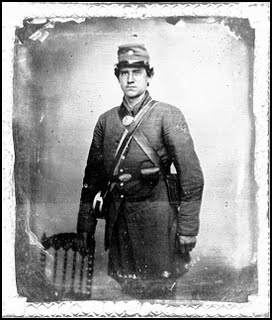


 In a move that surprised everyone involved, Tom Dula’s defense was handled, pro bono, by Zebulon B. Vance, former Governor of North Carolina and Colonel of the 26th North Carolina Regiment who fought valiantly for the Confederacy. Tom Dula is often incorrectly identified as a member of the 26th Regimentan – attempt to explain why Governor Vance took the case.
 . New York: Parkway, 2002.
 . New York: University of North Carolina, 1980.
_01.jpg)


.jpg)

 Mid-Late 19th Century John Henry, about whom little is known, is a subject of legend and song, and may well have been a real person living in the late 19th century in West Virginia or Alabama. The legend is the best-known black “tall tale,” honoring the achievements of an individual under difficult circumstances. In the case of John Henry, a “steel driving man,” he is memorialized for defeating a steam-powered machine in a test of strength and fortitude. As such, he continues to serve a vital mythic purpose in dramatizing the power of African Americans, and workers of all races.