by Fitz | Jun 15, 2026 | Journal
My journal starts again… Three years since my last posts; three years culling essays, songs and poetry out of the bilges of the past reflections–three years spent collecting, revising, and collating the bounty into five published books.
May I find the time to be faithful again to the empty page.
by Fitz | Mar 25, 2026 | Journal

A writer without an audience is like an egg without a yolk
~fitz
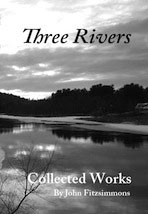
If you’d like to download my book of collected works, simply click the download button and you have a free book of my ramblings, songs, poems, essays, and stories. Enjoy! (I hope)
[easy_media_download url=”https://www.dropbox.com/s/vliiv0w29pjp4hs/Three%20Rivers%20Anthology%20epub.epub?dl=0
“]
by Fitz | Mar 25, 2026 | Journal
I have had a go0d read so far reading your haiku. I have a couple of thoughts…
I never quite know how to teach how to use specific imagery. When I say “specific” maybe I “real.” I–and every reader–wants to “see” what you are seeing.
- avoid anything generic that might mean something totally different depending on who and where you are. The ocean is different all of the world. There are a million types of flowers, so give your flower the name: rose, tulip, dandelion. What is in the field? What bug is it? The art of the haiku is in creating an image and then creating a mood, a meaning, or an insight.
- Emotions are tricky to write: joy and sadness, pain, sorrow don’t mean much on their own. Use specific imagery to create the sense of joy, sadness–or whatever emotion you are trying to capture in your haiku.
- Get rid of ALL unneeded words!
Here is Basho trying to capture “persistence”
Autumn moonlight–
a worm digs silently
into the chestnut.
Here is Issa capturing beauty:
Blooming Garden
Moonlit Wind Blowing
Silver Fragrance
Here is Buson capturing the essence of manual labor:
Blow of an ax,
pine scent,
the winter woods.
My haiku techniques should really be accompanied by you searching out the haiku of the Japanese masters. Check out this site and see what mean!
by Fitz | Mar 25, 2026 | Essays, Journal, Teaching
I have been teaching, writing, playing and performing for over thirty-five years, while during these last ten years I have been given the time and space and support (and funds) to create a classroom and pedagogy that through stops and starts and a deliberate evolution of ideas and practices has come to be known simply as “Fitz English.” I have always been somewhat of a traditionalist in my approach to what I teach, but I have always been driven to improve the classroom experience in a way that empowers students to become more confident, fluent, and engaged readers and writers; moreover, I have never “clung to my ways” or to any ways for that matter! When something worked, I tried to make it better. When something did not work, it went into my overflowing bin of teacher trash–and a mighty big bin it is.
I can only thank my students and an enlightened and indulgent administration for placing a sacred trust in my hands–for the learning and practice of effective and powerful writing and reading skills is a sacred trust, and a duty that any wise teacher lives through in every class he or she teaches. The seven guiding principles of The Crafted Word are the product of my own education in the hardscrabble reality of the classroom. The seven pillars: Read, Write, Create, Share, Collaborate, Assess, and Reflect capture the essence of what it takes to enable a more profound and enriching experience of a sustainable and dynamic literary life.
I try to give my students whatever they need to flourish in their next academic year; however, I try even harder to build a foundation and approach to reading, writing and content creation that will serve and guide them throughout the odyssey of each of their respective lives. For a new person entering my classroom, the most noticeable feature of my classroom is what is missing–desks! There are no desks. There is, however, a large round table around which students can stand or sit on stools (not chairs). It is at this table where we meet to discuss the coming class period, to share the work we have completed, and to prepare for the coming project–and there is always a project to undertake. There is a large library of books arrayed along one wall surrounded by comfortable chairs. There are a few computers set on a standing bar; there is a widescreen TV on one wall. There is a stage set up with a green screen and mics and lights; there are two alcoves set up as recording studios–but there is no pencil sharpener; there are no reams of paper on a shelf; there are no blackboards or whiteboards, or posters hung on the walls–only guitars and banjos and framed artworks. There is–and there has not been–any paper shared between myself and my students for over ten years. Paper is simply not needed and, for me at least, is simply an inefficient hindrance to the work we do.
For many teachers, my classroom seems like an anathema. The lack of paper seems foolish and unwise. The distractions of technology mixed with students plopped upside down and sideways on the floor and across the arms of comfortable chairs is more than they can handle. Few teachers are jealous of my room, yet I guard it jealously–though I am very eager and willing to share it (and the secrets it holds)–freely and openly. There is a great fear that real teaching and real learning cannot happen in a room where motion, action, and relaxation intermingle–where sitting takes a distant second to standing, where reading and writing on iPads, tablets–and even phones–is encouraged, where every essay is turned into a video, podcast, where a blog post is recreated in a multi-media portfolio, and where everything is shared with each other, oftentimes created with each other, and always respected by each other.
If I sound like I am crowing like a rooster at dawn, I am; and I will keep on crowing until one of my students says, “This is too easy,” “I’m not learning anything,” or “You really should get another job.” I will keep on crowing until a parent can sincerely say, “My child did not learn enough or write enough,” “Where is the rigor or basic skills my child needs?” or “What a waste of a year my child had in your class.” If I have not crowed so loudly as to turn you away, keep scrolling and let me show you what I mean and how this approach can work in any classroom. I have the gift of a well-created classroom, but the essence of what I am trying to do could be accomplished in my backyard in a circle of pumpkins.
by Fitz | Mar 25, 2026 | Journal, Songs
I always had in my mind a song about a woman named Ginny who lives (or lived) on an island off the coast of Maine. I want her to somehow represent someone who is willing to wait for something to return to her. What that something is I am not really sure. I was hoping that by writing her story that the plot will create itself.
I want it to feel like a myth being retold and that she is a ghost of some sort, maybe a tale that is simply being retold:
You can hear her in the breakers
Tightening the line in Jacob’s trawl
She is the story told by Nancy
in whispered words in empty halls
You can see her in the moonrise
In shadowed shapes of morning fog
Hid away in lightning traces
Buried deep in Caymans Bog
She is the dream that keeps eyes open