C&O Historical Society
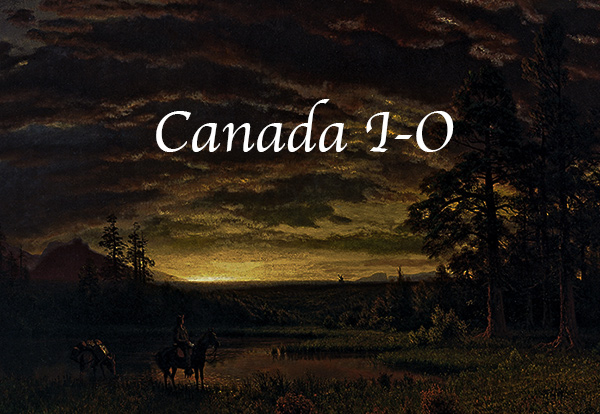
Come all ye jolly lumbermen, and listen to my song
But do not get discouraged, the length it is not long;
Concerning of some lumbermen, who did agree to go
To spend one pleasant winter up in Canada-I-O.
It happened late one season in the fall of fifty-three
A preacher of the gospel one morning came to me;
Says he, “My jolly fellow, how would you like to go
To spend one pleasant winter up in Canada-I-O?”
To him I quickly made reply, and unto him did say,
“In going out to Canada depends upon the pay.
If you will pay good wages, my passage to and fro,
I think I’ll go along with you to Canada-I-O.”
“Yes, we will pay good wages, and will pay your wages out,
Provided you sign papers that you will stay the route;
But if you do get homesick and swear that home you’ll go
We never can your passage pay from Canada-I-O.”
“And if you get dissatisfied and do not wish to stay,
We do not wish to bind you, no, not one single day,
You just refund the money we had to pay, you know,
Then you can leave that bonny place called Canada-I-O.
It was by his gift of flattery he enlisted quite a train,
Some twenty-five or thirty, both well and able men;
We had a pleasant journey o’er the road we had to go,
Till we landed at Three Rivers, up in Canada-I-O.
But there our joys were ended, and our sorrows did begin,
Fields, Phillips and Norcross they then came marching in.
They sent us all directions, some where I do not know,
Among those jabbering Frenchmen up in Canada-I-O.
After we had suffered there some eight or ten long weeks,
We arrived at headquarters, up among the lakes;
We thought we’d find a paradise, at least they told us so,
God grant there may be no worse hell than Canada-I-O.
To describe what we have suffered is past the art of man;
But to give a fair description I will do the best I can:
Our food the dogs would snarl at, our beds were on the snow,
We suffered worse than murderers up in Canada-I-O.
Our hearts were made of iron and our souls were cased with steel,
The hardships of that winter could never make us yield;
Fields, Phillips and Norcross they found their match, I know
Among the boys that went from Maine to Canada-I-O.
But now our lumbering is over and we are returning home,
To greet our wives and sweethearts and never more to roam;
To greet our friends and neighbors; we’ll tell them not to go
To that forsaken G—- D— place called Canada-I-O.

 I am indebted to the many friends who share my love of traditional songs and to the many scholars whose works are too many to include here. I am also incredibly grateful to the collector’s curators and collators of Wikipedia, Mudcat.org, MainlyNorfolk.info, and TheContemplator.com for their wise, thorough and informative contributions to the study of folk music.
I share this scholarly research on my site with humility, thanks, and gratitude. Please cite sources accordingly with your own research. If you have any research or sites you would like to share on this site, please post in the comment box.
Thanks!


| "Canada-I-O" | |
|---|---|
| Song | |
| Written | before 1700 |
| Songwriter | Traditional |
"Canada-I-O" (also known as "Canadee-I-O" or "The Wearing of the Blue") is a traditional English folk ballad (Roud 309).[1] It is believed to have been written before 1839.[2]
When her love goes to sea, a lady dresses as a sailor and joins (his or another's) ship's crew. When she is discovered, (the crew/her lover) determine to drown her. The captain saves her and they marry.
Based on similarity of title, some connect this song with "Canaday-I-O, Michigan-I-O, Colley's Run I-O". There is no connection in plot, however, and any common lyrics are probably the result of cross-fertilization.
The Scottish song "Caledonia/Pretty Caledonia" is quite different in detail — so much so that it is separate from the "Canada-I-O" texts in the Roud Folk Song Index ("Canaday-I-O" is #309;[3] "Caledonia" is #5543). The plot, however, is too close for scholars to distinguish.
[ Roud 309 ; Ballad Index HHH162 ; Bodleian Roud 309 ; Wiltshire Roud 309 ; trad. arr. Nic Jones]
The ballad Canadee-I-O was printed in Leach, Folk Ballads & Songs of the Lower Labrador Coast.
Harry Upton of Balcombe, Sussex, sang Canadee-I-O to Peter Kennedy on September 5, 1963. This recording was included in 2012 on the Topic anthology of songs by Southern English singers, You Never Heard So Sweet (The Voice of the People Volume 21), and the song was included in 1970 in Ken Stubb’s book of English folk songs from the Home Counties, The Life of a Man. Another recording made by Mike Yates in 1974 was included in 1975 on the Topic collection of traditional songs from Sussex, Sussex Harvest, and in 2001 on the Musical Traditions anthology of songs from the Mike Yates Collection, Up in the North and Down in the South. Mike Yates commented in the latter’s booklet:
Canadee-I-O is something of a hybrid folksong, combining, as it does, two separate motifs; namely the girl who follows her truelove abroad, and the myth of the shipboard Jonah. As in many broadsides, however, there is a happy ending.
According to Frank Kidson, Canadee-I-O is a song which first appeared during the 18th century. In form, it is related to the Scots song Caledonia—versions of which were collected by Gavin Greig—although exactly which song came first is one of those ‘chicken and egg’ questions that so frequently beset folkmusic studies.
Harry Upton recalled singing this song in a Balcombe pub in 1940, and remained puzzled as to how a visiting Canadian soldier could join in a song which he believed to be known only to himself and his father. It could be argued that the Canadian might have more reasonably asked the question, since Harry is the sole English singer named among Roud’s 28 instances of the song.
Canadee-I-O is arguably Nic Jones’ best known song, recorded in 1980 for his Topic album Penguin Eggs. Bob Dylan recorded it also for his 1992 album,Good as I Been to You, John Wesley Harding for his Nic Jones tribute album, Trad Arr Jones, and Éilís Kennedy recorded Canadee-I-O in 2001 for on her debut CD Time to Sail.
Hannah Sanders sang Canadee-I-O in 2013 on her EP Warning Bells. She commented in her liner notes:
A beautiful traditional ballad, about a cross dressing sailor gal. This is how all good stories should begin! I doff my cap to Nic Jones’s version here.
Andy Turner sang Canadee-I-O as the September 6, 2014 entry of his project A Folk Song a Week.
The Outside Track sang Canadee-I-O in 2015 on their CD Light Up the Dark. They commented in their liner notes:
No album from a band with this many x-chromosomes in it would be complete without a story about a feisty girl on a mission. Nor only does she avoid walking the plank, but she arrives at her destination triumphant, ascending from stowaway to Captain’s Wife! One of the rarer cases where the song doesn’t end in death and destruction!
Matt Quinn learned Canadee-I-O from the singing of Harry Upton and recorded it for his 2017 CD The Brighton Line. He commented:
A girl escapes being thrown overboard by the ship’s crew when the captain falls in love with her. Well that’s one way to thwart death… Harry sang this to Mike Yates in the mid 1970s and he remains one of the [few] English traditional singers from whom it has been collected.
It’s of a fair and handsome girl, she’s all in her tender years:
She fell in love with a sailor boy, it’s true that she loved him well,
For to go off to sea with him like she did not know how,
She longed to see that seaport town called Canadee-I-O.
So she bargained with a young sailor boy, it’s all for a piece of gold.
Straightway then he led her all down into the hold,
Saying, “I’ll dress you up in sailor’s clothes, your jacket shall be blue,”
You’ll see that seaport town called Canadee-I-O.
Now when the other sailors heard the news, well they fell into a rage
And with all the whole ship’s company they were willing to engage,
Saying, “We’ll tie her hands and feet me boys, overboard we’ll throw her.
She’ll never see that seaport town called Canadee-I-O.”
Now when the captain he’s heard the news, well he too fell in a rage
And with all of his whole ship’s company he was willing to engage,
Saying, “She’ll stay all in sailor’s clothes, her collar shall be blue.
She’ll see that seaport town called Canadee-I-O.”
Now when they came down to Canada, scarcely ’bout half a year
She’s married this bold captain who called her his dear.
She’s dressed in silks and satins now, and she cuts a gallant show,
She’s the finest of the ladies down Canadee-I-O.
Come you fair and tender girls wheresoever you may be,
I’ll have you to follow your own true love, when he goes out on the sea.
For if the sailors prove false to you, well the captain he might prove true,
You see the honour that I have gained by the wearing of the blue.
It’s of a gallant lady, just in the prime of youth.
She dearly loved a sailor; in fact, she loved to wed,
And how to get to sea with him the way she did not know,
All for to see this pretty place called Canadee-I-O.
She bargained with a sailor all for a purse of gold,
And straightway he had taken her right down into the hold,
“I’ll dress you up in sailor suit; your colours shall be blue
And you soon will see that pretty place, called Canadee-I-O,”
When our mate had heard this, he fell into a rage,
Likewise our ship’s company was willing to engage:
“I’ll tie your hands and feet, my love, and overboard you’ll go,
And you’ll never see the pretty place called Canadee-I-O.”
And when the captain heard this: “This thing shall never be,
For if you drown that fair maid, hanged sure you’ll be;
I’ll take her to my cabin, her colours shall be blue,
And she soon will see that pretty place called Canadee-I-O.”
They had not arrived in Canada more than the space of half a year,
Before the Captain married her, and called her his very dear.
She can dress in silk or satin; she caught a gallant show;
She was one of the fairest ladies in Canadee-I-O.
Come all ye, young ladies, whoever you may be,
To be sure and follow your true love, if ever he goes to sea,
And if your mate, he do prove false, you’re captain he’ll prove true,
And you’ll see the honour I have gained by wearing of the blue
Thanks to Garry Gillard for transcribing Nic Jones’ lyrics.
Performances, Workshops, Resources & Recordings
The American Folk Experience is dedicated to collecting and curating the most enduring songs from our musical heritage. Every performance and workshop is a celebration and exploration of the timeless songs and stories that have shaped and formed the musical history of America. John Fitzsimmons has been singing and performing these gems of the past for the past forty years, and he brings a folksy warmth, humor and massive repertoire of songs to any occasion.
Festivals & Celebrations
Coffeehouses School
Assemblies
Library Presentations
Songwriting Workshops
Artist in Residence House
Concerts Pub Singing
Irish & Celtic
Performances
Poetry Readings
Campfires
Music Lessons
Senior Centers
Voiceovers & Recording
““Beneath the friendly charisma is the heart of a purist gently leading us from the songs of our lives to the timeless traditional songs he knows so well…”
“The Nobel Laureate of New England Pub Music…”
On the Green, in Concord, MA Every Thursday Night for over thirty years…
“A Song Singing, Word Slinging, Story Swapping, Ballad Mongering, Folksinger, Teacher, & Poet…”
Fitz’s Recordings
& Writings
Songs, poems, essays, reflections and ramblings of a folksinger, traveler, teacher, poet and thinker…
Download for free from the iTunes Bookstore
“A Master of Folk…”
Fitz’s now classic recording of original songs and poetry…
Download from the iTunes Music Store
“A Masterful weaver of song whose deep, resonant voice rivals the best of his genre…”
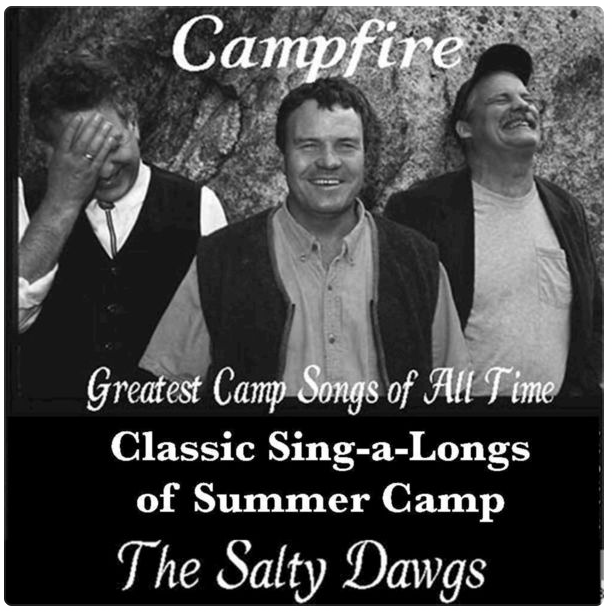
“2003: Best Children’s Music Recording of the Year…”
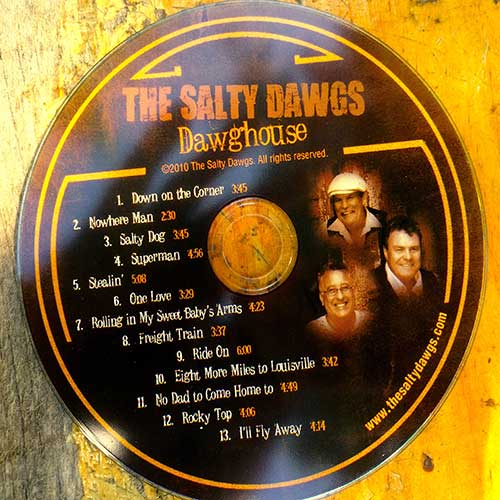
Fitz & The Salty Dawgs Amazing music, good times and good friends…

“When the eyes rest on the soul…that’s Fitzy…”

~Traditional
Stagolee was a bad man,
Ev'rybody knows.
Spent one hundred dollars
Just to buy him a suit of dothes.
     He was a bad man
     That mean old Stagolee

Stagolee shot BiUy de Lyons
What do you think about that?
Shot him down in cold blood
Because he stole his Stetson hat;
     He was a bad ma@
     That mean old Stagolee

Billy de Lyons said, Stagolee
Please don't take my life
I've got two little babes
And a darling, loving wife;
     You are a bad man
     You mean old Stagolee.

What do I care about your two little babes,
Your darling loving wife?,
You done stole my Stetson hat
I'm bound to take your life;
     He was a bad man,
     That mean old Stagolee.

The judge said, Stagolee,
What you doing in here?,
You done shot Mr. Billy de Lyons,
You going to die in the electric chair;
     He was a bad man
     That mean old Stagolee.

Twelve o'clock they killed him
Head reached up high
Last thing that poor boy said,
"My six-shooter never lied."
     He was a bad man,
     That mean old Stagolee.
If you have any more information to share about this song or helpful links, please post as a comment.
Thanks for stopping by the site! ~John Fitz
I am indebted to the many friends who share my love of traditional songs and to the many scholars whose works are too many to include here. I am also incredibly grateful to the collector’s curators and collators of Wikipedia, Mudcat.org, MainlyNorfolk.info, and TheContemplator.com for their wise, thorough and informative contributions to the study of folk music.
I share this scholarly research on my site with humility, thanks, and gratitude. Please cite sources accordingly with your own research. If you have any research or sites you would like to share on this site, please post in the comment box.
Thanks!
| "Stack O' Lee Blues" | |
|---|---|
| Single by Waring's Pennsylvanians | |
| B-side | "Stavin' Change"[1] |
| Released | 1923 |
| Recorded | Camden, New Jersey, April 18, 1923 |
| Length | 3:21 |
| Label | Victor |
| Songwriter | Ray Lopez (credited on single) |
"Stagger Lee" (Roud 4183), also known as "Stagolee" and other variants, is a popular American folk song about the murder of Billy Lyons by "Stag" Lee Shelton, in St. Louis, Missouri, on Christmas 1895. The song was first published in 1911 and first recorded in 1923, by Fred Waring's Pennsylvanians, titled "Stack O' Lee Blues". A version by Lloyd Price reached number one on the Billboard Hot 100 in 1959.
The historical Stagger Lee was Lee Shelton, an African-American pimp living in St. Louis, Missouri, in the late 19th century. He was nicknamed Stag Lee or Stack Lee, with a variety of explanations being given: he was given the nickname because he "went stag" (attended social events unaccompanied by a person of the opposite sex); he took the nickname from a well-known riverboat captain called Stack Lee; or, according to John and Alan Lomax, he took the name from a riverboat owned by the Lee family of Memphis called the Stack Lee, which was known for its on-board prostitution.[2] Shelton was well known locally as one of the Macks, a group of pimps who attracted attention through their flashy clothing and appearance.[3] In addition to those activities, he was the captain of a black Four Hundred Club, a social club with a dubious reputation.[4]
On Christmas night in 1895, Shelton and his acquaintance William "Billy" Lyons were drinking in the Bill Curtis Saloon. Lyons was also a member of St. Louis' underworld, and may have been a political and business rival to Shelton. Eventually, the two men got into a dispute, during which Lyons took Shelton's Stetson hat.[5] Subsequently, Shelton shot Lyons, recovered his hat, and left.[6] Lyons died of his injuries, and Shelton was charged, tried, and convicted of the murder in 1897. He was paroled in 1909, but returned to prison in 1911 for assault and robbery. He died incarcerated in 1912.[7]
The crime quickly entered into American folklore and became the subject of song, as well as folktales and toasts. The song's title comes from Shelton's nickname—Stag Lee or Stack Lee.[8] The name was quickly corrupted in the folk tradition. Early versions were called "Stack-a-Lee" and "Stacker Lee", while "Stagolee" and "Stagger Lee" also became common. Other recorded variants include "Stackerlee", "Stack O'Lee", "Stackolee", "Stackalee", "Stagerlee", and "Stagalee".[9]
A song called "Stack-a-Lee" was first mentioned in 1897, in the Kansas City Leavenworth Herald, as being performed by "Prof. Charlie Lee, the piano thumper".[10] The earliest versions were likely field hollers and other work songs performed by African-American laborers, and were well known along the lower Mississippi River by 1910. That year, musicologist John Lomax received a partial transcription of the song,[11] and in 1911, two versions were published in the Journal of American Folklore by the sociologist and historian Howard W. Odum.[12]
The song was first recorded by Waring's Pennsylvanians in 1923 and became a hit. Another version was recorded later that year by Frank Westphal & His Regal Novelty Orchestra, and Herb Wiedoeft and his band recorded the song in 1924.[13] Also in 1924, the first version with lyrics was recorded, as "Skeeg-a-Lee Blues", by Lovie Austin. Ma Rainey recorded "Stag O'Lee Blues", a different song based on the melody and words of "Frankie and Johnnie", the following year, with Louis Armstrong on cornet, and a version was recorded by Frank Hutchison on January 28, 1927, in New York, and is included in Harry Smith's famous Anthology of American Folk Music (Song 19 of 84).[10]
Before World War II, the song was commonly known as "Stack O'Lee". W.C. Handy wrote that it probably was a nickname for a tall person, comparing him to the tall smokestack of the famous steamboat Robert E. Lee.[14] By the time W.C. Handy wrote that explanation in 1926, "Stack O' Lee" was already familiar in United States popular culture, with recordings of the song made by pop singers of the day, such as Cliff Edwards.
The version by Mississippi John Hurt, recorded in 1928, is regarded by many as definitive.[10] In his version, as in all such pieces, there are many (sometimes anachronistic) variants on the lyrics. Several older versions give Billy's last name as "De Lyons" or "Delisle". Other notable pre-war versions were recorded by Duke Ellington (1927), Cab Calloway (1931), Woody Guthrie (1941),[10] and Sidney Bechet (1945).[15]
| "Stagger Lee" | ||||
|---|---|---|---|---|
| Single by Lloyd Price | ||||
| B-side | "You Need Love" | |||
| Released | November 1958 | |||
| Recorded | New York City, September 11, 1958 | |||
| Genre | ||||
| Length | 2:20 | |||
| Label | ABC-Paramount | |||
| Songwriters | Lloyd Price, Harold Logan (credited on single) | |||
| Producer | Don Costa | |||
| Lloyd Price singles chronology | ||||
| ||||
Lloyd Price recorded an R&B rendition of the song as "Stagger Lee" in 1958, and it rose to the top of both the R&B and US pop charts in early 1959.[18] Although his version uses similar lyrics to previous versions of the song, his rendition features a different melody and has no lyrical refrain, making it shorter than previous recordings of the song. Price's version of the song was ranked number 456 on Rolling Stone's 500 Greatest Songs of All Time list, and also reached number 7 on the UK singles chart. Price also recorded a lyrically toned-down version of the song that changed the shooting to an argument between two friends for his appearance on Dick Clark's American Bandstand.[10]
| Chart (1959) | Peak position |
|---|---|
| UK Singles (The Official Charts Company)[19] | 7 |
| US Billboard Hot 100 | 1 |
| US Hot R&B Sides (Billboard)[20] | 1 |
| Chart (1958-2018) | Position |
|---|---|
| US Billboard Hot 100[21] | 260 |
{{cite book}}: CS1 maint: publisher location (link){{cite book}}: CS1 maint: publisher location (link){{cite book}}: CS1 maint: publisher location (link) Brown summarizes what little is known about the club as follows: "The Four Hundred Club was a 'social club,' but such clubs always had a moral front. (...) The Four Hundred Club may have been a type of black-and-tan club, catering to an interracial clientele, and as such would have been under pressure from reform policies." Brown cites a contemporary source from the newspaper St. Louis Star-Sayings, in which a member of the club states: "Mr. [Stack] Lee was our captain."{{cite book}}: CS1 maint: publisher location (link) Based on the statements of witnesses, Cecil Brown retells the incident as follows: "Then Lyons grabbed Shelton's Stetson. When Shelton demanded it back, Lyons said no."{{cite book}}: CS1 maint: publisher location (link){{cite book}}: CS1 maint: publisher location (link)And in 1959, the New Orleans R&B singer and former Army serviceman Lloyd Price took one of those versions to #1....Instead, it's a total blast of a song, a spirited New Orleans rumble...
 The full text of five variations of "Stagger Lee" at Wikisource
[ Roud 4183 ; Laws I15 ; Ballad Index LI15 ; trad.]
John Gibbon sang Stakolee in 1957 on his Topic album John Gibbon’s Disc.
Trevor Lucas sang Stagger Lee accompanied by guitar and mouth-organ in full early Dylan mode from the 1963 Folk Attick recordings in Sydney—plenty of suck and blow braced harmonica playing between the verses, and very typical of that protest folk singer period. This recording was included in 1994 on the Friends of Fairport cassette Together Again – The Attic Tracks Vol. 4.
Jesse Fuller sang Stackolee in a recording made by Peter Kennedy at Cecil Sharp House on March 19, 1965. This track was included in the same year on Fuller’s Topic album Move On Down the Line. Joe Boyd commented in the album’s sleeve notes:
Of all the hero or villain legends in American folk music, Stackolee ‘that bad man’ appears in both white and Negro ballads, often with references to the supernatural powers of his ‘Five Dollar Stetson Hat’. There was a notorious family named Lee in Memphis during the late nineteenth century, and a longshoreman (stevedore) was often known as a stacker. The song was part of Ma Rainey`s repertoire long before she recorded it in 1925. There are several recorded melodies for the song, of which I think Jesse’s is the most interesting.
Martin Simpson sang Stagolee in 2007 on his Topic album True Stories. He commented in his liner notes:
I first learned Stagolee from Mississippi John Hurt and recorded it when I was 17. The origins of the story were long guessed at, but it was widespread amongst blues singers, songsters, old timey musicians, R&B singers and rock and rollers throughout the 20th century. In 2003, Harvard University Press published Cecil Brown’s book, Stagolee shot Billy, a superbly written account of the facts. Lee Shelton shot Billy Lyons on Christmas Night, in 1859. I’ve attempted to put some of the facts back into the song without losing the poetry. Facts aren’t everything, but these are all true stories in one way or another.
Snakefarm sang Staggerlee in 2011 on their Fledg’ling CD My Halo at Half-Light.
See also the Mudcat Café thread Listen to different versions of Stagger Lee and Paul Slade’s essay A Christmas Killing: Stagger Lee.
Source: AmericanBluesScene.com
Today we’re bringing you another entry in American Blues Scene’s exclusive “Brief History of a Song” series.
The feud between Stagger Lee and Billy Lyons is as legendary as the one between the Hatfields and the McCoys; a truly American folk tale, retold countless times, about Stagger shooting Billy Lyons over, varyingly, a Stetson hat, a woman, a gambling debt, politics, or simply because Stagger was that mean of a man. Amazingly enough, the song may be the most re-recorded in history, with well over four hundred separate recordings to it’s name. A brief search of the Stagger Lee name could reveal recordings from Mississippi John Hurt, Furry Lewis, Lloyd Price, Professor Longhair, The Black Keys, Samuel L. Jackson, The Fabulous Thunderbirds, Wilson Picket, Taj Mahal, Fats Domino, Bob Dylan, Beck, Elvis Presley, Ike Turner, and a great many others.
Who was Stagger Lee, who goes by different names depending on the storyteller; Stagger, Stack-O-Lee, Stackalee, etc.? Was there a real Stagger Lee? Did he really run with Jesse James, have a magical Stetson, or take hell away from the devil when he died, as has been suggested?
The origins of this tale begin with a Christmas Eve bar fight in Saint Louis in 1895. The events of the murder were fairly commonplace; two friends, Billy Lyons and “Stagger” Lee Shelton, were drinking at Bill Curtis’s saloon and became enthralled in a conversation about politics. Billy grabbed Shelton’s hat in anger, and when he refused to return it, Shelton shot Billy in the gut, picked up his hat, and left. Lyons died from his wound shortly afterwards. That same night alone, five murders were committed in Saint Louis, but only one shot to world-wide infamy through a tangled web of politics, folklore, and raw persistence. The story was first covered in the St. Louis Globe-Democrat on December 28th, 1895. In 1896, the political scene was extremely tense, and with Saint Louis being one of the largest cities in the country, it was necessary for politicians to get every vote, including the black vote. This was increasingly relevant because the republicans were losing their stronghold, and because Shelton was a democratic organizer, and Lyons a Republican one, according to StaggerLee.com. The murder received significant exposure and political scrutiny, and resulted in a hung jury trial, after Stagger Lee had hired one of the most prominent lawyers in the state. Shelton’s case was retried in 1897, and Stagger Lee was found guilty of murder and sentenced to the notorious Jefferson penitentiary in Jefferson City, Missouri. It only took until 1902 or 1903, depending on the source, for the first printed lyrics referring to the Stagger Lee murder.
In 1909, then-Missouri governor Joseph Wingate Folk gave Shelton a full pardon on Thanksgiving day. By this time, folk versions of the Stagger Lee song were cropping up all across the South. The next year, legendary Library of Congress musicologist John Lomax received a partial transcription of what was called “The Ballad of Stagalee”, from a woman in Texas. She claimed that “this song is sung by the Negroes on the levee while they are loading and unloading the river freighters.” In 1911, Shelton broke into a man’s home, murdered him, and was sent to prison, but by 1912, Shelton received yet another pardon from another governor, apparently due to political pressure. Before he could be released, the infamous Stack-O-Lee died in prison of tuberculosis.
In the 1920s, a number of varieties of “Stagger Lee” began to be recorded. Ma Rainey and her band, (including a young Louis Armstrong on cornet), recorded Stack O’Lee Blues in 1925. Duke Ellington recorded a version in 1927, and in 1928 Mississippi John Hurt recorded what is perhaps the most famous and most definitive version of Stagger Lee’s song in history.
Police officer, how can it be?
You can ‘rest everybody but cruel Stack O’ Lee
That bad man, oh, cruel Stack O’ LeeBilly de Lyon told Stack O’ Lee, “Please don’t take my life,
I got two little babies, and a darlin’ lovin’ wife”
That bad man, oh, cruel Stack O’ Lee“What I care about you little babies, your darlin’ lovin’ wife?
You done stole my Stetson1 hat, I’m bound to take your life”
That bad man, cruel Stack O’ Lee…with the forty-four
When I spied Billy de Lyon, he was lyin’ down on the floor
That bad man, oh cruel Stack O’ Lee“Gentleman’s of the jury, what do you think of that?
Stack O’ Lee killed Billy de Lyon about a five-dollar Stetson hat”
That bad man, oh, cruel Stack O’ LeeAnd all they gathered, hands way up high,
at twelve o’clock they killed him, they’s all glad to see him die
That bad man, oh, cruel Stack O’ Lee
In 1931, folk great Woodie Guthrie sang a rendition of the song, likely adapted from John Hurt’s version, as the lyrics are very similar. During his field recordings, John Lomax often recorded the Stagger Lee song by various groups in the American South, from Texas to the Appalachia, often times in prisons. Some of these recordings can be found at the Library of Congress. Later, in 1941 and ’42, John’s son Alan recorded a number of versions during his own field recording trips for the Library of Congress. The song continued to capture the imaginations of singers and poets everywhere until 1958, when Lloyd Price released a version simply called “Stagger Lee”. The song exploded in popularity and became #1 on the Billboard Pop Charts. From there, dozens and eventually hundreds of recorded renditions of Stack’s story were spawned. In the 1960s, when Mississippi John Hurt was re-discovered, he would often play a folk-style story called “Stagolee” in which Stag and, interestingly enough, Jesse James, rob a card game in a coal mine. In 2007, Samuel L. Jackson played “Stack-O-Lee” in the movie Black Snake Moan, backed by Cedrick Burnside and Kenny Brown. Cedric is the grandson of legendary bluesman R.L. Burnside, who also sang popular versions of Stagger Lee’s song.
Stagger Lee has been sang about nearly countless times. His story has appeared in movies, poems, and even as it’s own comic book. Through every generation and nearly every musical style, Stagger Lee has made an appearance. Punk, Hawaiian, Heavy Metal, Disco, Rock, Blues, Folk, Bluegrass, Country, and Soul have all seen recorded versions, often with great popularity and by names as wildly famous as Elvis and the Isley Brothers. The story of bad Stagger Lee has continued to capture American’s, and then the world’s, imaginations for over 100 years.
To find a largely comprehensive documentation of 420+ “Stagger Lee” recordings, see StaggerLee.com
Performances, Workshops, Resources & Recordings
The American Folk Experience is dedicated to collecting and curating the most enduring songs from our musical heritage. Every performance and workshop is a celebration and exploration of the timeless songs and stories that have shaped and formed the musical history of America. John Fitzsimmons has been singing and performing these gems of the past for the past forty years, and he brings a folksy warmth, humor and massive repertoire of songs to any occasion.
Festivals & Celebrations
Coffeehouses
School Assemblies
Library Presentations
Songwriting Workshops
Artist in Residence
House Concerts
Pub Singing
Irish & Celtic Performances
Poetry Readings
Campfires
Music Lessons
Senior Centers
Voiceovers & Recording
““Beneath the friendly charisma is the heart of a purist gently leading us from the songs of our lives to the timeless traditional songs he knows so well…”
“The Nobel Laureate of New England Pub Music…”
On the Green, in Concord, MA Every Thursday Night for over thirty years…
“A Song Singing, Word Slinging, Story Swapping, Ballad Mongering, Folksinger, Teacher, & Poet…”
Fitz’s Recordings
& Writings
Songs, poems, essays, reflections and ramblings of a folksinger, traveler, teacher, poet and thinker…
Download for free from the iTunes Bookstore
“A Master of Folk…”
Fitz’s now classic recording of original songs and poetry…
Download from the iTunes Music Store
“A Masterful weaver of song whose deep, resonant voice rivals the best of his genre…”
“2003: Best Children’s Music Recording of the Year…”
Fitz & The Salty Dawgs Amazing music, good times and good friends…
“When the eyes rest on the soul…that’s Fitzy…”
John Henry was a li’l baby, uh-huh,
Sittin’ on his mama’s knee, oh, yeah,
Said: “De Big Bend Tunnel on de C & O road
Gonna cause de death of me,
Lawd, Lawd. Gonna cause de death of me.
John Henry, he had a woman,
Her name was Mary Magdalene,
She would go to de tunnel and sing for John,
Jes’ to hear John Henry’s hammer ring, Lawd, Lawd,
Jes’ to hear John Henry’s hammer ring.
John Henry had a li’l woman,
Her name was Lucy Ann,
John Henry took sick an’ had to go to bed,
Lucy Ann drove steel like a man,
Lawd, Lawd, Lucy Ann drove steel like a man.
Cap’n says to John Henry,
Gonna bring me a steam drill ’round,
Gonna take dat steam drill out on de job,
Gonna whop dat steel on down, Lawd, Lawd,
Gonna whop dat steel on down.
John Henry tol’ his cap’n,
Lightnin’ was in his eye;
Cap’n, bet yo’ las’ red cent on me,
Fo’ I’ll beat it to de bottom or I’ll die, Lawd, Lawd,
I’ll beat it to de bottom or I’ll die.”
Sun shine hot an’ burnin’,
Wer’n’t no breeze a-tall,
Sweat ran down like water down a hill,
Dat day John Henry let his hammer fall,
Lawd, Lawd, dat day John Henry let his hammer fall.
John Henry went to de tunnel,
An’ dey put him in de lead to drive,
De rock so tall an’ John Henry so small,
Dat he lied down his hammer an’ he cried,
Lawd, Lawd, dat he lied down his hammer an’ he cried.
John Henry started out on de right hand,
De steam drill started on de lef’—
“Before I ‘d let dis steam drill beat me down,
I’d hammer my fool self to death,
Lawd, Lawd, I’d hammer my fool self to death.”
White man tol’ John Henry,
“Nigger, damn yo’ soul,
You might beat dis steam an’ dr;ll of mine,
When de rocks in dis mountain turn to gol’,
Lawd, Lawd, when de rocks in dis mountain turn to gol`.
John Henry said to his shaker,
“Nigger, why don’ you sing?
I’m throwin’ twelve poun’s from my hips on down,
Jes’ listen to de col’ steel ring,
Lawd, Lawd, Jes’ listen to de col’ steel ring.”
Oh, de captain said to John Henry,
“I b’lieve this mountain’s sinkin’ in,
John Henry said to his captain, oh my!
“Ain’ nothin’ but my hammer suckin’ win’,
Lawd, Lawd, ain’ nothln’ but my hammer suckin’ win.”
John Henry tol’ his shaker,
Shaker, you better pray,
For if I miss dis six-foot steel,
Tomorrow’ll be yo’ buryin’ day,
Lawd, Lawd, tomorrow’ll be yo’ buryin’ day.”
John Henry tol’ his captain,
“Looka yonder what l see —
Yo’ drill’s done broke an’ yo’ hole’s done choke,
An’ you cain’ drive steel like me,
Lawd, Lawd, an’ you cain’ drive steel like me.”
De man dat invented de steam drill,
Thought he was mighty fine.
John Henry drove his fifteen feet,
An’ de steam drill only made nine,
Lawd, Lawd, an’ de steam drill only made nine.
De hammer dat John Henry swung’,
It weighed over nine pound ;
He broke a rib in his lef’-han’ side,
An’ his intrels fell on de groun’,
Lawd, Lawd, an’ his intrels fell on de groun’.
John Henry was hammerin’ on de mountain,
An’ his hammer was strikin’ fire,
He drove so hard till he broke his pore heart,
An’ he lied down his hammer an’ he died,
Lawd, Lawd, he lied down his hammer an’ he died.
All de womens in de wes’,
When dey heared of John Henry’s death,
Stood in de rain, flagged de eas’-boun’ train,
Goin’ where John Henry fell dead,
Lawd, Lawd, goin’ where John Henry fell dead.
John Henry’s lil mother,
She was all dressed in red,
She jumped in bed, covered up her head,
Said she didn’ know her son was dead,
Lawd, Lawd, didn’ know her son was dead.
John Henry had a pretty lil woman,
An’ de dress she wo’ was blue,
An’ de las’ wards she said to him:
“John Henry, I’ve been true to you,
Lawd, Lawd, John Henry I’ve been true to you.”
“Oh, who’s gonna shoe yo’ lil feetses,
An’ who’s gonna glub yo’ han’s,
An’ who`g gonna kiss yo’ rosy, rosy lips,
An’ who’s gonna be yo’ man,
Lawd, Lawd, an’ who’s gonna be yo’ man?”
Dey took John Henry to de graveyard,
An’ dey buried him in de san’,
An’ every locomotive come roarin’ by,
Says, “Dere lays a steel-drivin’ man,
Lawd, Lawd, dere lays a steel-drivin’ man.”
From American Ballads and Folk Songs, Lomax
I am indebted to the many friends who share my love of traditional songs and to the many scholars whose works are too many to include here. I am also incredibly grateful to the collector’s curators and collators of Wikipedia, Mudcat.org, MainlyNorfolk.info, and TheContemplator.com for their wise, thorough and informative contributions to the study of folk music.
I share this scholarly research on my site with humility, thanks, and gratitude. Please cite sources accordingly with your own research. If you have any research or sites you would like to share on this site, please post in the comment box.
Thanks!
John Henry | |
|---|---|
_01.jpg) John Henry illustration by Roy E. LaGrone (1942) | |
| Born | 1840s or 1850s |
| Occupation | Railroad worker |
| Known for | American folk hero |
John Henry is an American folk hero. A black American freedman, he is said to have worked as a "steel-driving man"—a man tasked with hammering a steel drill (such as a star drill or similar) into a rock to make holes for explosives to blast the rock in constructing a railroad tunnel.
The story of John Henry is told in a classic blues folk song about his duel against a drilling machine, which exists in many versions, and has been the subject of numerous stories, plays, books, and novels.[1][2]

According to legend, John Henry's prowess as a steel driver was measured in a race against a steam-powered rock drill, a race that he won only to die in victory with a hammer in hand as his heart gave out from stress. Various locations, including Big Bend Tunnel in West Virginia,[3] Lewis Tunnel in Virginia, and Coosa Mountain Tunnel in Alabama, have been suggested as the site of the contest.
A real hammerman would have needed to work in tandem with a shaker, who would hold a chisel-like drill against mountain rock, wiggling and rotating the drill to optimize its bite. However, John Henry's shaker is seldom if ever mentioned in the tale. As a result, some retellings recast John Henry as a railroad worker driving spikes into railway tracks, and his mechanical opponent as a primitive rail fastening system.[citation needed]
The historical accuracy of many of the aspects of the John Henry legend are subject to debate.[1][2] According to researcher Scott Reynolds Nelson, the actual John Henry was born in 1848 in New Jersey and died of silicosis, a complication of his workplace, rather than from exhaustion.[4]
Several locations have been put forth for the tunnel on which John Henry died.

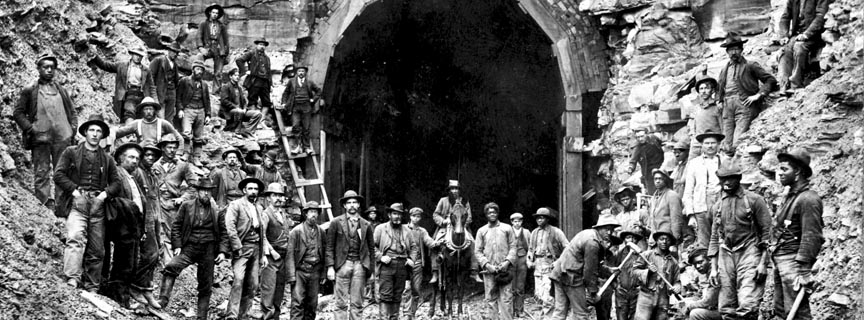
Sociologist Guy Benton Johnson investigated the legend of John Henry in the late 1920s. He concluded that John Henry might have worked on the Chesapeake and Ohio Railway's (C&O Railway) Big Bend Tunnel but that "one can make out a case either for or against" it.[5][3] The tunnel was built near Talcott, West Virginia, from 1870 to 1872 (according to Johnson's dating), and named for the big bend in the Greenbrier River nearby.
Some versions of the song refer to the location of John Henry's death as "The Big Bend Tunnel on the C. & O."[3] In 1927, Johnson visited the area and found one man who said he had seen it.

In the 2006 book Steel Drivin' Man: John Henry, the Untold Story of an American Legend, historian Scott Reynolds Nelson detailed his discovering documentation of a 19-year-old African-American man alternately referred to as John Henry, John W. Henry, or John William Henry in previously unexplored prison records of the Virginia Penitentiary. At the time, penitentiary inmates were hired out as laborers to various contractors, and this John Henry was noted as having headed the first group of prisoners to be assigned tunnel work. Nelson also discovered the C&O's tunneling records, which the company believed had been destroyed by fire. Henry, like many African Americans, might have come to Virginia to work on the clean-up of the battlefields after the American Civil War. Arrested and tried for burglary, John Henry was in the first group of convicts released by the warden to work as leased labor on the C&O Railway.[8]: 39
According to Nelson, objectionable conditions at the Virginia prison led the warden to believe that the prisoners, many of whom had been arrested on trivial charges, would be better clothed and fed if they were released as laborers to private contractors (he subsequently changed his mind about this and became an opponent of the convict labor system). In the C&O's tunneling records, Nelson found no evidence of a steam drill used in Big Bend Tunnel.[4]
The records Nelson found indicate that the contest took place 40 miles (64 km) away at the Lewis Tunnel, between Talcott and Millboro, Virginia, where prisoners did indeed work beside steam drills night and day.[9] Nelson also argues that the verses of the ballad about John Henry being buried near "the white house," "in the sand," somewhere that locomotives roar, mean that Henry's body was buried in a ditch behind the so-called white house of the Virginia State Penitentiary, which photos from that time indicate was painted white, and where numerous unmarked graves have been found.[10]
Prison records for John William Henry stopped in 1873, suggesting that he was kept on the record books until it was clear that he was not coming back and had died. Nelson stresses that John Henry would have been representative of the many hundreds of convict laborers who were killed in unknown circumstances tunneling through the mountains or who died shortly afterwards of silicosis from dust created by the drills and blasting.
The tale of John Henry has been used as a symbol in many cultural movements, including labor movements[11] and the Civil Rights Movement.[12] Philosopher Jeanette Bicknell said of the John Henry legend:
John Henry is a symbol of physical strength and endurance, of exploited labor, of the dignity of a human being against the degradations of the machine age, and of racial pride and solidarity. During World War II his image was used in U.S. government propaganda as a symbol of social tolerance and diversity.[13]
Destination Freedom, a 1950s American old time radio series written by Richard Durham, featured John Henry in a July 1949 episode.[21]
.jpg)
The story of John Henry is traditionally told through two types of songs: ballads, commonly called "The Ballad of John Henry", and "hammer songs" (a type of work song), each with wide-ranging and varying lyrics.[2][22] Some songs, and some early folk historian research, conflate the songs about John Henry with those of John Hardy, a West Virginian outlaw.[22] Ballads about John Henry's life typically contain four major components: a premonition by John Henry as a child that steel-driving would lead to his death, the lead-up to and the results of the legendary race against the steam hammer, Henry's death and burial, and the reaction of his wife.[22]
The well-known narrative ballad of "John Henry" is usually sung in an upbeat tempo. Hammer songs associated with the "John Henry" ballad, however, are not. Sung more slowly and deliberately, often with a pulsating beat suggestive of swinging the hammer, these songs usually contain the lines "This old hammer killed John Henry / but it won't kill me." Nelson explains that:
... workers managed their labor by setting a "stint," or pace, for it. Men who violated the stint were shunned ... Here was a song that told you what happened to men who worked too fast: they died ugly deaths; their entrails fell on the ground. You sang the song slowly, you worked slowly, you guarded your life, or you died.[8]: 32
There is some controversy among scholars over which came first, the ballad or the hammer songs. Some scholars have suggested that the "John Henry" ballad grew out of the hammer songs, while others believe that the two were always entirely separate.
Songs featuring the story of John Henry have been recorded by many musical artists and bands of different ethnic backgrounds. These include:
The story also inspired the Aaron Copland's orchestral composition "John Henry" (1940, revised 1952), the 1994 chamber music piece Come Down Heavy by Evan Chambers and the 2009 chamber music piece Steel Hammer by the composer Julia Wolfe.[41][42]
They Might Be Giants named their fifth studio album after John Henry as an allusion to their usage of a full band on this album rather than the drum machine that they had employed previously.[43]
The American cowpunk band Nine Pound Hammer is named after the traditional description of the hammer John Henry wielded.
Bengali musician Hemanga Biswas translated the song in Bengali.[44][45] Bangladeshi mass singer Fakir Alamgir later covered this version of the song.[46][47]
In 1996, the US Postal Service issued a John Henry postage stamp. It was part of a set honoring American folk heroes that included Paul Bunyan, Pecos Bill and Casey at the Bat.[54]
Notes

{{cite AV media}}: CS1 maint: bot: original URL status unknown (link)Further reading
| International | |
|---|---|
| National | |
| Other | |
 Mid-Late 19th Century John Henry, about whom little is known, is a subject of legend and song, and may well have been a real person living in the late 19th century in West Virginia or Alabama. The legend is the best-known black “tall tale,” honoring the achievements of an individual under difficult circumstances. In the case of John Henry, a “steel driving man,” he is memorialized for defeating a steam-powered machine in a test of strength and fortitude. As such, he continues to serve a vital mythic purpose in dramatizing the power of African Americans, and workers of all races.
There is some evidence that John Henry was a historical man, probably an emancipated slave born in either North Carolina or Virginia in the decade of the 1840s or 1850s. He apparently grew to great size, perhaps over six feet tall and weighing over 200 pounds, matched by big appetites for food and hard work. Like many recently freed African Americans, he went to work for the railroads during the post-Civil War Reconstruction period. At the time, many rail lines were pushing west through the Appalachian Mountains, part of the drive to expand the still-young nation to the western frontier.
The challenge of penetrating those mountains was formidable. Tunnels had to be blasted through the rock using manual labor. The technique was to drive a deep hole into the rock with a steel shaft called a drill, in which explosives would be placed and ignited to blast incrementally into the mountain. The drill was pounded in by a “steel driver” wielding a sledgehammer of considerable weight. Each driver had an assistant, called a “turner,” who held the drill and rotated it between hammer blows. Both were hazardous, sweaty, exhausting jobs, but it was some of the only work available at that time. Newly designed mechanical drivers, powered by steam engines, were beginning to be tested and used to improve efficiency and reduce costs.
The historical John Henry is widely believed to have worked as a steel-driver for the Chesapeake & Ohio, or C&O Railway. Recent academic research suggests that the actual location may have been in Alabama in the year 1887. In any event, the C&O was at that time extending its line west into the Ohio Valley. Progress was halted at one point by Big Bend Mountain in Talcott, West Virginia, a one-and-a-half mile obstruction that could not be circumvented. Beginning in 1870, a tunnel was blasted through the mountain over a three-year period. A roadside sign near the tunnel entrance reads as follows: “Tradition makes this the scene of the steel drivers’ ballad, ‘John Henry’.” Hundreds of African American and white laborers died blasting this tunnel, and others like it, due to unsafe conditions and brutal 12-hour days. In such difficult and close quarters, songs and stories provided both entertainment and inspiration for the men.
The legend itself bears the hallmarks of mythic archetypal power. Usually told in the form of a ballad, it is one of the best-known and most recorded American songs. According to its narrative, the white railroad owners and their field bosses, or “Captains,” allowed the salesman for a steam engine driver to bring his machine to Big Bend Tunnel. John Henry, who in some versions of the tall tale was born eight feet tall and went to work at three weeks of age, realized this was an assault on his and his coworkers’ effectiveness and their livelihood. He, therefore, challenged the salesman to a contest between him and the machine. At the end of the day-long competition, John Henry had driven more steel with his 14-pound hammer than the mechanical contraption, but he died a martyr on the spot, exhausted by his Herculean efforts or perhaps from heartbreak on realizing what inevitably lay in store.
Beyond its powerful core of racial pride, the legend has migrated to more universal themes of workers and owners, underdogs and oppressors, the individual and society, and according to one commentator, even the Bill of Rights with its famous song lyric, “A man ain’t nothin’ but a man.” This may account for its ongoing vitality, and the countless versions of song and story that have proliferated over more than a century. Other American tall tales, including Paul Bunyan, Pecos Bill, and Johnny Appleseed, tell similar stories of individuals displaying superhuman power, and were part of America’s evolving self-narrative: conquering a hostile wilderness through individual drive, courage, and determination. As the lyrics to an early version of the ballad put it:
John Henry said to his captain:
“A man ain’t nothin’ but a man,
And before I’ll let your steam drill beat me down,
I’ll die with my hammer in my hand.”
The John Henry ballads probably originated as work songs for steel-drivers and other rail workers in the 1870s, and became more generalized as chain gang, worker, and prison songs. In later incarnations, they became folk, blues, or protest vehicles for the likes of Leadbelly, Woody Guthrie, Johnny Cash, Harry Belafonte, and Dave Van Ronk. If the legend did indeed have a historical basis, it surely became exaggerated with the passage of time and reinterpretation, but its power and relevance remain strong to this day.
In addition to the musical version, the legendary John Henry has been depicted in sculpture, illustrations, books, and short films, and even served as the inspiration for a stage play, a ballet, and a postage stamp. These help ensure that his message will live, or as one early writer put it, John Henry “…didn’t really die… just stopped livin’ in his Mammy’s shack, and started livin’ in the hearts of men, forever and a day.”
|
C&O Historical Society Wherever you may find yourself in the New River Gorge, take the time to quietly listen. Intertwined with the sounds of nature; birdsong, flowing water, and wind through the trees you will most likely also hear the whistle of a train. The original Chesapeake and Ohio railroad company line was constructed, following the New River through the Gorge, between 1869 and 1872. This line is very active today with dozens of daily runs by CSX railway corporation coal and freight trains, and Amtrak’s Cardinal passenger line. 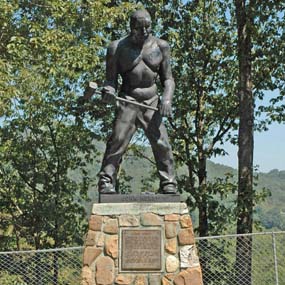 The coming of the railroad through New River Gorge and southern West Virginia was the key event in shaping the modern history of this region. It transformed an isolated and sparsely populated land of subsistence farmsteads into a booming area of company owned coal mining and logging towns that supplied the natural resources that were the base of our nation’s industrial revolution, and were melting pots for diverse groups of new peoples. The C&O railroad was built primarily by two groups of working men, thousands of African-Americans recently freed from enslavement, and recent Irish Catholic immigrants; both groups anxious to begin new lives for themselves and their families as American citizens. The construction of the Chesapeake and Ohio railroad from the Virginia border through the Appalachian Mountains of West Virginia to the Ohio River was a monumental undertaking. Working from both ends of the state the workers spent three years digging and grading the rail bed, hand drilling and blasting the tunnels, and building the bridges and laying the tracks. Using hand tools and explosives, with horses and mules helping with the heaviest loads, these men literally carved the pathway for the railroad through the rugged mountains by hand. 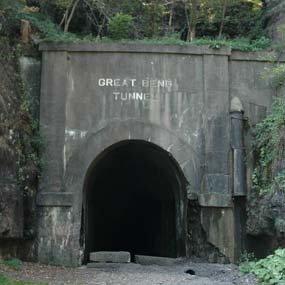 One of the greatest legends of world folklore was born from these workers and their enormous task; John Henry “The Steel Driving Man”. The John Henry of legend is more myth than man; a tragic, larger than life hero involved in an epic battle between man and machine, which was immortalized in a popular folk song the “Ballad of John Henry”. The song sings of a little boy born with a fateful vision of a “hammer in his hand”, who as a steel driver during the construction of the Great Bend Tunnel on the C&O railroad at Talcott, West Virginia takes a hammer in each hand crying “A man ain’t nothing but a man”, as he faces down a giant steam powered drilling machine with the promise “If I can’t beat this steam drill down I’ll die with this hammer in my hand!” John Henry was the working mans champion in a contest to defend the pride and livelihood of his co-workers as they faced the threat of competition from machines at their work. True to his boyhood vision, John Henry triumphs in a fierce race with the drilling machine, but he “dies with his hammer in his hand” from the exertion of his great feat of strength. 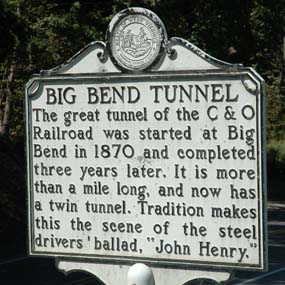 Historical research supports John Henry as a real person; one of thousands of African- American railroad workers, specifically a steel driver, half of a two man team specializing in the hand drilling of holes up to fourteen feet deep into solid rock for the setting of explosive charges. Steel drivers swung a nine pound hammer straight and strong, all day, everyday, pounding assorted lengths of steel drill bits held by their steady and trusting partners, called shakers, who placed and guided the drill bits , and after every strike of the hammer turned or “shook” the bits to remove the pulverized dust. Together these teams of perfectly choreographed industrial artists would with concentration and muscle lead the way, boring the mile long tunnel through Great Bend Mountain and onward along the pathway throughout the length of New River Gorge. Legend and history merged when to test the viability of purchasing steam powered drilling machines to replace the human drilling teams, the railroad staged a contest at the Great Bend Tunnel. Chosen for their skill and speed to compete against the machine, John Henry and his shaker (history does not record his name, although legend sometimes calls him “Little Bill”) faced off side by side with the steam drill and won, drilling farther and faster. Whatever version of the race you choose to believe, the result was the same. The construction of the Great Bend Tunnel and the entire C&O rail line was not a product of the modern machinery of the industrial age but the basic physical labor of thousands of now unknown workers in an everyday struggle to make a living for themselves and their families. Historians also believe that John Henry died at the Great Bend Tunnel, one of the estimated hundreds of workers dying in rock falls, malfunctioning explosions and “tunnel sickness(the excessive inhalation of dust), who now rest in unmarked graves at the tunnel entrance below the statue of John Henry, who still stands as their champion. John Henry was but one of the thousands of men whose strong backs, sweat, blood, and desire to build a new life for themselves and their families were the true foundation for the coming of the Chesapeake and Ohio railroad, the growth of our nation, and the whistle you still hear today. |
Performances, Workshops, Resources & Recordings
The American Folk Experience is dedicated to collecting and curating the most enduring songs from our musical heritage. Every performance and workshop is a celebration and exploration of the timeless songs and stories that have shaped and formed the musical history of America. John Fitzsimmons has been singing and performing these gems of the past for the past forty years, and he brings a folksy warmth, humor and massive repertoire of songs to any occasion.
Festivals & Celebrations
Coffeehouses
School Assemblies
Library Presentations
Songwriting Workshops
Artist in Residence
House Concerts
Pub Singing Irish & Celtic Performances
Poetry Readings
Campfires
Music Lessons
Senior Centers
Voiceovers & Recording
““Beneath the friendly charisma is the heart of a purist gently leading us from the songs of our lives to the timeless traditional songs he knows so well…”
“The Nobel Laureate of New England Pub Music…”
On the Green, in Concord, MA Every Thursday Night for over thirty years…
“A Song Singing, Word Slinging, Story Swapping, Ballad Mongering, Folksinger, Teacher, & Poet…”
Fitz’s Recordings
& Writings
Songs, poems, essays, reflections and ramblings of a folksinger, traveler, teacher, poet and thinker…
Download for free from the iTunes Bookstore
“A Master of Folk…”
Fitz’s now classic recording of original songs and poetry…
Download from the iTunes Music Store
“A Masterful weaver of song whose deep, resonant voice rivals the best of his genre…”
“2003: Best Children’s Music Recording of the Year…”
Fitz & The Salty Dawgs Amazing music, good times and good friends…
“When the eyes rest on the soul…that’s Fitzy…”
Child Ballad #78
Cold blows the wind to my true love,
And gently falls the rain.
I’ve never had but one true love,
And in green-wood he lies slain.
I’ll do as much for my true love,
As any young girl may,
I’ll sit and mourn all on his grave,
For twelve months and a day.
And when twelve months and a day was passed,
The ghost did rise and speak,
“why sittest thou all on my grave
And will no let me sleep?”
“Go fetch me water from the desert,
And blood from out the stone,
Go fetch me milk from a fair maid’s breast
That young man never has known.”
“My breast is cold as the clay,
My breath is earthly strong,
And if you kiss my cold clay lips,
Your days they won’t be long.”
“How oft on yonder grave, sweetheart,
Where we were want to walk,
The fairest flower that e’er I saw
Has withered to a stalk.”
“when will we meet again, sweetheart,
When will we meet again?”
“when the autumn leaves that fall from the trees
Are green and spring up again.”
If you have any more information to share about this song or helpful links, please post as a comment.
Thanks for stopping by the site!
~John Fitz
I am indebted to the many friends who share my love of traditional songs and to the many scholars whose works are too many to include here. I am also incredibly grateful to the collector’s curators and collators of Wikipedia, Mudcat.org, MainlyNorfolk.info, and TheContemplator.com for their wise, thorough and informative contributions to the study of folk music.
I share their research on my site with humility, thanks, and gratitude. Please cite their work accordingly with your own research. If you have any research or sites you would like to share on this site, please post in the comment box. Thanks!
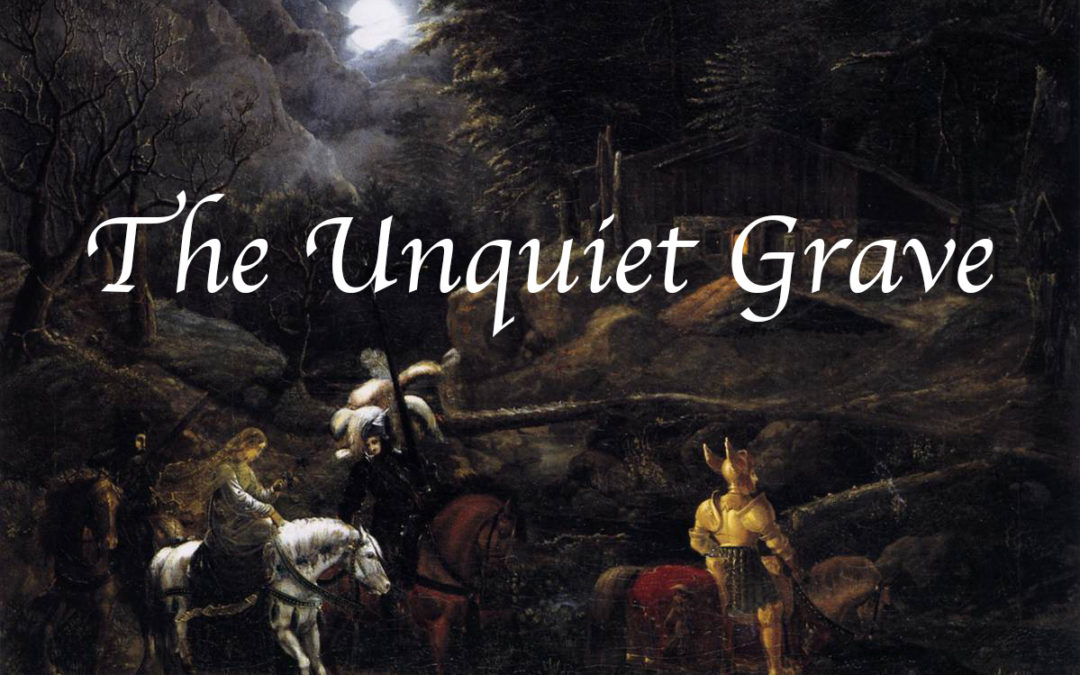
"The Unquiet Grave" is an Irish / English folk song in which a young man's grief over the death of his true love is so deep that it disturbs her eternal sleep. It was collected in 1868 by Francis James Child as Child Ballad number 78.[1] One of the more common tunes used for the ballad is the same as that used for the English ballad "Dives and Lazarus" and the Irish pub favorite "Star of the County Down".
A man mourns his true love for "a twelve month and a day". At the end of that time, the dead woman complains that his weeping is keeping her from peaceful rest. He begs a kiss. She tells him it would kill him. When he persists, wanting to join her in death, she explains that once they are both dead their hearts will simply decay, so he should enjoy life while he has it.
The version noted by Cecil Sharp[2] ends with "When will we meet again? / When the autumn leaves that fall from the trees / Are green and spring up again."
Many verses in this ballad have parallels in other ballads: Bonny Bee Hom, Sweet William's Ghost and some variants of The Twa Brothers.[3]
The motif that excessive grief can disturb the dead is found also in German and Scandinavian ballads, as well as Greek and Roman traditions.[4]
In 1941 the "Journal of the English Folk Dance and Song Society" Vol 4 no 2 included a long essay by Ruth Harvey. She compares motifs from "The Unquiet Grave" with other European ballads, including "Es ging ein Knab spazieren (Der tote Freier)" from Germany, and "Faestemanden I Graven" from Denmark.[5] She writes: "It is only inevitable that a song which certainly goes back to pre-Christian traditions should have suffered modification during the centuries."[6]
The Danish ballad "Faestemanden I Graven" was made into a short film, "Aage og Else" (1983).[7] Though not recorded till the nineteenth century, “The Unquiet Grave,” as a folk work, may date to the same period as those two seventeenth-century ballads. On the Fresno State University website, Robert B Waltz compares "The Unquiet Grave" with an older carol, "There blows a cold wind today," in the Bodleian Library MS 7683 (dated ca. 1500), but adds: "I must say that I find this a stretch; the similarities are slight indeed."[8]
[ Roud 51 ; Child 78 ; Ballad Index C078 ; Bodleian Roud 51 ; Wiltshire Roud 51 ; trad.]A.L. Lloyd sang The Unquiet Grave in 1956 on his and Ewan MacColl’s Riverside album of Child ballads, The English and Scottish Popular Ballads Volume I. Editor Kenneth G. Goldstein wrote in the album’s booklet:
Aside from its exquisite poety and music, this ballad is notable for its exhibition of the universal popular belief that excessive grief on the part of mourners disturbes the peace of the dead.
It is possible that this is only a fragment of a once popular longer ballad. In the form we have it today, no text has been reported earlier than the 19thcentury. The ballad is little known in Scotland and is quite rare in America. It is still current in England, however.
The text and tune sung by A.L. Lloyd were collected by Cecil Sharp from William Spearing of Ile Bruers, Somerset, excepting the last two stanzas, which were from Mrs. William Ree of Hambridge, Somerset.
See Child (78), Volume II, p. 78ff; Coffin, p.82; Dean-Smith, p.113.
Shirley Collins recorded this ballad in 1959 for her second LP, False True Lovers, a second time for her Collector EP English Songs Vol. 1, and a third time in 1967 for her album The Power of the True Love Knot. She commented in the first album’s notes:
From Cecil Sharp’s English Folk Songs. This is one of the classic pieces of English folk song literature. From one point of view it is a feminine fantasy or a wish, perhaps for the death of a lover, perhaps for a way of arranging a night visit by the lover, perhaps for a way of showing how strong her love is, perhaps of a feeling of guilt. Certainly, it is a ghost story designed to delight the imagination of young women. Finally, it shows the survival of ancient and widely distributed primitive beliefs about the treatment of the dead.
The rowdy Irish wake is the only one example of the common folk custom of a gathering in which ceremonial banqueting and games were indulged in to show honour to the dead person. The shade was given a great send-off to the other world. Sometimes guns were fired to send him skittering away in fear. Sometimes a special door was cut in the side of the wall so that the coffin could be taken out by that route; and then this hole was walled up so that the ghost could not find his way back into the house again.
In Scotland and Ireland it was believed that excessive grief prevented the dead from resting; that the tears shed by the mourners pierced holes in the corpse. In Persia they held that the tears shed by humanity for their dead flowed into a river in which the souls floated and drowned. Similar beliefs were held by the Greeks and Romans, and from mediaeval times throughout Germany and Scandinavia.
Sharp says that in England a belief was current that if a girl was betrothed to a man, she was pledged to him if he died, and was bound to follow him to the spirit world unless she solved certain riddles, or performed certain tasks, such as fetching water from a desert, blood from a stone, milk from the breast of a virgin…
and in the The Power of the True Love Knot album notes:
This song is a tender and magical expression of an ancient community belief: a very proper belief that when the mourning of a lover’s death started to drain life from the living, love was being misused. Tears flowed into the Styx, and the river swelled and became impassable, so the dead come back and warn the quick. On this track and elsewhere I play an instrument made for me by John Bailey, which is a dulcimer with a five-string banjo neck.
The Ian Campbell Folk Group with Dave Swarbrick sang The Unquiet Grave in 1963 on their album This Is the Ian Campbell Folk Group. This track was included in 2005 on their anthology The Times They Are A-Changin’.
Alex Campbell sang The Unquiet Grave in 1966 on his album Yours Aye, Alex; this track was included in 1966 on his compilation CD Been on the Road So Long.
Hedy West sang an American version The Unquiet Grave in 1967 on her Topic album Ballads. Her (or A.L. Lloyd’s) sleeve notes commented:
There’s widespread and ancient belief that excessive grieving over the dead disturbs their rest. The Greeks and Romans thought so, and the idea is as common in the Far East as in Western Europe. In Ireland as in Rumania it was thought that inordinate tears would burn a hole in the corpse, and in several ballads the dead complain that they cannot sleep because the tears of the living have wet their winding sheet. This ballad, of a restless ghost who confronts and reproaches the mourner, is probably a fragment broken off some longer, more complicated narrative. Though it’s been relatively common in England till recent times, it seems very rare in America, and has turned up only in a scattered handful of versions from Newfoundland, Virginia and North Carolina (which is where the present version comes from, collected by the indefatigable Frank C. Brown).
Jon Raven sang The Unquiet Grave in 1968 on the Broadside album The Halliard : Jon Raven.
Dave & Toni Arthur sang this ballad as Cold Blows the Winter’s Wind in 1969 on their Topic album The Lark in the Morning. The sleeve notes commented:
The ballad, usually called The Unquiet Grave, concerns a person who feels bound to sit and mourn by his (sometimes, her) lover’s grave for a period of time. In nearly all versions, the corpse complains of being disturbed, illustrating the ancient belief that excessive grief interferes with the peace of the dead. In archaic folklore, a constant concern, when faced with a death, is to try to ensure that the corpse makes a pleasant and reassured transit from the land of the living to the world of the dead. Otherwise the dead may return, uneasy and vengeful, to plague the living. Hence for instance the jollification at Irish wakes, intended to cheer and embolden the dead. Singers have ended our ballad in various ways, sometimes heartbroken and disconsolate, sometimes more or less lightheartedly as: “But since I have lost my own true love, I must get another in time.” Our tune is from Fred Hamer’s collection Garners Gay. The words are from Alfred Williams’s Folk-Songs of the Upper Thames.
Frankie Armstrong sang The Unquiet Grave in 1971 on her Topic album Lovely on the Water. A.L. Lloyd commented in the sleeve notes:
A woman laments long over the grave of her sweetheart, till he speaks from the grave and reproaches her for disturbing his rest. Usually in the ballads the setting and the characters are named, but here we know neither the who nor the where, and the supernatural climate is further charged with mystery on that account. The tale is old, like the belief that too much grief disturbs the dead, though to this day, in Eastern Europe, some peasants believe that mourner’s tears make an unhealing burn if they chance to light on a corpse. In some versions the dead person threatens to tear the living one to pieces (the favourite revenge of ghosts!) unless absolute fidelity can be sworn to. But Frankie’s version is milder, more consolatory, as fits her gentle character. By and large, the tune she uses is one recorded by Vaughan Williams at Dilwyn, Herefordshire.
John Kirkpatrick and Sue Harris sang this ballad as Cold Blows the Wind in 1976 on their Topic LP Among the Many Attractions at the Show Will Be a Really High Class Band and John Kirkpatrick did it again in 2007 on his Fledg’ling CD Make No Bones. He commented in the latter album’s sleeve notes:
When I moved to Shropshire in 1973 and started looking at the local folk music, the singing of May Bradley was a glorious revelation. I never saw her in the flesh, but Fred Hamer’s recordings of her in Ludlow during the 1960s proved to be a real treasure chest of wonderful songs wonderfully sung. She was the daughter of Ester Smith, a gypsy singer that Vaughan Williams had collected from in Herefordshire at the beginning of the century, and had some of her mother’s songs as well as plenty of others. This is her tune for what is sometimes known as The Unquiet Grave—Child Ballad no. 78. I’ve sung this before in a past life, but in revisiting the song I have added a few lines from other versions to fill out the sense of the words.
Two books of the songs Fred Hamer collected were published by EFDS Publications Ltd., and you can see this in the first one from 1967, Garners Gay. Or a much better option is to hear [May Bradley] singing it herself on the EFDSS LP Garners Gay issued in 1971, EFDSS LP 1006.
May Bradley’s version can also be found on her Musical Traditions anthology Sweet Swansea (2010).
Jo Freya sang The Unquiet Grave in 1992 on her CD Traditional Songs of England.
Sandra Kerr sang The Unquiet Grave in 1970 on the Argo Voices anthology series, Second Book, Record One (Argo DA96). Her daughter Nancy sang it in 1993 on the CD Eliza Carthy & Nancy Kerr. She referred in her sleeve notes to Evelin Wells’ The Ballad Tree, and to her mother singing this version onVoices.
Louis Killen learnt The Unquiet Grave from Brian Ballinger and sang in on his 1993 CD A Bonny Bunch.
Steeleye Span sang One True Love in 1998 on their CD Horkstow Grange, and they recorded The Unquiet Grave in 2009 for their CD Cogs Wheels and Lovers. Tim Harries commented in the former album’s notes:
The sources for [One True Love] are The Unquiet Grave, (spooky old English song), Lovely Joan, and a small fragment of Lowlands of Holland. The inspiration came largely from Borrowed Time by Paul Monette, a book you may be familiar with.
Kate Rusby couldn’t let the dead sleep on her 1999 CD Sleepless.
Like John Kirkpatrick, Jon Boden learned Cold Blows the Wind from the singing of May Bradley. He sang it with Bellowhead in 2010 on their CD Hedonism, and he sang it unaccompanied as the December 29, 2010 entry of his project A Folk Song a Day.
Rachel Newton sang The Unquiet Grave on The Furrow Collective’s 2015 EP Blow Out the Moon. She commented in the album’s notes:
I took the words for the well known ballad The Unquiet Grave from Child no. 78a; and the melody I use is based on a version I learned from the singing of Shirley Collins.
Siobhan Miller sang The Unquiet Grave on her 2017 album Strata.
| A.L. Lloyd sings The Unquiet Grave | |
|---|---|
| “Cold blows the wind to my true love, And gentle drops the rain, I never had but one true love And in Greenwood she is lain. |
|
| “I’ll do as much for my true love As any young man may, I’ll sit and weep all on her grave For a twelve month and a day.” |
|
| When the twelve month and one day was o’er, Her ghost begun for to speak, “Why sit you here all on my grave And will not let me sleep?” |
|
| “There’s one thing more I want, sweetheart, And one thing more I crave, And that’s a kiss from your lily-white lips And then I’ll go from your grave.” |
|
| “My lips are cold as clay, sweetheart, My breath smells heavy and strong, And if you kiss my lily-white lips, Your time would not be long.” |
|
| Shirley Collins sings The Unquiet Grave | Nancy Kerr sings The Unquiet Grave |
| “Cold blows the wind tonight, true love, Cold are the drops of rain, I only had but one true love And in Greenwood he lies slain. |
“The wind doth blow today, my love, And a few small drops of rain; I never had but one true love And in Greenwood he is lain. |
| “I’ll do as much for my true love As any young girl may, I’ll sit and mourn all by his grave For a twelve-month and a day.” |
“I’ll do as much for my true love As any young girl may, I’ll sit and mourn all on his grave For twelve months and a day.” |
| Now the twelve-month and a day being gone, The ghost began to greet: “Your salten tears they trickle down They wet my winding sheet.” |
The twelve months and a day being done, The dead began to speak: “Oh, who sits weeping on my grave And will not let me sleep?” |
| “It’s I, my love, sits by your grave And will not let you sleep. For I crave one kiss from your clay-cold lips And that is all I seek.” |
“’Tis I, your love sits on your grave And will not let you sleep. For I crave one kiss of your clay-cold lips And that is all I seek.” |
| “But lily, lily are my lips, My breath comes earthy strong. If you have one kiss from my clay-cold lips, Your time will not be long.” |
“Your breath is as the roses sweet, Mine as the sulphur strong. And if you get one kiss from my lips, Your time will not be long.“ |
| “’Twas down in yonder garden green, Love, where we used to walk. And the fairest flower that e’er was seen Has withered to the stalk.” |
“’Tis down in yonder garden green, Love, where we used to walk. The finest flower that e’er was seen Is withered to a stalk.” |
| “The stalk is withered dry, true love, So must our hearts decay. Then rest yourself content, my dear, Till God calls you away, Till God calls you away.” |
“The stalk is withered and dry, sweetheart, And the flower will never return. And since I lost my own true love What can I do but mourn?”“Mourn not for me, my own true love, Mourn not for me I pray. For I must leave you and all the world And go into my grave.” |
| Bellowhead sings Cold Blows the Wind | Steeleye Span sing One True Love |
| “Cold blows the wind over my true love, Cold blows the drops of rain, I never had but one true love And in Greenwood he lies slain.“I’ll do as much for my true love As any young girl may, I’ll sit and weep down by his grave For twelve months and a day.”But when twelve months they were up and gone This young man he arose: “What makes you sit by my grave and weep? I can’t take my repose!”“One kiss, one kiss from you lily-white lips, One kiss is all I crave. One kiss, one kiss from you lily-white lips, Then return back to your grave.”“These lips they are as cold as clay, My breath is heavy and strong. if you were to kiss these lily-white lips Your life would not be long.“Oh, don’t you remember the garden grove, Where once we used to walk? Go pick the finest flower of them all, It will wither to a stalk.“Go fetch me a flower from the dungeon deep, Bring water from a stone. Bring white milk from a virgin’s breast That baby never bore none.”“Go dig me a grave both wide and deep, Dig it as quick as you may. That I may lay down and take a long sleep For twelve months and a day.” |
Cold blows the wind o’er my true love, Cold blows the drops of rain, I never had but one true love And never will again.I’ll do as much for my true love As any lover may, I’ll sit and weep down by his grave A twelve-month in one day.One kiss, one kiss from your sweet lips, One kiss is all I grave. One kiss, one kiss from your sweet lips, And sink down in your grave.And your lips, they are not sweet my love Your kiss is cold as clay, My time be long, my time be short, Tomorrow or today.And down beyond the garden wall, Where we both used to walk, Are finest flowers that ever grew All withered to a stalk.(repeat first verse) |
Transcribed from the singing of Nancy Kerr by Kira White.
“The Unquiet Grave” is both a poem and a song. Intensely sad, and written in the first person singular, the mourner laments the love of his life sitting weeping at her graveside for a year and a day, at which point her ghost rises up and asks who will not allow her to sleep. He identifies himself and asks for “one kiss of your clay-cold lips”. She disavows him of that notion, and tells him to put his grief behind him and enjoy the rest of his life “Till God calls you away”.
Another musicologist who researched “The Unquiet Grave” in some depth was the aforementioned Cecil Sharp. Volume I of the 1994 Oxford University Press edition of his …Collection Of English Folk Songs, Edited by Maud Karpeles records no less than seventeen different versions, the oldest of which was sung to him by Mrs Ree at Hambridge, Somerset, on April 4, 1904.
Performances, Workshops,
Resources & Recordings
The American Folk Experience is dedicated to collecting and curating the most enduring songs from our musical heritage. Every performance and workshop is a celebration and exploration of the timeless songs and stories that have shaped and formed the musical history of America. John Fitzsimmons has been singing and performing these gems of the past for the past forty years, and he brings a folksy warmth, humor and massive repertoire of songs to any occasion.
Festivals & Celebrations
Coffeehouses
School Assemblies
Library Presentations
Songwriting Workshops
Artist in Residence
House Concerts
Pub Singing
Irish & Celtic Performances
Poetry Readings
Campfires
Music Lessons
Senior Centers
Voiceovers & Recording
““Beneath the friendly charisma is the heart of a purist gently leading us from the songs of our lives to the timeless traditional songs he knows so well…”
“The Nobel Laureate of New England Pub Music…”
On the Green, in Concord, MA
Every Thursday Night
for over thirty years…
“A Song Singing, Word Slinging, Story Swapping,
Ballad Mongering, Folksinger, Teacher, & Poet…”
Fitz’s Recordings
& Writings
Songs, poems, essays, reflections and ramblings of a folksinger, traveler, teacher, poet and thinker…
Download for free from the iTunes Bookstore
“A Master of Folk…”
Fitz’s now classic recording of original songs and poetry…
Download from the iTunes Music Store
“A Masterful weaver of song whose deep, resonant voice rivals the best of his genre…”
“2003: Best Children’s Music Recording of the Year…”
Fitz & The Salty Dawgs
Amazing music, good times and good friends…
“When the eyes rest on the soul…that’s Fitzy…”
~Traditional Ballad
There were three men,
Came from the west,
Their fortunes for to tell,
And the life of John Barleycorn as well.
They laid him in three furrows deep,
Laid clods upon his head,
Then these three men made a solemn vow
John Barleycorn was dead.
They let him die for a very long time
Till the rain from heaven did fall,
Then little Sir John sprang up his head
And he did amaze them all.
They let him stand till the midsummer day,
Till he looked both pale and wan.
The little Sir John he grew a long beard
And so became a man.
They have hired men with the scythes so sharp,
To cut him off at the knee,
They rolled him and they tied him around the waist,
They served him barbarously.
They have hired men with the crab-tree sticks,
To cut him skin from bone,
And the miller has served him worse than that,
For he’s ground him between two stones.
They’ve wheeled him here, they’ve wheeled him there,
They’ve wheeled him to a barn,
And thy have served him worse than that,
They’ve bunged him in a vat.
They have worked their will on John Barleycorn
But he lived to tell the tale,
For they pour him out of an old brown jug
And they call him home brewed ale.
If you have any more information to share about this song or helpful links, please post as a comment. Thanks for stopping by the site! ~John Fitz
I am indebted to the many friends who share my love of traditional songs and to the many scholars whose works are too many to include here. I am also incredibly grateful to the collector’s curators and collators of Wikipedia, Mudcat.org, MainlyNorfolk.info, and TheContemplator.com for their wise, thorough and informative contributions to the study of folk music. I share their research on my site with humility, thanks, and gratitude. Please cite their work accordingly with your own research. If you have any research or sites you would like to share on this site, please post in the comment box. Thanks!

"John Barleycorn" is an English and Scottish folk song.[1] The song's protagonist is John Barleycorn, a personification of barley and of the beer made from it. In the song, he suffers indignities, attacks, and death that correspond to the various stages of barley cultivation, such as reaping and malting.
The song may have its origins in ancient English or Scottish folklore, with written evidence of the song dating it at least as far back as the Elizabethan era.[2] It is listed as number 164 in the Roud Folk Song Index. The oldest versions are Scottish and include the Scots poem "Quhy Sowld Nocht Allane Honorit Be". In 1782, the Scottish poet Robert Burns published his own version of the song, which influenced subsequent versions.
The song survived into the twentieth century in the oral folk tradition, primarily in England, and many popular folk revival artists have recorded versions of the song. In most traditional versions, including the sixteenth century Scottish version entitled Alan-a-Maut, the plant's ill-treatment by humans and its re-emergence as beer to take its revenge are key themes.[3]
The Penguin Book of English Folk Songs (London, 1959), edited by the folk singer A. L. Lloyd and the composer Ralph Vaughan Williams, ponders whether the ballad is "an unusually coherent folklore survival" or "the creation of an antiquarian revivalist, which has passed into popular currency and become 'folklorised'". It has been theorised that the figure could have some relation to the semi-mythical wicker man ritual, which involves burning a man in effigy.[2]
A link between the mythical figure Beowa (a figure from Anglo-Saxon paganism, appearing in early Anglo-Saxon royal genealogies; his name means "barley") and John Barleycorn is suggested by the author Kathleen Herbert. In her 1994 book Looking for the Lost Gods of England, she suggests that Beowa and Barleycorn are one and the same, noting that the folksong details the suffering, death, and resurrection of Barleycorn, yet celebrates the "reviving effects of drinking his blood".[4]
.jpg)
The first song to personify Barley was called Allan-a-Maut ('Alan of the malt'), a Scottish song written prior to 1568.[3]
Allan is also the subject of "Quhy Sowld Nocht Allane Honorit Be", a fifteenth or sixteenth century Scots poem included in the Bannatyne Manuscript of 1568 and 17th century English broadsides.
The first mention of "John Barleycorn" as the character was in a 1624 London broadside entitled introduced as "A Pleasant New Ballad to sing Evening and morn, / Of the Bloody murder of Sir John Barley-corn".[3] The following two verses are from this 1624 version:
Yestreen, I heard a pleasant greeting
A pleasant toy and full of joy, two noblemen were meeting
And as they walked for to sport, upon a summer's day,
Then with another nobleman, they went to make affray
Whose names was Sir John Barleycorn, he dwelt down in a dale,
Who had a kinsman lived nearby, they called him Thomas Good Ale,
Another named Richard Beer, was ready at that time,
Another worthy knight was there, called Sir William White Wine.[3]
The final two verses of this 1624 version show Barleycorn's vengeance through intoxicating his killers:
When Sir John Goodale he came with mickle might
Then he took their tongues away, their legs or else their sight
And thus Sir John in each respect, so paid them all their hire
That some lay sleeping by the way, some tumbling in the mire
Some lay groaning by the walls, some in the streets downright,
The best of them did scarcely know, what they had done oernight
All you good wives that brew good ale, God turn from you all teen
But if you put too much liquor in, the Devil put out your een.
Robert Burns published his own version in 1782, which adds a more mysterious undertone and became the model for most subsequent versions of the ballad. Burns's version begins:
There was three kings unto the east,
Three kings both great and high,
And they hae sworn a solemn oath
John Barleycorn should die.
They took a plough and plough'd him down,
Put clods upon his head,
And they hae sworn a solemn oath
John Barleycorn was dead.
Unlike other versions, Robert Burns makes John Barleycorn into a saviour:
And they hae taen his very heart's blood,
And drank it round and round;
And still the more and more they drank,
Their joy did more abound.
John Barleycorn was a hero bold,
Of noble enterprise;
For if you do but taste his blood,
'Twill make your courage rise.
'Twill make a man forget his woe;
'Twill heighten all his joy;
'Twill make the widow's heart to sing,
Tho' the tear were in her eye.
Then let us toast John Barleycorn,
Each man a glass in hand;
And may his great posterity
Ne'er fail in old Scotland!
Many field recordings of the song were made of traditional singers performing the song, mostly in England. In 1908, Percy Grainger used phonograph technology to record a Lincolnshire man named William Short singing the song; the recording can be heard on the British Library Sound Archive website.[5] James Madison Carpenter recorded a fragment sung by a Harry Wiltshire of Wheald, Oxfordshire in the 1930s, which is available on the Vaughan Williams Memorial Library website[6] as well as another version probably performed by a Charles Phelps of Avening, Gloucestershire.[7] The Shropshire singer Fred Jordan was recorded singing a traditional version in the 1960s.[8]
A version recorded in Doolin, Co. Clare, Ireland from a Michael Flanagan in the 1970s is available courtesy of the County Clare Library.[9]
The Scottish singer Duncan Williamson also had a traditional version which was recorded.[10]
Helen Hartness Flanders recorded a version sung by a man named Thomas Armstrong of Mooers Forks, New York, USA in 1935.[11]
Ralph Vaughan Williams used a version of the song in his English Folk Song Suite (1923).[12] Many versions of the song have been recorded, including popular versions by the rock groups Traffic (appearing on their 1970 album John Barleycorn Must Die) and Jethro Tull (appearing first on their 1992 album A Little Light Music and then on various other albums). The song is a central part of Simon Emmerson's The Imagined Village project. Martin and Eliza Carthy perform the song alongside Paul Weller on the Imagined Village album. Billy Bragg sang in Weller's place on live performances. Rock guitarist Joe Walsh performed the song live in 2007 as a tribute to Jim Capaldi. English folk musician Sam Lee recorded a version on his album "Old Wow," accompanied by a video filmed at Stonehenge.[13] English black metal band Winterfylleth recorded a version included in the folk compilation One & All, Together, For Home.[14]
"John Barleycorn" has been used as a symbol or a slang term for alcohol,[15] and its association with alcohol has been used in various areas of life. Several pubs in the South of England are called "John Barleycorn", in places including Duxford,[16] Harlow,[17] Goring,[18] and Southampton.[19] Jack London's 1913 autobiographical novel John Barleycorn takes its name from the song and discusses his enjoyment of drinking and struggles with alcoholism.[20] The use of the term to symbolise alcohol misuse was so widespread that it was used as a headline on court reports about drunkenness in late Victorian times.[21]
In the climax of the Inside No. 9 episode "Mr King" (2022), the song is performed by a class of schoolchildren as they prepare to ritualistically sacrifice their teacher for their harvest festival.[22]


 Works related to John Barleycorn at Wikisource
[ Roud 164 ; G/D 3:559 ; Ballad Index ShH84 ; Full English CJS2/9/2124 ; trad.]This old ballad of the death and resurrection of the Corn God was recorded in many versions by lots of musicians:
A.L. Lloyd sang John Barleycorn in 1956, accompanied by Alf Edwards on English concertina, on English Drinking Songs. This recording was also included in 1994 on his Fellside anthology CD Classic A.L. Lloyd. Lloyd commented in the latter’s sleeve notes:
The song is related to the ancient idea of the Corn King. Perhaps too neatly so, hence the suspicion that it may not be a genuine piece of primitive folklore. It is old (it was already in print c.1635) and has been passed on by generations of country singers. The tune is a variant of Dives and Lazarus.
A group of Boggans from Haxey, Lincolnshire, sang John Barleycorn in the 1950s in a recording made by Peter Kennedy and Seamus Ennis. It was included on the anthology Songs of Ceremony (The Folk Songs of Britain Volume 9; Caedmon 1961; Topic 1970).
Mike Waterson sang John Barleycorn on the Watersons’ 1965 LP Frost and Fire. His first three verses are quite similar to Lloyd’s, the first half of the fourth differs more and his fifth verse is completely different from Lloyd’s fifth and sixth verse. Mike Waterson’s recording was also published on the Topic Sampler No. 6, A Collection of Ballads & Broadsides and in 2004 on the Watersons’ 4CD anthology Mighty River of Song. A.L. Lloyd commented in Mike’s original recording’s sleeve notes:
Sometimes called The Passion of the Corn. It’s such an unusually coherent figuration of the old myth of the Corn-king cut down and rising again, that the sceptical incline to think it may be an invention or refurbishing carried out by some educated antiquarian. If so, he did his work long ago and successfully, for the ballad was already in print in the early years of the seventeenth century, and it has been widespread among folk singers in many parts of the English and Scottish countryside. Cecil Sharp obtained this version from Shepherd Haden of Bampton, Oxfordshire [on August 31, 1909].
Fred Jordan sang John Barleycorn in a recording made by Bill Leader and Mike Yates in a private room in The Bay Malton Hotel, Oldfield Brow, Altringham, Cheshire, in 1966. It was included in the same year on his Topic album Songs of a Shropshire Farm Worker and in 1998 on the Topic anthology They Ordered Their Pints of Beer and Bottles of Sherry (The Voice of the People Series Volume 13). Another recording made by Mike Yates in 1965 was included in 2003 on his Veteran anthology A Shropshire Lad.
Martin Carthy sang John Barleycorn in 1966 on Songs from ABC Television’s “Hallelujah” and, accompanied by Dave Swarbrick, on their 1967 LPByker Hill. This version is quite similar to Mike Waterson’s, see the lyrics below. It was reissued on the compilation album This Is… Martin Carthy. Another version is on his 1974 album Sweet Wivelsfield. A live recording from Memphis Folk Club, Leeds dating from 1973 can be found on The Carthy Chronicles. He also sang it live in studio in July 2006 for the DVD Guitar Maestros. Martin Carthy commented in his original album’s sleeve notes:
A.L. Lloyd in The Penguin Book of English Folk Songs points out that if John Barleycorn is a folklore survival of the ancient myth of the death and resurrection of the Corn God, it is remarkable if only for its coherence, but, he says, it could be the work of some more recent writer which was somehow absorbed into the tradition. It is certainly powerful enough to be the former but also quaint enough (not to use the word in its pejorative sense) to be the latter. It might be interesting to speculate further of the three men coming from the West (sunset—the place of death?) bringing with them the promise of live (for no matter what they do they succeed only in giving John Barleycorn new life) and the Three Wise Men coming from the East (sunrise—the place of life?) to see Jesus, bringing as gifts the promise of death. It is found all over the British Isles; this version was taken down in Bampton, Oxfordshire, by Cecil Sharp.
and in the Carthy Chronicles:
Forget the academic stuff about death and rebirth, fertility symbols and corn gods! The reason that this is one of the best known and most popular of all ballads—and one which has crossed a great many musical thresholds—is that it’s actually about that other activity which most commonly accompanies the singing of traditional songs—drinking!
Dave and Tony Arthur sang The Barley Grain for Me in 1967 on their Transatlantic album Morning Stands on Tiptoe.
The Young Tradition sang John Barleycorn in 1968 on their last LP, Galleries. This track was included in 1994 on the Ronco anthology The British Folk Collection as the first Young Tradition track reissued on CD. They also sang it on November 17, 1968 at their concert at Oberlin College, Ohio, that was published in 2013 on their Fledg’ling CD Oberlin 1968. Heather Wood commented in the original album’s sleeve notes:
From the Cecil Sharp collection. One of the many songs which we picked up by a process of osmosis.
Traffic recorded John Barleycorn as title track of their 1970 album John Barleycorn Must Die with verses nearly identical to Mike Waterson’s. In fact, Steve Winwood learnt the song from the Watersons. This track was also included in 1975 on the famous anthology Electric Muse: The Story of Folk into Rock.
Derek and Dorothy Elliott sang John Barleycorn in 1972 on their eponymous Leader album, Derek & Dorothy Elliott.
Steeleye Span’s version on their 1972 album Below the Salt is again similar in the beginning to the previous versions but differs in the last verse. They recorded John Barleycorn a second time in 2002 for their CD Present. A live recording from The Forum, London on September 2, 1995 was released on their double CD The Journey. Their singer Maddy Prior recorded John Barleycorn in 2003 for her solo album Lionhearts; this track can also be found on her anthology Collections: A Very Best of 1995 to 2005. Their first recording’s sleeve notes commented:
Adam, Cain and Abel staggered manfully across the field carrying a plough, a harrow and a grain of wheat … John Barleycorn—mysterious intimations from above told them to dig three deep furrows and bury him—this done they returned home and started to draw up plans for the first ale house.
Bob Hart sang John Barleycorn at home in Snape, Suffolk in July 1972 in a recording made by Tony Engle. It was published in 1973 on his Topic album Songs from Suffolk. Another recording made by Rod and Danny Stradling in July 1969 was included in 2007 on his Musical Traditions anthology A Broadside.
Ernest Austin sang John Barleycorn in a recording made by Tony Engle at Bentley, Essex, in November 1973 that was published in 1974 on the Topic albumFlash Company.
Bob Blake sang John Barleycorn in a recording made by Mike Yates at Broadbridge Heath, Sussex in 1974 that was included in 1987 on the Veteran Tapes cassette of traditional singing in Sussex, Ripest Apples (VT107), and in 2001 on the Veteran CD anthology of “traditional folk music from rural England”,Down in the Fields.
Tom Smith of Thorpe Morieux (b. 1918) learned John Barleycorn from his father Bert Smith and sang it in a John Howson recording on the Veteran Tapes cassette Songs Sung in Suffolk Vol 2 (VT102, published in 1987-89), on the 2000 Veteran CD Songs Sung in Suffolk, and on the CD accompanying The Folk Handbook (2007).
Austin Flanagan sang The Barley Grain at home in Luogh, Doolin, Co. Clare, in August 1974. This recording made by Jim Carroll and Pat Mackenzie was included in 1998 on the Topic anthology Troubles They Are But Few (The Voice of the People Series Volume 14).
Barry Skinner sang John Barleycorn in 1974 on the Argo album The World of the Countryside.
Roy Bailey learned John Barleycorn from The Constant Lovers, edited by Frank Purslow, and sang it in 1976 on his album New Bell Wake.
The Songwainers sang John Barleycorn in June 1976 at the festival Eurofolk ’76 in Ingelheim, Germany.
The John Renbourn Group sang John Barleycorn in 1977 on their Transatlantic album A Maid in Bedlam.
Louis Killen sang John Barleycorn in Winter 1977 at the Eldron Fennig Museum of American Ephemera; this recording was published in the following year on his album Old Songs, Old Friends.
There are several Fairport Convention live recordings of John Barleycorn, e.g. on Forever Young (Cropredy 1982), The Boot (Cropredy 1983), and The Cropredy Box (Cropredy 1997).
Andy Turner first learned John Barleycorn from Steeleye Span’s album. He and Ian Giles sang the classic Shepherd Haden version collected by Cecil Sharp, though, in 1983 on Magpie Lane’s first album, The Oxford Ramble, and he sang it as the June 10, 2016 entry of his project A Folk Song a Week. This video shows And and Ian at the very first Magpie Lane gig at Holywell Music Room in May 1993:
Andy Turner also sang a version of John Barleycorn that was collected in the 1970s by Gwilym Davies on Magpie Lane’s 2000 CD A Taste of Ale. Andy Turner and Chris Wood recorded another version on a demo tape in ca. 1985 which he used as the October 22, 2012 entry of his project A Folk Song a Week. This version was collected from Bert Edwards of Little Stretton, Shropshire, by Peter Kennedy and printed in the latter’s Folksongs of Britain and Ireland, and is similar to Fred Jordan’s version.
Pete Morton sang John Barleycorn in 1990 at the Folk Festival Sidmouth.
Barry Dransfield sang John Barleycorn in 1994 on his Rhiannon CD Be Your Own Man. This track was also included in 2007 on the anthology Old Wine New Skins.
Coope, Boyes & Simpson sang John Barleycorn on their 1998 CD Hindsight.
Chris Foster sang Jack Barleycorn in 2003 on his Tradition Bearers CD Traces.
Jim Causley sang John Barleycorn in 2005 on his WildGoose CD Fruits of the Earth.
Chris Wood sang John Barleycorn in 2005 on his CD The Lark Descending.
Duncan Williamson sang John Barleycorn at the Fife Traditional Singing Festival, Collessie, Fife in May 2006. This recording was included a year later on Festival anthology Some Rants o’ Fun (Old Songs & Bothy Ballads Volume 3). His version was also included in the EFDSS book of songs of English and Scottish Travellers and Gypsies, Traveller’s Joy.
Tim van Eyken sang Barleycorn “after Fred Jordan” in 2006 on his Topic CD Stiffs Lovers Holymen Thieves. This track was also included in 2009 on Topic’s 70th Anniversary anthology, Three Score and Ten.
Paul Weller and Martin and Eliza Carthy sang John Barleycorn in 2007 on The Imagined Village’s eponymous first CD, The Imagined Village.
The Lark Rise Band recorded John Barleycorn in 2008 for their album Lark Rise Revisited.
Jon Boden sang John Barleycorn as the April 13, 2011 entry of his project A Folk Song a Day. He noted in his blog:
Another ‘big song’ that I’ve only just got around to learning. There are so many good versions around, to choose from, but this is basically Carthy’s version I think.
Mark T sang John Barleycorn in 2011 on his CD Folk Songs & Ballads.
The Dovetail Trio sang John Barleycorn in 2014 on their eponymous EP, The Dovetail Trio. This video shows them at the Wheelhouse on January 4, 2014:
| A.L. Lloyd sings John Barleycorn | Mike Waterson sings John Barleycorn |
|---|---|
| There was three men come out of the west Their fortunes for to try, And these three men made a solemn vow: John Barleycorn should die. They ploughed, they sowed, they harrowed him in, Throwed clods upon his head. And these three men made a solemn vow: John Barleycorn was dead. |
There were three men come out of the west Their fortunes for to try, And these three men made a solemn vow: John Barleycorn should die. They’ve ploughed, they’ve sown, they’ve harrowed him in, Throwed clods on his head. And these three men made a solemn vow: John Barleycorn was dead. |
| They let him lie for a very long time Till the rain from heaven did fall, And little Sir John sprung up his head And that amazed them all. They let him stand till midsummer And he growed both pale and wan. Then little Sir John, he growed a long beard And so become a man. |
They’ve let him lie for a very long time Till the rain from hea’en did fall, And little Sir John sprung up his head And soon amazed them all. They’ve let him stand till midsummer day Till he looked both pale and wan. And little Sir John’s grown a long, long beard And so become a man. |
| They hired men with the scythes so sharp To cut him off at the knee. And poor little Johnny Barleycorn They served most barbarously. They hired men with the sharp pitchforks To pierce him to the heart. And the loader, he served him worse than that For he bound him to the cart. |
They’ve hired men with the scythes so sharp To cut him off at the knee. They’ve rolled him and tied him by the waist, Serving him most barbarously. They’ve hired men with the sharp pitchforks Who pricked him to the heart. And the loader, he served him worse than that For he’s bound him to the cart. |
| They wheeled him all around the field A prisoner to endure, And in the barn poor Barleycorn They laid him upon the floor. They hired men with the crab tree sticks To cut him skin from bone, And the miller, he served him worse than that For he ground him between two stones. |
They’ve wheeled him round and around the field Till they came into the barn And there they’ve made a solemn mow Of poor John Barleycorn. They’ve hired men with the crab tree sticks To cut him skin from bone, And the miller, he has served him worse than that For he’s ground him between two stones. |
| I’ll make a boy into a man, A man into an ass. I’ll change your gold to silver, lass, And your silver into brass. I’ll make the huntsman hunt the fox With never a hound or horn. I’ll bring the tinker into gaol Says old John Barleycorn. |
Here’s little Sir John in the nut-brown bowl And here’s brandy in the glass And little Sir John in the nut-brown bowl Proved the strongest man at last. For the huntsman, he can’t hunt the fox Nor so loudly to blow his horn, And the tinker, he can’t mend kettles nor pots Without a little barley corn. |
| Oh barley wine is the choicest drink That was ever drunk on land. It will make a man do miracles By the turning of his hand. You can tip your brandy in a glass, Your whiskey in a can, But barley corn and his nut-brown ale Will prove the stronger man. |
|
| Martin Carthy sings John Barleycorn | Steeleye Span sing John Barleycorn |
| Oh there were three men came out of the west Their fortunes for to try, And these three men made a solemn vow: John Barleycorn should die. They ploughed, they sowed, they harrowed him in, Throwed clods upon his head. Then these three men made a solemn vow: John Barleycorn was dead. |
[spoken] There were three men Came from the west Their fortunes for to tell, And the life of John Barleycorn as well.They have laid him in three furrows deep, Laid clods upon his head, Then these three man made a solemn vow 𝄆 John Barleycorn was dead. 𝄇 |
| They let him lie for a very long time Till the rain from heaven did fall. Then little Sir John he raised up his head And he soon amazed them all. They let him lie till the long midsummer Till he looked both pale and wan. Then little Sir John growed a long, long beard And so became a man. |
They let him lie for a very long time Till the rain from heaven did fall, Then little Sir John he sprang up his head And 𝄆 he did amaze them all. 𝄇And they let him stand till the midsummer day, Till he looked both pale and wan. The little Sir John he grew a long beard And 𝄆 he so became a man. 𝄇 |
They hired men with the scythes so sharp
To cut him off down by the knee.
They rolled him and tied him around by the waist,
Served him most barbarously.
They hired men with the sharp pitchforks
Who pierced him to the heart.
But the loader, he served him far worse than that
For he bound him to the cart.So they have hired men with the scythes so sharp,
To cut him off at the knee,
And they rolled him, they tied him around the waist,
𝄆 They’ve served him barbarously. 𝄇They rode him around and around the field
Till they came into a barn,
And there they made a solemn mow
Of poor John Barleycorn.
They hired men with the crab-tree sticks
Who cut him skin from bone
But the miller, he served him far worse than that
For he ground him between two stones.And they have hired men with the crab tree sticks,
To cut him skin from bone,
And the miller, he has served him worse than that,
𝄆 He ground him between two stones. 𝄇Here’s little Sir John in the nut-brown bowl
And brandy in a glass.
And little Sir John in the nut-brown bowl
Proved the stronger man at last.
For the hunter, he can’t hunt the fox
Nor so loudly blow his horn,
And the tinker, he can’t mend his kettles or his pots
Without a little bit of John Barleycorn.And they have wheeled him here and they’ve wheeled him there,
They’ve wheeled him to a barn,
And they have served him worse than that,
𝄆 They’ve bunged him in a vat. 𝄇Well, they have worked their will on John Barleycorn
But he lived to tell the tale,
For they pour him out of an old brown jug
And 𝄆 they call him home brewed ale. 𝄇
Lyrics transcribed by Garry Gillard and Reinhard Zierke
See also Pete Wood’s article John Barleycorn revisited: Evolution and Folk Song at Musical Traditions.
Performances, Workshops, Resources & Recordings
The American Folk Experience is dedicated to collecting and curating the most enduring songs from our musical heritage. Every performance and workshop is a celebration and exploration of the timeless songs and stories that have shaped and formed the musical history of America. John Fitzsimmons has been singing and performing these gems of the past for the past forty years, and he brings a folksy warmth, humor and massive repertoire of songs to any occasion.
Festivals & Celebrations Coffeehouses School Assemblies Library Presentations Songwriting Workshops Artist in Residence House Concerts Pub Singing Irish & Celtic Performances Poetry Readings Campfires Music Lessons Senior Centers Voiceovers & Recording
““Beneath the friendly charisma is the heart of a purist gently leading us from the songs of our lives to the timeless traditional songs he knows so well…”
“The Nobel Laureate of New England Pub Music…”
On the Green, in Concord, MA Every Thursday Night for over thirty years…
“A Song Singing, Word Slinging, Story Swapping, Ballad Mongering, Folksinger, Teacher, & Poet…”
Fitz’s Recordings
& Writings
Songs, poems, essays, reflections and ramblings of a folksinger, traveler, teacher, poet and thinker…
Download for free from the iTunes Bookstore
“A Master of Folk…”
Fitz’s now classic recording of original songs and poetry…
Download from the iTunes Music Store
“A Masterful weaver of song whose deep, resonant voice rivals the best of his genre…”
“2003: Best Children’s Music Recording of the Year…”
Fitz & The Salty Dawgs Amazing music, good times and good friends…
“When the eyes rest on the soul…that’s Fitzy…”