Edward
Child Ballad #13
What makes that blood on the point of your knife?
My son, now tell to me
It is the blood of my old grey mare
Who plowed the fields for me, me, me
Who plowed the fields for me.
It is too red for your old grey mare
My son, now tell to me
It is the blood of my old coon dog
Who chased the fox for me, me me
Who chased the fox for me.
It is too red for your old coon dog
My son, now tell to me
It is the blood of my brother John
Who hoed the corn for me, me, me
Who hoed the corn for me.
What did you fall out about?
My son, now tell to me
Because he cut yon holly bush
Which might have been a tree, tree, tree
Which might have been a tree.
What will you say when your father comes back
When he comes home from town?
I’ll set my foot in yonder boat
And sail the ocean round, round, round
I’ll sail the ocean round.
When will you come back, my own dear son?
My son, now tell to me
When the sun it sets in yonder sycamore tree
And that will never be, be, be
And that will never be.
 I am indebted to the many friends who share my love of traditional songs and to the many scholars whose works are too many to include here. I am also incredibly grateful to the collector’s curators and collators of Wikipedia, Mudcat.org, MainlyNorfolk.info, and TheContemplator.com for their wise, thorough and informative contributions to the study of folk music.
I share their research on my site with humility, thanks, and gratitude. Please cite their work accordingly with your own research. If you have any research or sites you would like to share on this site, please post in the comment box. Thanks!


"Edward" is a traditional murder ballad existing in several variants, categorised by Francis James Child as Child Ballad number 13[1] and listed as number 200 in the Roud Folk Song Index. The ballad, which is at least 250 years old (a text of its Swedish counterpart has been dated to the mid-17th century[2]), has been documented and recorded numerous times across the English speaking world into the twentieth century.
Synopsis
A mother questions her son about the blood on his "sword" (most likely a hunting knife, given the era when the story is occurring). He avoids her interrogation at first, claiming that it is his hawk or his horse (or some other kind of animal depending on the variation of the song), but finally admits that it is his brother, or his father, whom he has killed. He declares that he is leaving and will never return, and various creatures (wife, children, livestock) will have to fare without him. His mother then asks what she will get from his departure. He answers "a curse from hell" and implicates his mother in the murder.
Traditional recordings
Several Appalachian musicians recorded the ballad; Jean Ritchie sang the Ritchie family version in 1946 with her sister (recorded by Mary Elizabeth Barnacle)[3] and in 1961 on the album Jean Ritchie: Ballads from her Appalachian Family Tradition,[4] whilst Bascom Lamar Lunsford (1935),[5] Horton Barker (1941),[6] and Almeida Riddle (1972)[7] also had their traditional versions recorded. The children's writer Edith Ballinger Price was recorded by Helen Hartness Flanders performing a traditional version in 1945.[8]
The song was recorded a handful of times in England; Mike Yates recorded Frank Hinchliffe of Sheffield, Yorkshire singing his version in 1977[9] and Danny Brazil of Gloucestershire singing a different version the following year.[10] George Dunn of Quarry Bank, Staffordshire was recorded by Roy Parmer singing another version in 1971, which can be heard online via the Vaughan Williams Memorial Library.[11]
In Scotland, the song was generally known as "My Son David". Recordings were made of traditional Scottish traveller Jeannie Robertson (1953),[12][13] her nephew Stanley Robertson (1987)[14] and daughter Lizzie Higgins (1970)[15] singing the ballad; Lizzie Higgins' recording publicly available on the Vaughan Williams Memorial Library website.[15]
Irish traditional singers such as Thomas Moran of Mohill, Co. Leitrim (1954),[16] John "Jacko" Reilly of Boyle, Co. Roscommon (1967),[17] Paddy Tunney of Co. Fermanagh (1976)[18] and Christy Moore of Co. Kildare were also recorded singing versions of the ballad. Versions collected orally in Ireland are usually named "What Put the Blood" or something similar. Tunney's version, for example, (released on his Folk-Legacy CD The Man of Songs) was entitled "What put the Blood on Your Right Shoulder, Son?"[19]
Parallels
This ballad may not be complete in itself. Large portions of the ballad are also found in the longer ballads "The Twa Brothers" (Child 49) and "Lizie Wan" (Child 51).[20]
Parallels in other languages
This ballad type was also found in Northern Europe, where it is often known under "Svend i Rosensgård" or a similar name. Its general Scandinavian classification is TSB D 320, and it is known in Danish (DgF 340), Icelandic (IFkv 76), Norwegian, and Swedish (SMB 153). In Finland, it is popular as "Poikani Poloinen", both as a poem and as a song, first published in the collection Kanteletar.
In the Scandinavian versions, and the Finnish one, the stress is more on the gradual divulge of the fact that the son will never return home to his mother.
Percy's "Edward"
The authenticity of one popular version of this ballad (Child 13B) has been called into question.[21] This version originally appeared in print in Bishop Thomas Percy's 1765 edition of Reliques of Ancient English Poetry. Percy reported that he received this Scottish ballad from Sir David Dalrymple, who said he heard it from an unnamed lady. This version appears inauthentic because it seems, in short, too "good": it makes exceptional use of literary devices for maximum impact. Moreover, unlike most other versions, the father is the victim rather than the brother, and the mother receives a curse at the end. There is also little evidence that this version was disseminated orally; it seems to have appeared most often in print form. The name "Edward" appears to have come from Percy's version; versions which seem to have existed independently of Percy's don't use this name for the protagonist.[22]
Adaptations
- The version sung by John ("Jacko") Reilly in the 1960s became very popular in Ireland[23][24] and was covered by Christy Moore, The Johnstons, Karan Casey, Al O'Donnell and others.
- Carl Loewe set a German translation of Percy's version to music in his Op. 1, No. 1 (1817/18).
- Franz Schubert also used Percy's version in his "Eine altschottische Ballade" D. 923 (1827).
- Johannes Brahms was inspired by Percy's version of "Edward" twice in his ballades, in opus 10 (1854) and opus 75, no. 1 (late 1870s).
- Pyotr Ilyich Tchaikovsky used a translation by Aleksey Konstantinovich Tolstoy in his Six Duets with piano accompaniment, Op. 46, No. 2 (1880).[25]
- Algernon Charles Swinburne's poem "The Bloody Son" in his collection Poems and Ballads, 1866
- Nic Jones recorded a version of "Edward" on his 1971 album Nic Jones.
- Steeleye Span recorded a version of "Edward", arranged in a 'question and answer' format by Bob Johnson on the 1986 album Back in Line.
- Amps for Christ recorded a version on their 1999 album Circuits.
- James Yorkston recorded a version on his 2004 album Just Beyond the River.
- Sam Amidon recorded a version on his 2010 album I See the Sign.
- Oysterband recorded a version called "Son David" on Ragged Kingdom, their 2011 collaboration with June Tabor.
- Terrance Zdunich and Saar Hendelman recorded a version of "Edward" on their 2016 American Murder Song album Dawn
- Lankum included a version called "What Put The Blood" on their album Cold Old Fire, released in 2014 under the group's original name, Lynched.
See also
References
- ↑ Francis James Child, English and Scottish Popular Ballads, "Edward"
- ↑ Jonsson, Bengt R., ed. (1983–1996). Sveriges medeltida ballader (in Swedish). Stockholm: Almqvist & Wiksell. p. 160. ISBN 91-22-01733-X. Retrieved 13 November 2022.
- ↑ "Edward (Roud Folksong Index S273288)". The Vaughan Williams Memorial Library. Retrieved 2020-11-20.
- ↑ "Jean Ritchie: Ballads from her Appalachian Family Tradition". Smithsonian Folkways Recordings. Retrieved 2020-11-20.
- ↑ "Edward (Roud Folksong Index S259329)". The Vaughan Williams Memorial Library. Retrieved 2020-11-20.
- ↑ "Edward (Roud Folksong Index S397837)". The Vaughan Williams Memorial Library. Retrieved 2020-11-20.
- ↑ "The Blood of the Old Rooster (Roud Folksong Index S169512)". The Vaughan Williams Memorial Library. Retrieved 2020-11-20.
- ↑ "Edward (Roud Folksong Index S233995)". The Vaughan Williams Memorial Library. Retrieved 2020-11-20.
- ↑ "Edward (Roud Folksong Index S340552)". The Vaughan Williams Memorial Library. Retrieved 2020-11-20.
- ↑ "Edward (Roud Folksong Index S340575)". The Vaughan Williams Memorial Library. Retrieved 2020-11-20.
- ↑ "Edward (Roud Folksong Index S233987)". The Vaughan Williams Memorial Library. Retrieved 2020-11-20.
- ↑ "Edward (Roud Folksong Index S174287)". The Vaughan Williams Memorial Library. Retrieved 2020-11-20.
- ↑ "Son David (Roud Folksong Index S161735)". The Vaughan Williams Memorial Library. Retrieved 2020-11-20.
- ↑ "My Son David (Roud Folksong Index S433934)". The Vaughan Williams Memorial Library. Retrieved 2020-11-20.
- 1 2 "Son David (Roud Folksong Index S304847)". The Vaughan Williams Memorial Library. Retrieved 2020-11-20.
- ↑ "Edward (Roud Folksong Index S233972)". The Vaughan Williams Memorial Library. Retrieved 2020-11-20.
- ↑ "What Put the Blood (Roud Folksong Index S255692)". The Vaughan Williams Memorial Library. Retrieved 2020-11-20.
- ↑ "What Brought the Blood (Roud Folksong Index S165011)". The Vaughan Williams Memorial Library. Retrieved 2020-11-20.
- ↑ "O'er his grave the grass grew green", Tragic Ballads, The Voice of the People vol. 3, Topic TSCD 653 (1975)
- ↑ Francis James Child, The English and Scottish Popular Ballads, vol. 1, p. 167, Dover Publications, New York 1965
- ↑ Most notable is Bertrand Bronson in "Edward, Edward. A Scottish Ballad and a Footnote," in The Ballad as Song (Berkeley and Los Angeles: University of California Press, 1969).
- ↑ "The Yorkshire Garland Group". www.yorkshirefolksong.net. Retrieved 2020-12-31.
- ↑ John Reilly, Topic 12T 359, 1969 ("The Bonny Green Tree")
- ↑ Folktrax 175-C60 ("John Reilly"), 1967
- ↑ "Six Duets (Шесть дуэтов)", Tchaikovsky Research
External links

Source: Mainly Norfolk
Edward / My Son David / Henry
[ Roud 200 ; Child 13 ; TYG 35 ; Ballad Index C013 ; trad.]Jeannie Robertson sang My Son David to Alan Lomax in London in November 1953. This recording was included in 1961 on the Tradition Records LPHeather and Glen and in 1998 on the Rounder CD The Queen Among the Heather. Another recording made by Peter Kennedy was included in 1955 on the HMV LP Folk Song Today.
Angela Brazil, Weenie Brazil, and Alice Webb’s son sang three versions of Son Come Tell It Unto Me in recordings made in 1954, 1955 and 1968. They were all included in 2007 on the Brazil Family’s Musical Tradition anthology Down By the Old Riverside. The accompanying booklet commented:
This was also sung by Lemmie, Alice, Danny and Tom [Brazil], so it could be considered the family’s favourite song. One of the most striking things about these recordings of a significant number of singers from one family, is that—given the slight variations of text and melody from one singer to another—it seems fairly clear that all family members got their songs from one source; most likely their parents, or even grandparents.
Son Come Tell It Unto Me is unusual in that here we have three completely different tunes to the same song from three singers; Weenie’s is essentially the Family one, whilst Angela’s and young Mr Webb’s are not. (…)
This is a very popular song with 236 Roud entries, of which 59 are sound recordings. The great majority are from the USA (148 entries) and Scotland (46 entries). Only 4 other singers from England are named.
Danny Brazil sang another version, called The Two Turtle Doves, to Mike Yates in Gloucester in 1979. This was printed in 2006 in Yates EFDSS book of songs of English and Scottish travellers and gypsies, Traveller’s Joy.
Ewan MacColl sang My Son David in 1956 on his and A.L. Lloyd’s Riverside anthology The English and Scottish Popular Ballads (The Child Ballads) Volume II. This song and 28 other from this series were reissued in 2009 on his Topic double CD set Ballads: Murder·Intrigue·Love·Discord. Kenneth S. Goldstein commented in the album’s booklet:
The high esteem in which Child held this ballad is indicated by the statement in his introductory notes: “Edward … has ever been regarded as one of the noblest and most sterling specimens of the popular ballad.” Such praise is entirely deserved, for the ballad, employing throughout a simple dialogue device, builds to a climatic emotional peak unsurpassed in any other Child ballad.
The ballad is known in the Northern countries of Europe, the dialogue form being maintained in every instance. Since Child’s time, most reported texts do not implicate the mother in the crime, which in almost every case is fratricide (rather than patricide as in the Child “B” text). Archer Taylor, in his full-length study of the ballad, feels the fratricide factor relates recent findings to the earliest Scandinavian forms of the ballad, whence the English versions stem.
The ballad has been collected rather frequently in America; until recently it had been unreported in Britain for many years.
MacColl’s version was learned from Jeannie Robertson, housewife and former tinker from Aberdeen.
The anthology The Child Ballads 1: The English and Scottish Popular Ballads Numbers 2-95 (The Folk Songs of Britain Volume 4; Caedmon 1961; Topic 1968) has a track of Edward / My Son David that is patched up of verses from Jeannie Robertson, Paddy Tunney, and Angela Brazil.
Norman Kennedy sang My Son David in 1965 on the Topic LP New Voices from Scotland.
John Reilly sang What Put the Blood? to Tom Munnelly in his own home in Dublin in Winter 1967. This recording was released ten years later on his Topic album The Bonny Green Tree: Songs of an Irish Traveller.
Lizzie Higgins sang My Son David in a 1970 recording in Aberdeen made by Allie Munro. This was published on the 2006 Musical Traditions anthology In Memory of Lizzie Higgins. Rod Stradling commented in the album’s booklet:
This old ballad is almost universally called Edward (or something similar), and the Son David title appears only in Scotland. (…) When Hamish Henderson ‘discovered’ Jeannie Robertson in 1953 and demonstrated her repertoire to the world, this particular ballad caused a sensation amongst scholars, as it had been thought to have been completely lost from the oral traditions for well over a hundred years, and caused the rest of her repertoire to be examined with the greatest of interest. (…) Considering this very much her mother’s song, requiring Jeannie’s “big classical ballad” style, Lizzie nevertheless went on to perform it after her death.
Nic Jones, accompanying himself on fiddle, sang the grisly dialogue Edward in 1971 on his eponymous second album, Nic Jones. He commented in the album notes:
This is more or less a version of a large group of songs under the various titles of Edward, Lizzie Wan, Lucy Wan, What Blood is This?, etc. In this version the whole incident turns on the seemingly irrelevant statement:
It’s all about a little holly bush
That might have made a tree.The lines are possibly explained by a glance at some of the other versions, where the son has made love to his sister and subsequently killed her when she turns out to be pregnant. The holly bush could reasonably represent some kind of guarded reference to this incident; the incident itself having been excluded from the song.
John Wesley Harding also sang this song on his Nic Jones tribute album, Trad Arr Jones.
George Dunn sang Edward in a recording made by Bill Leader in December 1971 on his eponymous 1973 Leader album, George Dunn. Another fragment of this song, recorded by Roy Palmer on December 3, 1971 was included in 2002 on Dunn’s Musical Tradition anthology Chainmaker.
Isabel Sutherland sang Son Davie on her eponymous 1974 EFDSS album, Isabel Sutherland.
Paddy Tunney sang What Brought the Blood? with quite a different story-line on his 1976 Topic album, The Flowery Vale. This track was also included in 1998 on the Topic anthology O’er His Grave the Grass Grew Green (The Voice of the People Volume 3). Another version of What Put the Blood?, sung by Mary Delaney, is on volume 17 of this series, It Fell on a Day, a Bonny Summer Day. Cathal Ó Baoill commented in Tunney’s album’s sleeve notes:
In this old English ballad we are given a slight clue as to a possible background of the story when Paddy sings, “all through mother’s treachery”.
In the version I heard from Frank Quinn on the Lough Neagh Shore the involvement of the mother was never mentioned in the text, so that the whole tale of her guile and her hidden desire for the inheritance of both her sons had to be told as a preliminary to the singing. Different versions suggest different motives, but in any case the story of how the boy is driven away from home to avoid his father’s anger is clear enough in every version. The Lough Neagh version also included a localising verse which said,
What will you do in the winter of your life,
Like a saggin on the Lough I’ll bow with the wind.
Frank Hinchliffe sang Edward on his 1977 Topic album of traditional songs from South Yorkshire, In Sheffield Park.
Steeleye Span recorded Edward with somewhat changed lyrics courtesy of Bob Johnson in 1986 for their album Back in Line. A live recording from The Forum, London on September 2, 1995 was released on the CD The Journey.
Chris Coe sang Edward in 2001 on her Backshift CD A Wiser Fool.
Kieron Means sang Edward in 2003 on his Tradition Bearers CD of North American songs and ballads, Run Mountain. His mother Sara Grey commented in the album’s notes:
From the singing of Donal McGuire, a great singer from Ireland who has lived for several years in East Lancashire, England. It is the biblical parable of Cain and Abel. It has never been regarded as one of the best examples of popular ballads, it’s more like a detached part of a ballad rather than a complete one. It is known to have Finnish and Swedish counterparts. These Scandinavian versions are closer to the American ones but the ‘Edward’ story was too strong for Americans. The mother had no part in the crime, as she did in Scottish versions. There’s no more powerful ending in a ballad than the final realisation that the mother helped in or committed the murder of her son. Being ‘put to sea’ was a medieval punishment for fratricide.
The Demon Barbers learned Edward from Nic Jones’ Trailer album and sang it in 2005 on their CD Waxed.
Jeana Leslie and Siobhan Miller sang Edward in 2008 on their Greentrax CD In a Bleeze.
Al O’Donnell sang What Put the Blood? in 2008 on his CD Ramble Away.
Rubus sang My Son David in 2008 on their CD Nine Witch Knots. Emily Portman commented in their liner notes:
Perhaps the sequel to Rolling of the Stones, here a mother gradually uncovers the truth about the origin of the blood on her son’s sword. I imagine that this mother already knows what has happened, as mothers often do. The incomparable Louis Killen gave me this song, whose own source is Jeannie Robertson.
Nick Wyke & Becki Driscoll sang Edward on their 2009 CD Beneath the Black Tree.
Alasdair Roberts sang What Put the Blood on Your Right Shoulder, Son? in 2010 on his CD Too Long in This Condition.
June Tabor and Jon Jones sang My Son David in 2011 on her and the Oysterband’s second collaboration, Ragged Kingdom. Their sleeve notes commented:
From the singing of Margaret Stewart of Aberdeen. Long thought to be preserved only in Scandinavian and American traditions, this ancient ballad of mindless violence, fratricide ad exile was found to be treasured still by Travellers.
This video shows them on Later with Jools Holland on May 18, 2012:
Fay Hield sang this ballad as Henry in 2012 on her CD with the Hurricane Party, Orfeo. She commented in her liner notes:
More commonly known as Edward, or in Scotland My Son David, this song is pretty unusual for being entirely developed through dialogue. It’s not a song I’ve been attracted to before, perhaps because of the lack of direct action. However, I wrote this version to fit a tune I’ve been humming which I felt needed a repetitive lyric to complement it. The tune is Mandad ei Comigo, from the Codax manuscripts of 13th century Spain. The longer I spent with the song, the deeper it began to affect me and what I could once switch off as tediously repetitive I now struggle to reach the end of without a catch in my throat. It’s intensely powerful to take the role of the mother and discover, during the course of a conversation, that you have lost your daughter, your unborn grandchild, and that there is no other choice than for your son to leave for an unknown destiny. Then, consider the twisted feelings of anguish she must be feeling towards all of these people as a result of their activities. An incredible song, essentially delivered through just one line of text: “It’s the blood of my sister dear, she would have my baby.”
Jeff Davis sang Edward in 2013 on his and Brian Peters’ CD of songs collected by Cecil Sharp in the Appalachian Mountains, Sharp’s Appalachian Harvest. Sharp collected this version from Jane Gentry of Hot Springs, North Carolina, on August 24, 1916.
Lyrics
| Jeannie Robertson sings My Son David | Nic Jones sings Edward |
|---|---|
| “O what’s the blood that’s on your sword, My son David, O son David? What’s the blood it’s on your sword? Come promise, tell me true.”“O that’s the blood of my grey mair, Hey lady mother, ho lady mother; That’s the blood of my grey mair, Because it widnae rule my me.” |
“What’s that blood all on your shirt? Son, come tell to me.” “Oh, that’s the blood of my own grey hound, He wouldn’t run with me, with me, He wouldn’t run with me.” |
| “O that blood it is owre clear, My son David, O son David; That blood it is owre clear, Come promise, tell me true.”“O that’s the blood of my grey hound, Hey lady mother, ho lady mother; That’s the blood of my grey hound, Because it widnae rule my me.”“O that blood it is owre clear, My son David, O son David; That blood it is owre clear, Come promise, tell me true.”“O that’s the blood of my huntin’ haak, Hey lady mother, ho lady mother; That’s the blood of my huntin’ haak, Because it widnae rule my me.” |
“Oh it’s too pale for your greyhound’s blood, Son, come tell to me.” “It is the blood of my own grey mare, He wouldn’t hunt with me, with me, He wouldn’t hunt with me.” |
| “O that blood it is owre clear, My son David, O son David; That blood it is owre clear, Come promise, tell me true.”“O that’s the blood of my brother John, Hey lady mother, ho lady mother; That’s the blood of my brother John, Because he drew his sword tae me. |
“Oh it’s too red for your grey mare’s blood, Son, come tell to me.” “Well, it’s the blood of me own dear brother, He wouldn’t ride with me, with me, He wouldn’t ride with me.” |
| “And what were you all quarrelling about? Son, come tell to me.” “Oh it’s all about a little holly bush And it might have made a tree, a tree, It might have made a tree.” |
|
| “I’m gaun awa’ in a bottomless boat, In a bottomless boat, in a bottomless boat, But I’m gaun awa’ in a bottomless boat, And I’ll ne’er return again.” |
“And what will you do when your father comes to know? Son, come tell to me.” “Oh, I’ll set sail in a little sailing boat, I’ll sail across the sea, the sea, I’ll sail across the sea.” |
| “And what will you do with your pretty little wife? Son, come tell to me.” “Oh she’ll sail along in my little sailing boat, She’ll sail along with me, with me, She’ll sail along with me.” |
|
| “And what will you do with your eldest son? Son, come tell to me.” Oh I’ll leave him here for you to raise, Rock all-upon your knee, your knee, To rock all-upon your knee.” |
|
| “O whan will you come back again My son David, O son David? Whan will you come back again? Come promise, tell me true.”“When the sun and the moon meets in yon glen, Hey lady mother, ho lady mother; When the sun and the moon meets in yon glen, For I’ll return again.” |
“And when will you come back again? Son, come tell to me.” When the sun and the moon there on yonder hill, I know that will never never be, never be, Know that will never never be.” |
| Steeleye Span sing Edward | Fay Hield sings Henry |
| “What’s that blood upon your sword, Edward?” “’Tis the blood of my grey mare.” “Your grey mare’s blood was never that red, Edward, You’re telling lies, telling lies.”“What’s that blood upon your sword, Edward?” “’Tis the blood of my greyhound.” “Greyhound’s blood was never that red, Edward, You’re telling lies, telling lies.”“What’s that blood upon your sword, Edward?” “’Tis the blood of my great hawk.” “Great hawk’s blood was never that red, Edward, You’re telling lies.”
“What’s that blood upon your sword, Edward?” Chorus What will you do, where will you go, Edward? “What of your wife, what of your son, Edward? Chorus |
“Oh what is the blood on your shirt sleeve? Oh my son Henry, come tell unto me.” “It’s the blood of my grey hound; He would not run for me.”“Oh that’s not the blood of your greyhound, Oh my son Henry, don’t lie unto me. It would be a far redder blood, This can never be.“Oh what is the blood on your shirt sleeve? Oh my son Henry, come tell unto me.” “It’s the blood of my grey mare; She would not ride for me.”“Oh that’s not the blood of your grey mare, Oh my son Henry, don’t lie unto me. It’d be a far darker red, This can never be.“Oh what is the blood on your shirt sleeve? Oh my son Henry, come tell unto me.” “It’s the blood of my goshawk; He would not hunt for me.”“Oh that’s not the blood of your goshawk, Oh my son Henry, don’t lie unto me. It’d be a far thicker blood, This can never be.“Oh what is the blood on your shirt sleeve? Oh my son Henry, come tell unto me.” “It’s the blood of my sister dear; She would have my baby.“Oh set me a boat on the ocean, Set it to sail over all the seven seas. I must die for the love of My sister and me.” |
| Paddy Tunney sings What Put the Blood? | |
| “Where have you been the whole day long? Son, come tell it unto me.” “I was fishing and fowling the whole day long All through mother’s treachery, all through mother’s treachery.”“What put the blood on your right shoulder? Son, come tell it unto me.” “’Twas the killing of a hare, that I killed today, That I killed right manfully, that I killed right manfully.”“The blood of the old hare it could never be so red. Son, come tell it unto me.” “’Twas the killing of a boy, that I killed today, That I killed most manfully, that I killed most manfully.”“What came between yourself and the boy? Son, come tell it unto me.” “It was mostly the cutting of a rod That would never come a tree, that would never come a tree.”“What are you going to do when your daddy finds out? Son, come tell it unto me.” “I will put my foot on board a ship And sail to a foreign country, and sail to a foreign country.”“What are you going to do with your lovely young wife? Son, come tell it unto me.” “She can put her foot on board of a ship And sail e’er after me, and sail e’er after me.”“What are you going to do with your two fine young babes? Son, come tell it unto me.” “I’ll give one to my father and the other to my mother For to bear them company, for to bear them company.”“What are you going to do with your two fine racehorses? Son, come tell it unto me.” “I will take the bridles off their necks For they’ll run for more for me, they’ll run for more for me.”“What are you going to do with your two fine greyhounds? Son, come tell it unto me.” “I will take the leads all off their necks For they’ll run for more for me, they’ll run for more for me.”“What are you going to do with your houses and your lands? Son, come tell it unto me.” “I will lay them bare to the birds on the air For there is no more welcome there for me, there’s no more welcome there for me.” |
|
Performances, Workshops,
Resources & Recordings
The American Folk Experience is dedicated to collecting and curating the most enduring songs from our musical heritage. Every performance and workshop is a celebration and exploration of the timeless songs and stories that have shaped and formed the musical history of America. John Fitzsimmons has been singing and performing these gems of the past for the past forty years, and he brings a folksy warmth, humor and massive repertoire of songs to any occasion.
Festivals & Celebrations
Coffeehouses
School Assemblies
Library Presentations
Songwriting Workshops
Artist in Residence
House Concerts
Pub Singing
Irish & Celtic Performances
Poetry Readings
Campfires
Music Lessons
Senior Centers
Voiceovers & Recording
““Beneath the friendly charisma is the heart of a purist gently leading us from the songs of our lives to the timeless traditional songs he knows so well…”
Join Fitz
at The Colonial Inn
“The Nobel Laureate of New England Pub Music…”
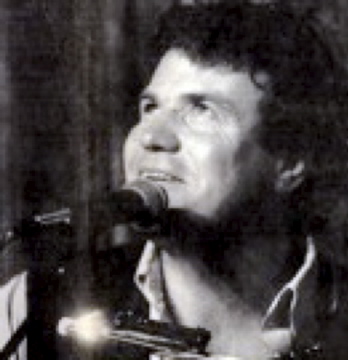
On the Green, in Concord, MA
Every Thursday Night
for over thirty years…
“A Song Singing, Word Slinging, Story Swapping,
Ballad Mongering, Folksinger, Teacher, & Poet…”
Fitz’s Recordings
& Writings
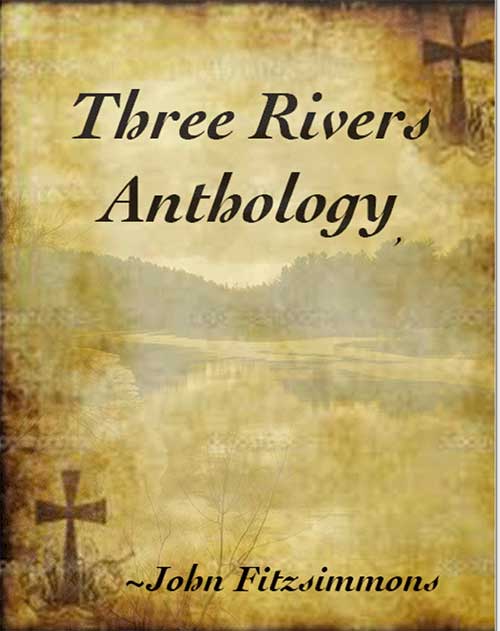
Songs, poems, essays, reflections and ramblings of a folksinger, traveler, teacher, poet and thinker…
Download for free from the iTunes Bookstore
“A Master of Folk…”
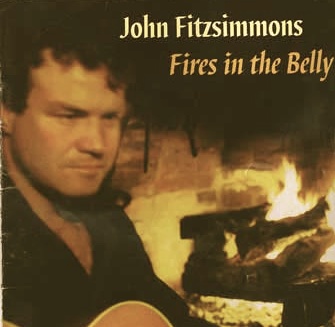
Fitz’s now classic recording of original songs and poetry…
Download from the iTunes Music Store
“A Masterful weaver of song whose deep, resonant voice rivals the best of his genre…”
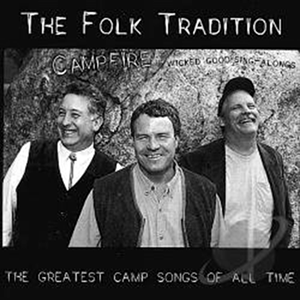
“2003: Best Children’s Music Recording of the Year…”
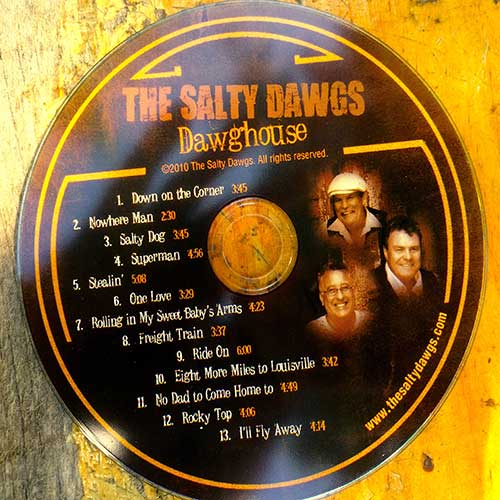
Fitz & The Salty Dawgs
Amazing music, good times and good friends…
TheCraftedWord.org
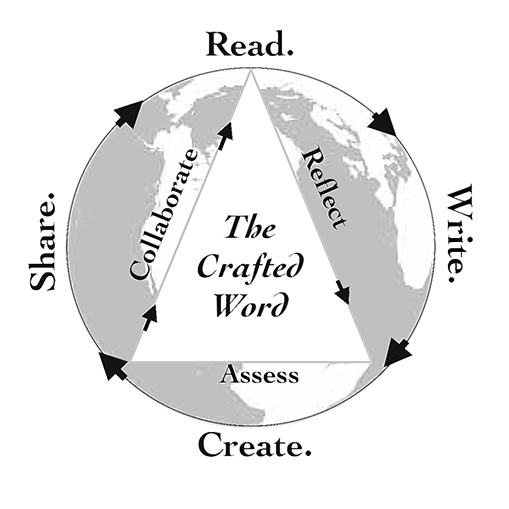
Writing help
when you need it…
“When the eyes rest on the soul…that’s Fitzy…”
0 Comments