Life Outside the Curriculum

“My teachers could have written with Jesse James for all time they stole from us…”

~Richard Brautigan, “Trout Fishing in America”


     My classroom is often a bit of a mess—a mass of sprawled bodies scattered around like casualties of battle, ensconced in various states of slothy repose, on and over the armchairs, couches—and often each other. It may look like sloth, but generally the kids (8th grade and freshman boys) are quietly engaged and productive in whatever dreary task I plied upon them.

Until someone brings up some aspect of school injustice. 

Then it spins and turns into collective rants against the injustices cast by us teachers against them. For the most part, it is myopic and self-serving commentary, but there is always some kernel of truth in the sincerity of their complaints, for, no doubt, we expect a lot of them: we steal their time in all variety of thoughtful ways, artfully designed and full of earnest intent to better them in some way, shape or form and mold them into some configuration of a student who makes us proud to be their educators; hence, we teachers get pissy when things don’t go as artfully as the plan.

Somewhere there is a disconnect. Somehow our expectations are not in line with our students, and they are frustrated. And we are frustrated. Something is wrong with the system.

The truth is that we are Jesse Jameses stealing their time–their most precious and fleeting commodity. To paraphrase Henry David Thoreau, we are “trying to solve the problem with a formula more complicated than the problem itself.” Our schools have become labor camps with an incredible assortment of add-ons: committees they should join, service learning they must do, philanthropy they must engage in, speakers they must hear, and outside projects they must dutifully complete.

And all of it is outside the demands of a rigorous (or so we believe) curriculum— outside the demands of homework, sports, musical performances, outside tutoring, and beyond the expectations, rife with pressure, from family obligations. We celebrate them as individuals while expecting them to be obedient and acquiescent students, and therein lies the crux: we are robbing their last gasps at childhood. There is little time for them to grow like the weeds they are. We raise them and teach them to be crops brought to market and sold to future schools. 

Is this the generation we want to create? Is there another way? A better way? Is there a healthy balance between weed and fruit?

Yes, there is—and to quote Thoreau again: “Simplicity. Simplicity. Simplicity.” Put all things needed in the basket of curriculum. Prune away what is not needed. My students are willing—and they have proved themselves dutiful—to do whatever is asked of them within the curriculum, but they smolder with rancor when they smell the odor of artifice. They intuitively sniff out the good from the bad. If something is worth doing, it is worth being taught within the confines and the expanse of our classes, not as one more obligatory dish to add to the feast of the day, for there is little day left before the night, and the thief of time lurks in the shadows, waiting.

As teachers, we may be willing to sway and even bend, but we seldom break out of our habits; we rarely agree to cut back on what and why we teach, and we rarely admit that less is more, so we teach the hell out of our packs of students and preach that there is still more that must be done; there are more notches to notch on your achievement stick; there are more ways to bolster your fledgling resume, so come early to school; learn to be a philanthropist; stay late and prove that you embrace service; give up your lunch and learn and respect and embrace diversity; skip recess; go to the Makerspace and embrace design thinking; wow your class with up a better presentation—and then go home and do the real work—forty minutes, at least, for each class. After all, we only have you here nine hours out of your day… And the homework is due tomorrow. No excuses. Be sure to do some outside reading, too. Everyone should love reading.

No wonder there is grumbling. No wonder our students feel marginalized. No wonder that the totality of expectations seems—and is—oppressive. No wonder that they cling to the draining minutes and the dwindling vestiges of time to simply be the kids they are. Irrepressible, irreverent, and  incredible…

At the same time, kids need guidance. Kids need structure. They need to see the blueprint being built. Kids need to be held to high standards of conduct. They need to do the work they are asked to do, and they need to figure out what needs figuring without some tutor prodding them out of a state of torpor.

We teachers and administrators need to look at the days we design for our students and create curriculums that work in ways that enlighten without deadening the spirit and clogging the drainpipe of time. We need to accept and acknowledge that we are not the totality of their education. Everything does not need to flow from us. School can and should be a more simple affair. Yes! Demanding moral conduct, based on enlightened and progressive values, is a given, but we should not presume to be the guardians of the totality of their ethical lives. We need to assume that moral values are taught and practiced and embodied by our students’ parents and guardians. It is almost an anathema to say, but we hobble our students with constraints more than we unshackle them from insistent drudgery.

What we teach, what we practice and what we cultivate must grow from a thoughtful, embracing and invigorating curriculum, taught by teachers who give a damn and know what they teach, but above all, who know their students and who appreciate and respect that we—the proverbial we—cannot do it all. And neither can our cast of young scholars, but some things we can do incredibly well, and whatever the bent of genius of an individual teacher, I say, “set them free!” In the long run, those teachers are the life-changers and authors of lasting and effective pedagogy, and it is those teachers who are remembered and revered for giving truth to the lives of their students.

Oh, but that is fun and easy and invigorating to pen to this page. I am, though, a curmudgeon at heart and sense the bad as early as the good. Freedom is a fickle beast, and I have an instinctive aversion to progress for the sake of progress, especially if it strays from teaching enduring and proven basic skills. My school is an incredible school, and it has freed me to follow my chaotic genius, which, for better or worse, reveres the old as likely as the new and, like any teacher, I am convinced that what I teach is what my students should and need to learn. And they learn. Or so I convince myself…

Most of my students are raised by parents who are insistent to raise well-educated children, and they are willing (and sometimes barely able) to pay the price for that education. Their children are coddled and cajoled to be good students and good persons, and, by and large, they meet with uncommon success in their future lives. I can’t help but think, however, that it is a part of a caste system, a subtle tool that benefits the few and that the education is necessarily incomplete. We have an increasingly diverse community in my school, but not real diversity—diversity that mimics the reality of the real world; hence, we embrace diversity as an ideal more than we reflect diversity as a messy mix of reality.

I have seven well-educated children. My four boys had a mixture of elite private schools (because I work at an elite private school) and public schools, whereas my three girls spent all their school lives in a small public school in the small mill town of Maynard—a town that is not the envy of the wealthy surrounding towns of Concord or Sudbury or Acton that squeeze its small borders, yet even as a teacher of some thirty-five years, I would say, “Come to Maynard. Here is true community. Here is unabashed and natural diversity. Here are basic skills taught well, though you might not know it through the flopping of disgruntled tongues. For the most part, here are parents that embrace the reality of small paychecks, multiple jobs and tough daily choices. Kids learn grit because it is a gritty life, not because grit is taught as a value to learn, but because they are allowed to fail as readily as they are encouraged to flourish. Still, the odds are always stacked against our kids. It is tough to say to our children (my children included), “Yes, this school offered you a good scholarship, BUT, we still cannot pay for that school, unless you want to hobble your future with debt that will take years to repay,” So, all of my kids (so far five of them) enrolled in some UMass or another, and, lo and behold, they have some slice of the American dream. Their intellects are yet intact, and the future is still bright, and they truly did it on their own. 

My apologies: I am a wordy and rambling writer. My own students would admonish my lack of a unified theme, my intrusions of personal bias, and no doubt, my lazy adherence to a singular topic, not to mention my lack of rhetorical techniques. 

I actually began this essay as a plea to simplify education, to think outside of the proverbial box, and to find ways to give time back to those restive students who have huge reservoirs of energy, intent and excitement to explore their own potential, their own passions and their own perspectives. I am a traditionalist at heart. I want schools to get back to teaching time-tested skills that lay a lasting foundation that shore up the dreams students can build their futures upon. If I am a radical in any way, it is to thresh the wheat from the chaff and to see with clear eyes the purpose of our pasture. The values and morals we wish to instill should be modeled on the actions and ethos of a vibrant school community and the local community, not as a series of moral scriptures and political dogma inserted into another long day. Schools need to create possibilities, not conformities. Schools need to be launching pads, not factories of conventional thinking. Schools need to trust the wisdom of parents and recognize the parameters of what can and should be accomplished in any given school day. 

Above all, we will not survive as a country unless we give students what they truly need.

A paradox of education is that the more you offer, the less you accomplish. We can’t assume that breadth will ever equal depth. There is no reason that schools should sharpen and hone every tool in the shed, for that labor, spread broadly across the table, brings diminishing returns; instead, choose the most useful tools and focus our pride and effort on mastering what those tools can do—and whatever time is left outside the curriculum should be given back to what most interests our students. 

Let’s figure out ways to help our students become really, really, really good at something. But that also means we need to give them the time and freedom. It means potentially missing out on all the add-ons that fill out an increasing bulk of the day. It might mean they miss the the walk for hunger; it might mean they miss this or that speaker, or the workshop on sustainability, or conflict resolution, or white privilege. 

Or it might mean they lead the walk for hunger, or they are the speaker telling their story of discovering racial inequity. Or it might mean they are part of a movement to unmask white privilege and show us—me—what white privilege really is. Or how we are screwing up the planet. Or how sexuality identity is not a choice.

It might mean they become incredibly good at soccer or archery or chess. It might mean they grow a Youtube Channel with a million hits. It might mean they can rip out every Led Zeppelin riff with blazing speed. It might mean, god forbid, they become world-ranked gamers, fishermen, meme-makers or avatar aficionados.

It will give annoying, over-bearing, hovering (and generally wealthy) parents even more time to mold and morph their offspring into some perfected version of something—some kid with perfect SAT’s, impeccable musical virtuosity, and a portfolio of essays ripe and ready for the admissions process, a history of philanthropy and good deed doing, and athletic prowess in an obscure sport. 

. 

It will, however, be a huge pain in the ass for working class parents who will shudder at the thought of of their feral, unkempt children being furloughed too early from school—freed to roam the streets, freed to smoke legal weed, freed to have sex, freed to snap, chat or pop for even more hours of the day. For these parents, who are often too busy and frazzled to parent, it is critical that their workday more or less mirror the school day—and a teacher, god forbid, needs to work a full day for an honest day’s work. 

So, damn… this is a conundrum. It is great sport for parents to criticize schools and teachers and administrators; nonetheless, it is high treason to question any aspect of how that parent raises his or her child or children, but that trust has to start somewhere; that trust has to be embodied and embraced in some way, shape or form somewhere, and that trust has to begin by giving it to our kids. Some will certainly fail. But they will probably fail anyway. Some will be slow to adapt to opportunity. But that is on them; if they squander opportunities now, they may well learn much from it in the future, and it will guide them in their newly invigorated lives! But some many will soar. They will realize unimagined majesty from their efforts. They will learn about choice, priorities, perseverance and vision. 

They will not become punks. They will not become anarchists. They will not squander the magi’s gift.They will, inevitably, become our future, and we need to give them the reins of that future.

Give them that future now. Blemished, broken and bankrupt as it seems.

The Old Tote Road

The Old Tote Road

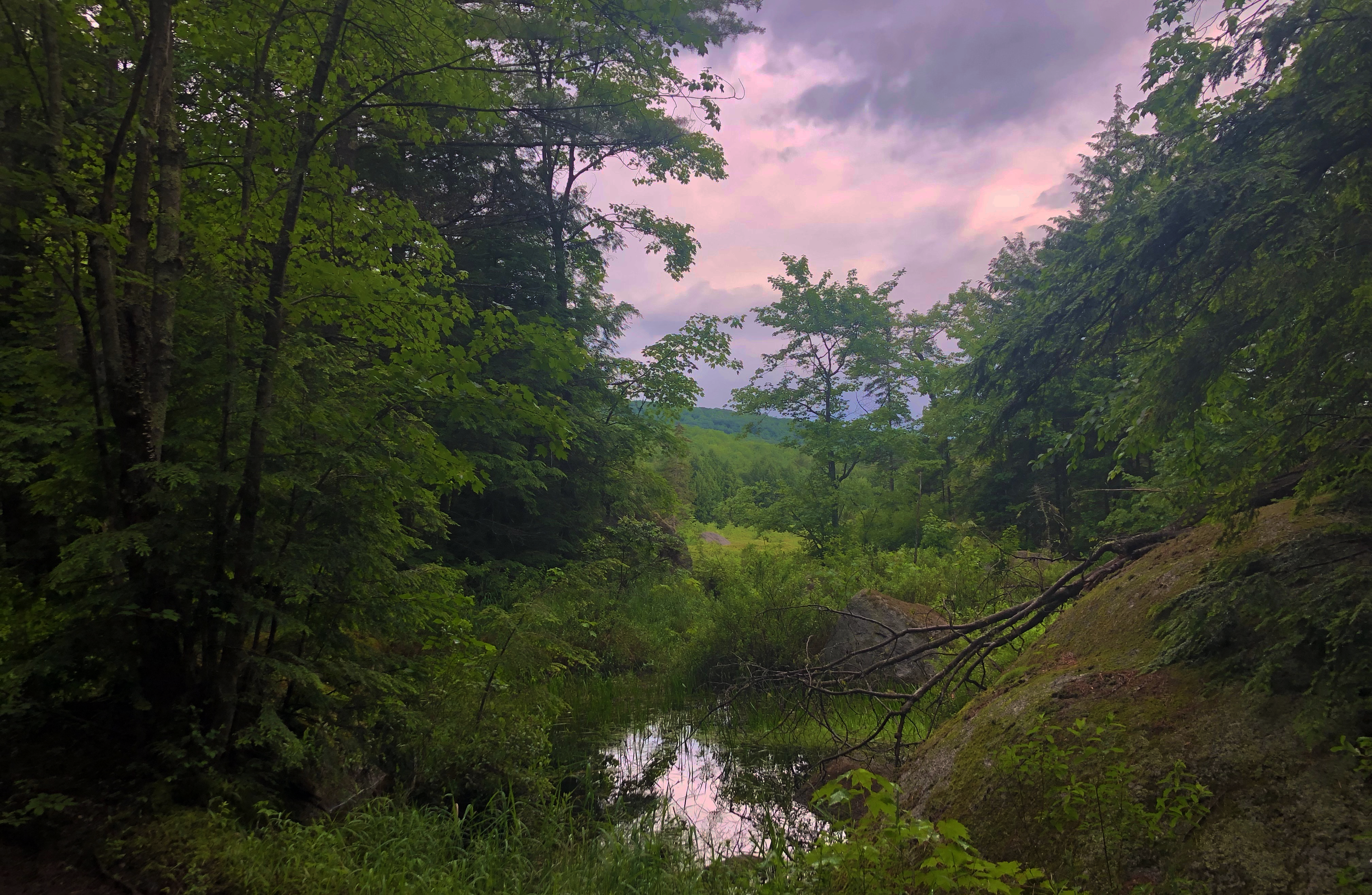
I clabber down the old tote road towards the red pine forest, leaning on my staff, skirting boulder-strewn ruts and small gullies carved out by two days of heavy rain. It is only a mile or so from our cabin, still, my wife makes me wear a pouch with an iPhone and an epi-pen. I once poked a yellow jacket nest with the stub of my staff and had to run like an enraged bear through the mad tangles of this New Hampshire forest. 

I am wiser now.

I don’t know why I am drawn to this daily amble. There is nothing special here: miles of mossy stone walls slowly sinking under the detritus—a hundred years or more of leaf, moss and deadwood, edging what once were fields, overtaken now by massive white pine, ashes weakened by blight, red oaks and sugar maples; The floor is an impenetrable bramble of gnarly bush, ferns and bog. Here and there are old foundations, small and square, meticulously laid, dug into scrabbly hillsides, yet, somehow, hardy, cursing men lived in the rough cabins and spent their days cutting timber, carving fields out of impossible ground, wrestling massive granite stones to set the lines between them.

My epi-pen and phone hang on me like effete sophistry. I do not even recognize what bird is calling whom? Certainly not me—this morning intruder stopping by the great swamp. I scan the shores for moose. I know they are there, along with black bear, bobcats and deer, fisher cats, skunks and raccoons. It is a fool’s errand to think they would reveal what they know or where they lie at daybreak.

They, too, must have their walls.

The deer flies attack me like I am their last supper, but I learned long ago to dress for a summer hike as if it is mid-winter: heavy boots, gloves, denim—a shroud of mosquito mesh covering my head, tucked deliberately into my sweaty breast. They do not bother me, incessant as they are, any more than any other swatch of warm flesh breathing slowly in this still morning air, lingering with low fog.

If not for these flies I would have to share this trail with gobs of humanity bent on an easier hike. They will come in the fall when the weather is cool and mad dashes of color are ripped from the trees and soften this worn trail.

I only once met another hiker—an old woman with a willow basket and an old camp saw. She seemed unnerved to see me clothed in my normality and revealed in a wispish voice: “I am here to find some black birch to make my tea.” I offered her some extra mesh, but, “They do not bother me,” was all she said. A few steps later I looked back, and she was gone. The mystic in me saw some ancient Margaret searching for her illicit lover, Tamlin, in this lonely bower—but she probably just strode away faster than the flies could fly.

I’ve never seen her again.

At a certain point the tote road splits: to the left it cleaves around the massive swamp into which empties innumerable freshets, springs and small brooks, The springs of water that fill Black Pond—black as tea, steeped in a broth of bitter New England leaf.

To the right it arcs into a smaller trail that runs many miles inland into forgotten land. Another small trail wends three more miles to Trout Pond. Every day I remind myself to someday bushwhack that overgrown path, just so I can be one of the few who can say, “I have been there.”

But it is the Red Pine Forest that calls me. The vague entrance marked by a mossy boulder. I duck under arches of young beech, saplings that will never grow old in this forbidden place. The red pines are an odd anomaly, planted in straight lines by some dreamer plotting a handsome fortune In telephone poles—seemingly hundreds of piercingly straight spires interlaced by an equal number of deadened timber, holed by woodpeckers and jays—leaning and hanging, ominous widow-makers ravaged by wind and storms, who died trying. I sneak in as the sun is rising, bending under an arc of beech saplings into the mysterious grove. Like the immigrant red pines, I feel strangely out of place—as if I, too, am not welcome. I am Narcissus staring into his vain pool of water, drawn and entranced by fleeting, corporeal beauty, but unlike the red pines I am not trapped here, stoic to the last.

I watch the streams of light bolt in flashes of geometric entropy scanning the soft needled floor. I feel a murmur of wind and a cackling jay urging me quickly to leave. And so I clabber back home along the old tote road, coddled by deer flies, swarmed by mosquitoes, kindred to the moose and the old Finns of these woods, accepting there are things I may never know.

If you don’t stand, you cower…

     Maybe it is time to be less forgiving. I have rarely agreed with our president, but I held on to the shreds of truth that shore up his arguments: we can’t welcome every immigrant who makes it to our border; we cannot bow to the audacity of corrupt governments in corrupt countries, and we can’t let our democracy morph into a theocracy of liberal dogma.

But his anger seems to have no bounds. His political bravado is predicated on lies, misjudgments and unabashed bigotry. He is, in short, a brooding maniac without bounds. I was once simply embarrassed by him and mortified—yet not afraid—of his megalomania, yet I now doubt he is fit for the office of president. I am late to the game, I know…

I am late to the game because I do believe in the power, progress and ultimate purpose of democracy—to serve and manifest the common will of our country. He was elected because he won. Pure and simple. She didn’t. But he crosses and crisscrosses the moral boundaries imposed upon us and embodied by “our” constitution; and right now, it is not “we the people;” it is an “us against them” revolution—an abnegation of the sacred trust of democracy to lead a diverse coalition of humanity forward to a better tomorrow.

But we are not moving forward. We are fractured schists of angry and myopic ideologies averse to compromise, devoid of any real empathy and impossibly and implacably entrenched in our divisions. He is not solely to blame, but he is the goddamned president whose first and only response is to diminish and denigrate the promise of competing points of view—and, more tellingly, any thoughtful and noble person who calls out his blundering, racist and misogynist bravado.

I am embarrassed by my votive quest to find a quiet and wise response to this maelstrom of inadequacy. I am embarrassed that I have not been chattering like an annoyed grackle whose nest is being torn apart. I am embarrassed for his party whose parochial silence is stunningly devoid of any semblance of originality and  temperate vision, but mostly I am embarrassed to say that I am an American living in an un-American time in an un-American place, yet I still love this country more than I can put into words. I know we are not a lost cause because people are literally pouring across our borders—legally and illegally—to find and feast on some small slice of the American dream. There may be a very few who are very bad, but that is an easy game to play—there are bad men everywhere—and he is one of them.

Our insidious him, our president, sees the sinister in any shade of skin, bent of sexuality, or non-conforming prayer that does not mirror the vanity preening in his mirror. He is a bully on the playground, not a steward of our great and imperfect experiment in freedom. If he was in any school, he would spend the better part of every day in detention.

I am writing this because I can and should have done so sooner, and I realize that my pensive thoughts need to put into action. My rusty belts and levers need to be oiled and put into use. Democracy cannot be a passive amusement. Freedom is not a gift with a pretty bow. It is a messy idea we stand beside and fight for. It is an overwrought garden that can easily overwhelm even the most diligent farmer. I love that I am free to disagree, free to engage and free to change. I love that I can write this and my only burden will be a condemnation of my ignorance and a defanging of my intellect. I will not be thrown in jail. I won’t lose my job. I doubt I will even lose those friends who disagree with me vehemently. I will, however, rise tomorrow and go about my day with a blessed commonness surged with a new and motivating purpose—to make sure he is not our next president but merely a tawdry footnote on a messy page of history.

And I won’t go quiet unto that good night. 

Our country is better than him.
Diesel Lullaby

I’ve been spending a lot of time lately writing sketches of songs—some more complete than others. I have found that it takes time for a song to evolve into its final form, so what I have posted here is more the end of the beginning, not the end. Denise gave me the idea for this song and gave me the first verse to have at it. She has a great way with words and an even greater way at finding enduring themes. I’d welcome any comments or helpful critiques. No worries… I have a pretty thick skin.

Share if you can!

Fenn Speaks…

Fenn Speaks…

I am You, and You are me…

Screen Shot 2019-05-07 at 12.09.07 AMGive a damn & figure it out


     I feel like one of my students: it’s the night before my big presentation at All-school-meeting, and I still don’t know what I am going to talk about. I just know I am supposed to talk about me…

That’s pretty scary for me because, well, I’m me. At any given time I know myself too well, and at other times I’m like, who is this guy? 

I’m the guy whose socks probably don’t match, and one of my socks is on onside out.

I’m the guy whose engine warning light in my van was probably on the whole way to school–and I never noticed.

I’m the guy who forgot to post an assignment on Fenn.org and his students are plotting a revolution and mass protest.

I’m the guy who tries to be a teacher–and so he is…

So, how does one start something like this?

I am John Fitzsimmons, and let me tell you about me…

(No–way to vain and presumptuous)

Hi, I’m Fitz, and I may be old, but I’m slow…
(No–you are not here to hear the truth)


Hi, I am Mr. Fitzsimmons, your new teacher: I just flew in from Chicago and boy my arms are tired…
(Nope… That was funny forty years ago)

Hi… so glad to be here: Last night I went to a fight and a hockey game broke out…

But if you know me, you have heard this all before…

I’m the kid who got grounded if I ever got a B for a grade… Because my mother would think I cheated…

I’m the kid who went to Peabody and Sanborn and CCHS and who warns all you going CCHS next year to wear thick-soled boots to school…so you don’t cut your feet on the broken hearts I left behind.

Not really, because I’m really the shy kid who spent an entire summer after 8th grade trying to find the courage to hold Megan Tassini’s hand–and I never did! 

I’m the kid who spent entire dances lurking in the corner of the Hunt Gym fearing that Stairway to Heaven would start, and a whole night would have gone by–and I wouldn’t have asked a single girl to dance…

I’m the kid whose father spray painted his sister’s figure skates black and told me everyone would think they were hockey skates, and I’d walk home in the dark from Greenes Pond, down Plainfield Road to 38 Longfellow road, still wearing my black figure skates… 

I lived in and on and through Greenes Pond, Whites Pond, Walden Pond, Warners Pond–The Concord River, The Assabet River, The Sudbury River. I was fish and fisherman, sailor and boat, landmark and explorer–all within this beautiful, precious, magnificent  expanse of earth called Concord.

I was an ADD wonder child whose eyes could dart in a thousand directions in a single glance; whose head was built out of dreams; who made sunburned skin a living, breathing whirl and endless dance of motion and adventure…

I was you, and you are me, and our lives are inextricably linked in this adventure called life… We know that nothing gold can stay, so we breath in the best of each day and never let it out.

I was a wrestler and now a wrestling coach. The coach whose only wise words to a wrestler heading out on the mat against a Goliath of a monster–a skinny kid from Fenn facing certain annihilation–and I shrug and say, “do one good thing. Do one good thing and accept defeat with a smile, for you don’t learn anything much from winning, but you learn a lot by trying.”

I was a reluctant, timid student–and now I am a teacher. Go figure… Maybe that’s why I drive my students crazy with answers that are not really answers. I respond to simple questions with things like:

Get through it, get over it. Give a damn and figure it out. It’s your essay not mine. Make it as long as it should be and as short as you can… Give me a pebble and I’ll show you the universe; show me the universe and I’ll give you a pebble… It’s not where you go; it’s how you go… Good writers don’t always make good poets–but good poets always make for great writers…don’t mistake the finger pointing at the moon for the moon itself. 

And that list goes on and on because a good question is better than a good answer.

The question I ask myself each day is “Who am I and what should I try to do?” 

And that is why my life is shaped and formed, sculpted and forged out of the fire of my mind–a fire that is as bright and intense as it was when I was you–you who are probably dreaming and scheming of what is possible as soon as the old guy finishes his presentation and you can go off to recess. 

After 61 years on this planet asking the same question, what then am I?

In short, I am a poet–and everything else are tentacles on the octopus that is my life. So I am also a folksinger, a songwriter, a tinkerer and a maker of meatballs. I’m a father to seven wild and unadorned children, and a husband to a beautiful and forbearing wife. I am everything I ever hoped I could be, and far short of where I still can be. I am you and you are me.

I love teaching, but I equally love the coming summer as much as any of you, for  for summer gives me the time to live in the woods of a rustic summer camp in New Hampshire (and also Camp Sewataro in Sudbury were I first met and sang many of you); to swim, fish, sail and hike; to write in my beloved journal and to sing at campfires with piles of weathered, mosquito-bitten kids bunched like starfish on a beach, singing their heads off–even though, technically, starfish don’t have heads…

And so I will end this presentation of me–the immutable me–with the only gift I that is truly me and has never–as in ever–let me down–Song…