Tom Dooley
Hang down your head, Tom Dooley
Hang down your head and cry
You killed poor Laura Foster
And now you’re bound to die
You took her on the hillside,
As God almighty knows
You took her on the hillside
And there you hid her clothes
You took her by the roadside
Where you begged to be excused
You took her by the roadside
Where there you hid her shoes
You took her on the hillside
To make her be your wife
You took her on the hillside
There you took her life
Hand me down my banjo
I’ll pick hit on my knee
This time tomorrow,
It’ll be no use to me
They had my trial in Wilkesboro
To reckon what I done
They had my trial in Wilkesboro
That’s where I’ll be hung
This time tomorrow
I reckon where I’ll be
Down in some lonesome hollow
Hanging from a white oak tree
Tom Dula was hanged for the murder of Laura Foster
in Wilkes County, NC in 1868


I am indebted to the many friends who share my love of traditional songs and to the many scholars whose works are too many to include here. I am also incredibly grateful to the collector’s curators and collators of Wikipedia, Mudcat.org, MainlyNorfolk.info, and TheContemplator.com for their wise, thorough and informative contributions to the study of folk music.
I share this scholarly research on my site with humility, thanks, and gratitude. Please cite sources accordingly with your own research. If you have any research or sites you would like to share on this site, please post in the comment box.
Thanks!


| "Tom Dooley" | |
|---|---|
| Single by The Kingston Trio | |
| from the album The Kingston Trio | |
| Written | Unknown, Frank Proffitt’s grandfather (possibly) |
| Released | November 19, 1958 |
| Genre | Folk |
| Label | Capitol |
| Songwriters | Alan Lomax, Frank Warner |
| Producer | Voyle Gilmore |
| Audio sample | |
"Tom Dooley" (Roud 4192) is a traditional North Carolina folk song based on the 1866 murder of a woman named Laura Foster in Wilkes County, North Carolina by Tom Dula (whose name in the local dialect was pronounced "Dooley"). One of the more famous murder ballads, a popular hit version recorded in 1958 by The Kingston Trio reached No. 1 on the Billboard Hot 100 singles chart, was in the top 10 on the Billboard R&B chart, and appeared in the Cashbox Country Music Top 20.
The song was selected as one of the American Songs of the Century by the Recording Industry Association of America (RIAA), the National Endowment for the Arts, and Scholastic Inc. Members of the Western Writers of America chose it as one of the Top 100 Western songs of all time.[1]
"Tom Dooley" fits within the wider genre of Appalachian murder ballads. A local poet named Thomas Land wrote a song about the tragedy, titled "Tom Dooley", shortly after Dula was hanged.[2][3] In the documentary Appalachian Journey (1991), folklorist Alan Lomax describes Frank Proffitt as the "original source" for the song, which was misleading in that he did not write it.[4] There are several earlier known recordings, notably one that G. B. Grayson and Henry Whitter made in 1929, approximately 10 years before Proffitt cut his own recording.
The Kingston Trio took their version from Frank Warner's singing. Warner had learned the song from Proffitt, who learned it from his aunt, Nancy Prather, whose parents had known both Laura Foster and Tom Dula.[5] In a 1967 interview, Nick Reynolds of the Kingston Trio recounted first hearing the song from another performer and then being criticized and sued for taking credit for the song.[6] Supported by the testimony of Anne and Frank Warner, Frank Proffitt was eventually acknowledged by the courts as the preserver of the original version of the song, and the Kingston Trio were ordered to pay royalties to him for their uncredited use of it.
History

In 1866, Laura Foster was murdered. Confederate veteran Tom Dula, Foster's lover and the father of her unborn child, was convicted of her murder and hanged May 1, 1868. Foster had been stabbed to death with a large knife, and the brutality of the attack partly accounted for the widespread publicity the murder and subsequent trial received.
Anne Foster Melton, Laura's cousin, had been Dula's lover from the time he was twelve and until he left for the Civil War – even after Anne married an older man named James Melton. When Dula returned, he became a lover again to Anne, then Laura, then their cousin Pauline Foster. Pauline's comments led to the discovery of Laura's body and accusations against both Tom and Anne. Anne was subsequently acquitted in a separate trial, based on Dula's word that she had nothing to do with the killing. Dula's enigmatic statement on the gallows that he had not harmed Foster but still deserved his punishment led to press speculation that Melton was the actual killer and that Dula simply covered for her. (Melton, who had once expressed jealousy of Dula's purported plans to marry Foster, died either in a carting accident or by going insane a few years after the homicide, depending on the version.[citation needed])
Thanks to the efforts of newspapers such as The New York Times and to the fact that former North Carolina governor Zebulon Vance represented Dula pro bono, Dula's murder trial and hanging were given widespread national publicity. A local poet, Thomas C. Land, wrote a song titled "Tom Dooley" about Dula's tragedy soon after the hanging. Combined with the widespread publicity the trial received, Land's song further cemented Dula's place in North Carolina legend.[2][3]
A man named "Grayson", mentioned in the song as pivotal in Dula's downfall, has sometimes been characterized as a romantic rival of Dula's or a vengeful sheriff who captured him and presided over his hanging. Some variant lyrics of the song portray Grayson in that light, and the spoken introduction to the Kingston Trio version[6] did the same. Col. James Grayson was actually a Tennessee politician who had hired Dula on his farm when the young man fled North Carolina under suspicion and was using a false name. Grayson did help North Carolinians capture Dula and was involved in returning him to North Carolina but otherwise played no role in the case.[citation needed]
Dula was tried in Statesville, North Carolina as it was believed he could not get a fair trial in Wilkes County. He was given a new trial on appeal but he was again convicted and hanged on May 1, 1868. On the gallows, Dula reportedly stated, "Gentlemen, do you see this hand? I didn't harm a hair on the girl's head."[7]
Dula's last name was pronounced "Dooley", leading to some confusion in spelling over the years. The pronunciation of a final "a" like "y" (or "ee") is an old feature in Appalachian speech, as in the term "Grand Ole Opry".[citation needed] The confusion was compounded by the fact that Dr. Tom Dooley, an American physician known for international humanitarian work, was at the height of his fame in 1958 when the Kingston Trio version became a major hit.[citation needed]
Recordings
Many renditions of the song have been recorded, most notably:
- In 1929, G. B. Grayson and Henry Whitter made the first recorded version of Land's song by a group well known at the time, for Victor.[8][9][10][11]
- Frank Warner, Elektra, 1952. Warner, a folklorist, unaware of the 1929 recording, in 1940 took down the song from Frank Proffitt and passed it to Alan Lomax who published it in Folk Song: USA.[12]
- On March 30, 1953, the CBS radio series Suspense broadcast a half-hour "Tom Dooley" drama loosely based on the song, which was sung during the program by actor Harry Dean Stanton. While not issued as a commercial recording, transcription discs of the broadcast eventually were digitized and circulated by old time radio collectors.[13][better source needed]
- The Folksay Trio, which featured Erik Darling, Bob Carey and Roger Sprung, issued the first post-1950 version of the song for American Folksay-Ballads and Dances, Vol. 2 on the Stinson label in 1953. Their version was noteworthy for including a pause in the line "Hang down your head Tom...Dooley". The group reformed in 1956 as The Tarriers, featuring Darling, Carey and Alan Arkin, and released another version of "Tom Dooley" for The Tarriers on the Glory label in 1957.[14]
- The Kingston Trio recorded the most popular version of the song in 1958 for Capitol. This recording sold in excess of six million copies, topping the U.S. Billboard Hot 100 chart, and is often credited with starting the "folk music boom" of the late 1950s and 1960s.[6] It only had three verses (and the chorus four times). This recording of the song was inducted into the National Recording Registry of the Library of Congress[15] and honored with a Grammy Hall of Fame Award.[16] The Grammy Foundation named it one of the Songs of the Century.[8]
- Neil Young and Crazy Horse recorded an eight-minute version on their 2012 album Americana, on which they retitled the song to the proper spelling "Tom Dula".
- The French group Les Compagnons de la Chanson recorded a French version titled "Tom Dooley (Fais ta priere)", which reached No. 1 on the Belgian chart and No. 4 on the French chart in 1959.[17][18]
Other artists who have recorded versions of the song include Paul Clayton, Line Renaud, Bing Crosby, Jack Narz, Steve Earle the Grateful Dead, Arthur "Guitar Boogie" Smith, and Doc Watson. Lonnie Donegan also recorded the song in the UK. It spent 14 weeks in the British charts from November 1958, reaching its highest ranking at number 3 for 5 weeks.[citation needed]
References in other songs
- The third and final verse of country music singer Stonewall Jackson's 1958 crossover hit "Waterloo" referenced Tom Dooley with the lyrics, "Now he swings where the little birdie sings, and that's where Tom Dooley met his Waterloo."
- Ella Fitzgerald includes an altered line from the song in a recording of "Rudolph the Red-Nosed Reindeer" on her 1967 album, Ella Wishes You a Swinging Christmas.
Parodies
"Tom Dooley" prompted a number of parodies, either as part of other songs or as entire songs. For example:
- The Smothers Brothers did a version of the song on their 1961 debut album, The Smothers Brothers at the Purple Onion, which referenced the lawsuit against The Kingston Trio by claiming that Dickie Smothers had written it and The Kingston Trio had stolen it.
- The Four Preps used this song and "Worried Man Blues" to make fun of The Kingston Trio in their song "More Money For You and Me".
- The Incredible Bongo Band recorded the song "Hang Down Your Head Tom Dooley, Your Tie's Caught In Your Zipper" (1972).
- The Capitol Steps used this song to make fun of South Dakota Senator Tom Daschle on their 2003 album Between Iraq and a Hard Place.[19]
Charts
| Chart (1958–1959) | Peak position |
|---|---|
| Belgium (Ultratop 50 Flanders)[20] | 1 |
| Belgium (Ultratop 50 Wallonia)[21] | 1 |
| Canada (CHUM)[22] | 1 |
| Netherlands (Single Top 100)[23] Then called the Muziek Parade chart. | 1 |
| Norway (VG-lista)[24] | 1 |
| UK Singles (Official Charts)[25] | 5 |
| US Billboard Hot 100[26] | 1 |
| Italy (FIMI)[27] | 1 |
| US Hot R&B/Hip-Hop Songs (Billboard)[28] Then called the Hot R&B Singles chart. | 9 |
Certifications
| Region | Certification | Certified units/sales |
|---|---|---|
| United States (RIAA)[29] | Gold | 1,000,000^ |
|
^ Shipments figures based on certification alone. | ||
In popular culture
- The Kingston Trio's hit song was the inspiration for the 1959 film The Legend of Tom Dooley, starring Michael Landon as Dooley, and co-starring Richard Rust. A Western set in the immediate aftermath of the Civil War, it was not about traditional Tom Dula legends or the facts of the case, but a fictional treatment tailored to fit the lyrics of the song.
- "Tom Dooley" is the name of a season 5 episode of Ally McBeal, in which John Cage sings a version of the song with his Mexican band.
- The song was parodied in episode No. 702 of Mystery Science Theater 3000. Crow T. Robot, motivated by one actor's resemblance to Thomas Dewey, sang a version beginning "Hang down your head, Tom Dewey."
- In the 1980 film Friday the 13th, the campers in the opening scene start to sing the song. The opening scene is set in 1958, the year the Kingston Trio version of the song debuted.
- Episode 10 of Santo, Sam and Ed's Total Football Podcast is titled "Hang Down Your Head Tom Dula". This naming was in reference to a sample of the song generated by Santo Cilauro whereby he jokingly claimed Tiziano Crudeli had performed a version of Tom Dooley with "The Kingstown Trio". Crudeli's bombastic commentary style on Diretta Stadio afforded him celebrity status in Italy, and audio of Crudeli's pronunciation of various footballers' names was a constant running gag throughout the Total Football Podcast.
- Irish comedian Dave Allen did a sketch in which two cowboys with guitars sit by a hangman's gallows, trying to compose a ballad. They try to think of a name to incorporate into their song, but have no success. Then Tom Dooley walks past, and they sing, "Hand down your head, Tom Dooley" and think that sounds great, so they hang him.
Song books
- Blood, Peter; Patterson, Annie (1992). Rise Up Singing. Amherst, Ma: Sing Out Publications. p. 104. ISBN 978-1-881322-13-9.
- Lomax, Alan; John A., Lomax (1947). Folk Song U.S.A.. Best Loved American Folk Songs (1 ed.). New York: Duell, Sloan and Pearce.
See also
References
- ↑ Western Writers of America (2010). "The Top 100 Western Songs". American Cowboy. Archived from the original on October 19, 2010.
- 1 2 Waltz, Robert B.; Enge, David G. "Murder of Laura Foster, The [Laws F36]". The Ballad Index. Fresno State University. Archived from the original on September 24, 2015. Retrieved August 2, 2015.
- 1 2 Trimble, Marshall (September 25, 2009). "Ask the Marshall: What is the story behind the folk song 'Tom Dooley?'". True West Magazine. Archived from the original on February 17, 2020. Retrieved February 27, 2016.
- ↑ Lomax, Alan (1991). Appalachian Journey (PBS American Patchwork Series ed.). Association for Cultural Equity. Archived from the original on October 2, 2017. Retrieved August 2, 2015.
- ↑ Cohen, Ronald (2002). Rainbow Quest: The Folk Music Revival and American Society, 1940–1970. University Of Massachusetts Press. p. 132. ISBN 978-1-55849-348-3.
- 1 2 3 Gilliland, John (1969). "Show 18 – Blowin' in the Wind: Pop discovers folk music. [Part 1]" (audio). Pop Chronicles. University of North Texas Libraries. Track 5.
- ↑ "Foster, Sir Tom Scott, (1845–18 Sept. 1918)", Who Was Who, Oxford University Press, December 1, 2007, doi:10.1093/ww/9780199540884.013.u196545, retrieved September 25, 2023
- 1 2 Lopresti, Rob (January 17, 2010). "Boy Kills Girl". Tom Dooley. Criminal Brief. Retrieved February 21, 2010.
- ↑ John Lomax; Alan Lomax, eds. (1947). Folk Song USA. Duell, Sloan and Pearce. ISBN 978-0452253070.
{{cite book}}: ISBN / Date incompatibility (help) - ↑ "G.B. Grayson and Henry Whitter". Our Musical Heritage– Biographies. Bristol, Tn: Birthplace of Country Music Alliance. September 30, 2007. Archived from the original on June 3, 2011.
- ↑ "Grayson & Whitter". Artist Biography. CMT. October 18, 2009. Archived from the original on September 25, 2008. Retrieved February 23, 2010.
- ↑ O'Donnell, Lisa (December 8, 2018). "A Bond of Song: Two men, one from New York and the other from the mountains of North Carolina, formed an enduring friendship that brought the ballad of Tom Dooley out of the hollers and onto mainstream radio". Winston-Salem Journal. Winston-Salem, NC. Retrieved November 29, 2020.
- ↑ "Oldtime Songs as Oldtime Radio Drama" http://boblog.blogspot.com/2017/02/oldtime-songs-as-radio-drama.html
- ↑ Curry, Peter J. "Tom Dooley: The Ballad That Started The Folk Boom". The Kingston Trio Place.
- ↑ "The Full National Recording Registry". The Library of Congress. Retrieved May 2, 2010.
- ↑ "Grammy Hall of Fame Award: Past Recipients". The Recording Academy/Grammy.com. Archived from the original on December 24, 2010. Retrieved May 2, 2010.
- ↑ "Les Compagnons De La Chanson – Tom Dooley (fais ta prière)". Ultratop.
- ↑ "Les Compagnons de la chanson". infordisc. Select "Les Compagnons de la chanson" from list
- ↑ "Capitol Steps rolling along". Chicago Tribune. January 16, 2004. Archived from the original on February 10, 2020. Retrieved February 9, 2020.
- ↑ "The Kingston Trio – Tom Dooley" (in Dutch). Ultratop 50. Retrieved May 28, 2024.
- ↑ "The Kingston Trio – Tom Dooley" (in French). Ultratop 50. Retrieved May 28, 2024.
- ↑ "CHUM Hit Parade - November 3, 1958".
- ↑ "The Kingston Trio – Tom Dooley" (in Dutch). Single Top 100. Retrieved May 28, 2024.
- ↑ "The Kingston Trio – Tom Dooley". VG-lista. Retrieved May 28, 2024.
- ↑ "Kingston Trio Songs and Albums | Full Official Chart History". Official Charts Company. Retrieved May 28, 2024.
- ↑ "The Kingston Trio Chart History (Hot 100)". Billboard. Retrieved May 28, 2024.
- ↑ "The Kingston Trio – Tom Dooley". Top Digital Download. Retrieved 1959.
- ↑ "The Kingston Trio Chart History (Hot R&B/Hip-Hop Songs)". Billboard. Retrieved May 28, 2024.
- ↑ "American single certifications – Kingston Trio – Tom Dooley". Recording Industry Association of America. Retrieved July 1, 2024.
- ↑ "Rectify Season 2 Music Round-up". Sundance TV. August 27, 2015. Archived from the original on December 1, 2017. Retrieved November 22, 2017.


Source: Mainly Norfolk
Saturday, January 23, 2010
Hang Down Your Head Tom Dula
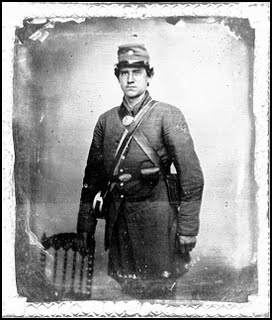 |
| Confederate Soldier |
Location: Elkville, NC
Victim: Laura Foster
Cause of Death: Stabbing
Accused: Tom Dula
Recording:
“Tom Dooley” – The Kingston Trio
Synopsis:
In the traditional story, Laura Foster was a beautiful young girl with blue eyes and chestnut hair who was being courted by Bob Cummings (some say Bob Grayson) a Yankee schoolteacher. When Laura met Tom Dula, a tall handsome Confederate soldier returning from the war she instantly fell in love. Ann Melton also fell in love with Tom Dula. She was a wealthy, married woman who was even more beautiful than Laura. Ann Melton stabbed Laura Foster to death out of jealousy and Tom Dula was blamed. Dula was hunted relentlessly with Cummings in the lead. He was captured and brought to trial. A witness who could have provided an alibi for Dula was paid by Cummings not to testify. Tom Dula was found guilty and sentenced to hang. Before his execution he confessed to the murder and exonerated Ann Melton. Years later when Ann Melton died people heard the sizzling of cooking meat and saw a black cat climb the wall as the devil came to take her to hell.

That’s the storyteller’s version, but newspapers and the transcripts of Tom Dula’s trials tell a different tale.
The section of North Carolina known as Happy Valley was marked by sharp class distinctions in the 1860’s. The town of Elkville and the fertile lands along the Yadkin River were home to merchants and gentleman farmers. But in the ridges of the mountains a lower class of people lived in squalid cabins on subsistence farms. In an 1868 article, the New York Herald described conditions there:
“A state of immorality unexemplified in the history of any country exists among these people, and such a general system of freeloveism prevails that it is ‘a wise child that knows its father.’”
Tom Dula was born and raised in these mountains and became sexually active at a tender age. Ann Foster married James Melton, a successful cobbler, when she was 14 or 15. Almost immediately she began an affair with Tom Dula who was about the same age as she was. At age 17 Tom joined the 42nd Regiment North Carolina Infantry (not 26th Regiment as is sometimes reported) and fought for the Confederacy in the Civil War. When he returned from the war he picked up his relationship with Ann Melton where it had left off. James Melton, who no longer slept with his wife, didn’t seem to mind when Tom shared his wife’s bed in their one-room cabin.
There were three beds in the Melton cabin. The third was occupied by Pauline Foster, a distant cousin of Ann’s who was hired to do house and farm work. Tom would sometimes share her bed as well, and sometimes Ann, Pauline, Tom would all sleep together. Unbeknownst to Tom and the Meltons, Pauline Foster had come to Elkville seeking treatment for syphilis.
In March of 1866, when Tom Dula was 21, he began to visit Laura Foster, another cousin of Ann Melton, about the same age, who lived with her father Wilson Foster. Laura was described by the newspaper as “frail but beautiful.” She had large front teeth with a large gap between them. Laura had been with many men, but there is no record of a Bob Cummings or a schoolteacher of any name courting her.
Tom Dula frequently spent the night with Laura in her father’s house and, though Wilson Foster was well aware of this, it didn’t seem to bother him. Not long after he started seeing Laura, Tom went to Dr. George N. Carter in Elkville and was diagnosed with syphilis. Tom blamed the disease on Laura Foster and told a friend that he intended to “put through” the woman who gave it to him.
The date of Laura Foster’s disappearance is uncertain – three separate trials recorded three different dates – but from trial testimony, it can be deduced that the date was Friday, May 25, 1866. When Wilson Foster woke up that morning his daughter was gone and so was the mare he kept tied to a tree. The following day the mare returned to Foster’s cabin alone. It was assumed that Laura had died and men in the community spent weeks looking for her body. On June 24, in a spot in the woods near Tom Dula’s place, they found the rope used to tie the mare to a tree and a spot on the ground presumed to be blood.
As Rumors began to spread that Tom Dula had killed Laura Foster, Tom left for Tennessee. Around the same time Pauline Foster also went to Tennessee for some undisclosed reason. When she returned, a friend said she must have gone because she killed Laura Foster. Jokingly Pauline replied “Yes, I and Dula killed her, and I ran away to Tennessee.” Two or three weeks after the remark, Pauline was arrested as an accessory to murder and taken to Wilkesboro Jail. Pauline decided to tell all she knew. She said that Tom Dula and Ann Melton had killed Laura Foster and on September 1 she led a search party to a spot Ann Melton had pointed out as the place they buried Laura. At the spot, one of the horses snorted at a foul order coming out of the ground. The men dug there and found a woman’s body, badly decomposed but identified as Laura Foster by the dress she wore and the gap in her teeth. She had been stabbed through the ribs under the left breast.

In Tennessee, Tom Dula had already been captured. He had changed his name to Hall and was working as a farm hand for Col. James Grayson when deputies from Wilkes County, NC came to arrest him. Dula had left Grayson’s farm by the time deputies arrived. After hearing the story, Col. Grayson joined the deputies in the search for Tom Dula. They caught up with him in Pandora, Tennessee and Col. Grayson persuaded him to surrender. He spent the night under guard at Grayson’s farm before being taken back to Elkville.
2. January 20, 1868
 In a move that surprised everyone involved, Tom Dula’s defense was handled, pro bono, by Zebulon B. Vance, former Governor of North Carolina and Colonel of the 26th North Carolina Regiment who fought valiantly for the Confederacy. Tom Dula is often incorrectly identified as a member of the 26th Regimentan – attempt to explain why Governor Vance took the case.
The trial opened in Wilkesboro, NC on October 1, 1866. The defense requested a severance – that Tom Dula and Ann Melton be tried separately- and a change of venue. Both were granted and the trial was moved to Statesville, NC.
The case against Tom Dula was circumstantial but compelling. All of the dirty laundry was aired, the promiscuity, the syphilis, and the threats made by Tom against Laura Foster. While there were many witnesses who testified on each of these aspects, the most damaging testimony came from Pauline Foster who held nothing back.
Tom Dula was found guilty of murder but the verdict was thrown out on appeal due to some irregularities in the admission of testimony.
The second trial was delayed twice as each side was granted a continuance when witnesses did not appear. To end the delay, a special court of Oyer and Terminer was convened in Statesville on January 20, 1868. Once again Tom Dula was found guilty of murder. This verdict was appealed as well, but the appeal was declined. Dula was sentenced to death.
2. Guilty of murder
Aftermath:
On May 1, 1868 Tom Dula was taken to the old depot in Statesville to a makeshift gallows with a cart as scaffold. According to the New York Herald he spoke for nearly an hour about his childhood, about politics, and about all the people who had perjured themselves at his trials. He did not confess to the crime or exonerate Ann Melton. Allegedly his last words were, “You have such a nice clean rope, I ought to have washed my neck.”
In on November 22, 1958, the Kingston Trio’s recording of “Tom Dooley” reached #1 on the Billboard charts.
On January 9, 2009, his last day in office, Gov. Mike Easley of North Carolina received a request from the Wilkes County newspaper, The Record, and the Wilkes Playmakers, to pardon Tom Dula. The request was denied. The group claimed that Laura Foster was pregnant when she died and Tom Dula was planning to marry her. A good storyteller never lets the facts get in the way.
 |
This is one of 50 stories featured in the new book The Bloody Century |
 . New York: Parkway, 2002.
 . New York: University of North Carolina, 1980.
Source: Traditional Songfacts
-
“The Unquiet Grave” is both a poem and a song. Intensely sad, and written in the first person singular, the mourner laments the love of his life sitting weeping at her graveside for a year and a day, at which point her ghost rises up and asks who will not allow her to sleep. He identifies himself and asks for “one kiss of your clay-cold lips”. She disavows him of that notion, and tells him to put his grief behind him and enjoy the rest of his life “Till God calls you away”.
-
Like most traditional songs there are many variations, of the title as well as the lyrics in this case. Extensive research on its origin and development can be found in Volume II of The Traditional Tunes Of The Child Ballads With Their Texts, according to the Extant Records of Great Britain and America, by Bertrand Harris Bronson, which was published by Princeton University Press in 1962. According to this book, none of the extant texts of the ballad is older than the early 19th Century but it probably dates from about the end of the 15th. A version was recorded by [ie sung to] musicologist Cecil Sharp on January 23, 1907 by Mrs Ware of Eley Over Stowey. The same day, Sharp recorded “Cold Blows The Wind” by James Chedgey of Bincombe Over Stowey. Sabine Baring-Gould (who is best known for writing the lyrics to “Onward Christian Soldiers”) collected a version, from J. Woodrich, a blacksmith of Wollacot Moor, Thrushleton, in 1889. Probably the earliest recorded version is “Cold Blows The Wind” which was sung by Elizabeth Doidge, a nurse of Brentnor, and collected by Mrs Gibbons, the daughter of W.L.Trelawney, Bart, c1830. This version had the tune usually associated with “Childe The Hunter”.There is also “How Cold The Winds Do Blow”, sung by Mrs Rugman of Dunsfold, Surrey, 1896; “Cold Blows The Wind To-night, Sweetheart”, sung by Mrs Bowker, of Sunderland Point, Lancashire, in September 1909, and further afield, “The Auld Song From Cow Head” sung by the Reverend Mr Gibbs Bull of Newfoundland in 1929.
-
Another musicologist who researched “The Unquiet Grave” in some depth was the aforementioned Cecil Sharp. Volume I of the 1994 Oxford University Press edition of his …Collection Of English Folk Songs, Edited by Maud Karpeles records no less than seventeen different versions, the oldest of which was sung to him by Mrs Ree at Hambridge, Somerset, on April 4, 1904.
-
“The Unquiet Grave” has been recorded by many artists, including Joan Baez and Karen Mall (suitably amended for gender) and by Luke Kelly. >>
Performances, Workshops, Resources & Recordings
The American Folk Experience is dedicated to collecting and curating the most enduring songs from our musical heritage. Every performance and workshop is a celebration and exploration of the timeless songs and stories that have shaped and formed the musical history of America. John Fitzsimmons has been singing and performing these gems of the past for the past forty years, and he brings a folksy warmth, humor and massive repertoire of songs to any occasion.
Festivals & Celebrations Coffeehouses School Assemblies Library Presentations Songwriting Workshops Artist in Residence House Concerts Pub Singing Irish & Celtic Performances Poetry Readings Campfires Music Lessons Senior Centers Voiceovers & Recording
““Beneath the friendly charisma is the heart of a purist gently leading us from the songs of our lives to the timeless traditional songs he knows so well…”
Join Fitz at The Colonial Inn
“The Nobel Laureate of New England Pub Music…”
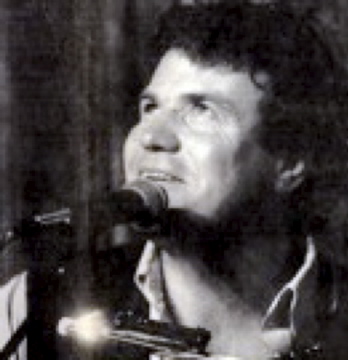
On the Green, in Concord, MA Every Thursday Night for over thirty years…
“A Song Singing, Word Slinging, Story Swapping, Ballad Mongering, Folksinger, Teacher, & Poet…”
Fitz’s Recordings
& Writings

Songs, poems, essays, reflections and ramblings of a folksinger, traveler, teacher, poet and thinker…
Download for free from the iTunes Bookstore
“A Master of Folk…”
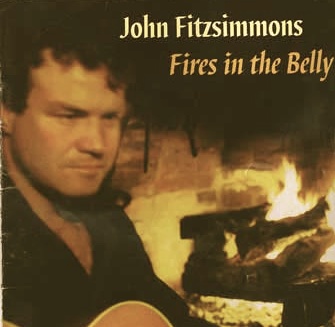
Fitz’s now classic recording of original songs and poetry…
Download from the iTunes Music Store
“A Masterful weaver of song whose deep, resonant voice rivals the best of his genre…”
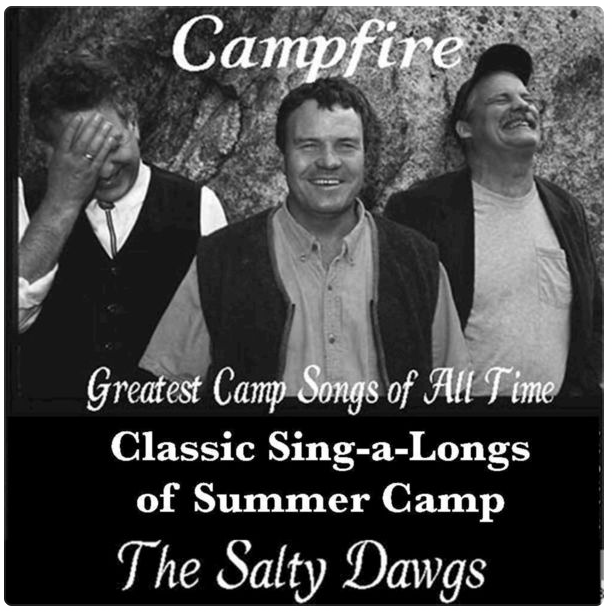
“2003: Best Children’s Music Recording of the Year…”
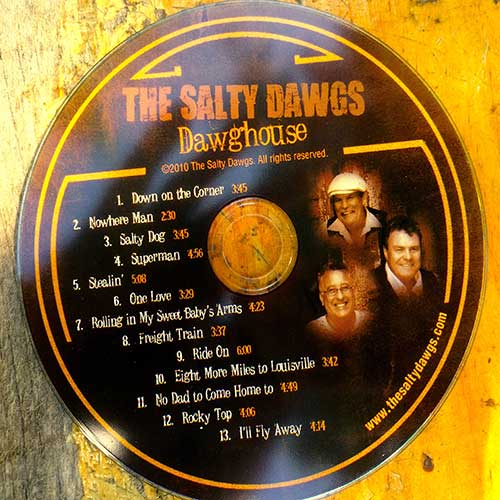
Fitz & The Salty Dawgs Amazing music, good times and good friends…
TheCraftedWord.org

Writing help
when you need it…
“When the eyes rest on the soul…that’s Fitzy…”

0 Comments