
John Henry
John Henry was a li’l baby, uh-huh,
Sittin’ on his mama’s knee, oh, yeah,
Said: “De Big Bend Tunnel on de C & O road
Gonna cause de death of me,
Lawd, Lawd. Gonna cause de death of me.
John Henry, he had a woman,
Her name was Mary Magdalene,
She would go to de tunnel and sing for John,
Jes’ to hear John Henry’s hammer ring, Lawd, Lawd,
Jes’ to hear John Henry’s hammer ring.
John Henry had a li’l woman,
Her name was Lucy Ann,
John Henry took sick an’ had to go to bed,
Lucy Ann drove steel like a man,
Lawd, Lawd, Lucy Ann drove steel like a man.
Cap’n says to John Henry,
Gonna bring me a steam drill ’round,
Gonna take dat steam drill out on de job,
Gonna whop dat steel on down, Lawd, Lawd,
Gonna whop dat steel on down.
John Henry tol’ his cap’n,
Lightnin’ was in his eye;
Cap’n, bet yo’ las’ red cent on me,
Fo’ I’ll beat it to de bottom or I’ll die, Lawd, Lawd,
I’ll beat it to de bottom or I’ll die.”
Sun shine hot an’ burnin’,
Wer’n’t no breeze a-tall,
Sweat ran down like water down a hill,
Dat day John Henry let his hammer fall,
Lawd, Lawd, dat day John Henry let his hammer fall.
John Henry went to de tunnel,
An’ dey put him in de lead to drive,
De rock so tall an’ John Henry so small,
Dat he lied down his hammer an’ he cried,
Lawd, Lawd, dat he lied down his hammer an’ he cried.
John Henry started out on de right hand,
De steam drill started on de lef’—
“Before I ‘d let dis steam drill beat me down,
I’d hammer my fool self to death,
Lawd, Lawd, I’d hammer my fool self to death.”
White man tol’ John Henry,
“Nigger, damn yo’ soul,
You might beat dis steam an’ dr;ll of mine,
When de rocks in dis mountain turn to gol’,
Lawd, Lawd, when de rocks in dis mountain turn to gol`.
John Henry said to his shaker,
“Nigger, why don’ you sing?
I’m throwin’ twelve poun’s from my hips on down,
Jes’ listen to de col’ steel ring,
Lawd, Lawd, Jes’ listen to de col’ steel ring.”
Oh, de captain said to John Henry,
“I b’lieve this mountain’s sinkin’ in,
John Henry said to his captain, oh my!
“Ain’ nothin’ but my hammer suckin’ win’,
Lawd, Lawd, ain’ nothln’ but my hammer suckin’ win.”
John Henry tol’ his shaker,
Shaker, you better pray,
For if I miss dis six-foot steel,
Tomorrow’ll be yo’ buryin’ day,
Lawd, Lawd, tomorrow’ll be yo’ buryin’ day.”
John Henry tol’ his captain,
“Looka yonder what l see —
Yo’ drill’s done broke an’ yo’ hole’s done choke,
An’ you cain’ drive steel like me,
Lawd, Lawd, an’ you cain’ drive steel like me.”
De man dat invented de steam drill,
Thought he was mighty fine.
John Henry drove his fifteen feet,
An’ de steam drill only made nine,
Lawd, Lawd, an’ de steam drill only made nine.
De hammer dat John Henry swung’,
It weighed over nine pound ;
He broke a rib in his lef’-han’ side,
An’ his intrels fell on de groun’,
Lawd, Lawd, an’ his intrels fell on de groun’.
John Henry was hammerin’ on de mountain,
An’ his hammer was strikin’ fire,
He drove so hard till he broke his pore heart,
An’ he lied down his hammer an’ he died,
Lawd, Lawd, he lied down his hammer an’ he died.
All de womens in de wes’,
When dey heared of John Henry’s death,
Stood in de rain, flagged de eas’-boun’ train,
Goin’ where John Henry fell dead,
Lawd, Lawd, goin’ where John Henry fell dead.
John Henry’s lil mother,
She was all dressed in red,
She jumped in bed, covered up her head,
Said she didn’ know her son was dead,
Lawd, Lawd, didn’ know her son was dead.
John Henry had a pretty lil woman,
An’ de dress she wo’ was blue,
An’ de las’ wards she said to him:
“John Henry, I’ve been true to you,
Lawd, Lawd, John Henry I’ve been true to you.”
“Oh, who’s gonna shoe yo’ lil feetses,
An’ who’s gonna glub yo’ han’s,
An’ who`g gonna kiss yo’ rosy, rosy lips,
An’ who’s gonna be yo’ man,
Lawd, Lawd, an’ who’s gonna be yo’ man?”
Dey took John Henry to de graveyard,
An’ dey buried him in de san’,
An’ every locomotive come roarin’ by,
Says, “Dere lays a steel-drivin’ man,
Lawd, Lawd, dere lays a steel-drivin’ man.”
From American Ballads and Folk Songs, Lomax


I am indebted to the many friends who share my love of traditional songs and to the many scholars whose works are too many to include here. I am also incredibly grateful to the collector’s curators and collators of Wikipedia, Mudcat.org, MainlyNorfolk.info, and TheContemplator.com for their wise, thorough and informative contributions to the study of folk music.
I share this scholarly research on my site with humility, thanks, and gratitude. Please cite sources accordingly with your own research. If you have any research or sites you would like to share on this site, please post in the comment box.
Thanks!


John Henry | |
|---|---|
_01.jpg) John Henry illustration by Roy E. LaGrone (1942) | |
| Born | 1840s or 1850s |
| Occupation | Railroad worker |
| Known for | American folk hero |
John Henry is an American folk hero. A black American freedman, he is said to have worked as a "steel-driving man"—a man tasked with hammering a steel drill (such as a star drill or similar) into a rock to make holes for explosives to blast the rock in constructing a railroad tunnel.
The story of John Henry is told in a classic blues folk song about his duel against a drilling machine, which exists in many versions, and has been the subject of numerous stories, plays, books, and novels.[1][2]
Legend

According to legend, John Henry's prowess as a steel driver was measured in a race against a steam-powered rock drill, a race that he won only to die in victory with a hammer in hand as his heart gave out from stress. Various locations, including Big Bend Tunnel in West Virginia,[3] Lewis Tunnel in Virginia, and Coosa Mountain Tunnel in Alabama, have been suggested as the site of the contest.
A real hammerman would have needed to work in tandem with a shaker, who would hold a chisel-like drill against mountain rock, wiggling and rotating the drill to optimize its bite. However, John Henry's shaker is seldom if ever mentioned in the tale. As a result, some retellings recast John Henry as a railroad worker driving spikes into railway tracks, and his mechanical opponent as a primitive rail fastening system.[citation needed]
History
The historical accuracy of many of the aspects of the John Henry legend are subject to debate.[1][2] According to researcher Scott Reynolds Nelson, the actual John Henry was born in 1848 in New Jersey and died of silicosis, a complication of his workplace, rather than from exhaustion.[4]
Several locations have been put forth for the tunnel on which John Henry died.
Big Bend Tunnel

Sociologist Guy Benton Johnson investigated the legend of John Henry in the late 1920s. He concluded that John Henry might have worked on the Chesapeake and Ohio Railway's (C&O Railway) Big Bend Tunnel but that "one can make out a case either for or against" it.[5][3] The tunnel was built near Talcott, West Virginia, from 1870 to 1872 (according to Johnson's dating), and named for the big bend in the Greenbrier River nearby.
Some versions of the song refer to the location of John Henry's death as "The Big Bend Tunnel on the C. & O."[3] In 1927, Johnson visited the area and found one man who said he had seen it.
Lewis Tunnel

In the 2006 book Steel Drivin' Man: John Henry, the Untold Story of an American Legend, historian Scott Reynolds Nelson detailed his discovering documentation of a 19-year-old African-American man alternately referred to as John Henry, John W. Henry, or John William Henry in previously unexplored prison records of the Virginia Penitentiary. At the time, penitentiary inmates were hired out as laborers to various contractors, and this John Henry was noted as having headed the first group of prisoners to be assigned tunnel work. Nelson also discovered the C&O's tunneling records, which the company believed had been destroyed by fire. Henry, like many African Americans, might have come to Virginia to work on the clean-up of the battlefields after the American Civil War. Arrested and tried for burglary, John Henry was in the first group of convicts released by the warden to work as leased labor on the C&O Railway.[8]: 39
According to Nelson, objectionable conditions at the Virginia prison led the warden to believe that the prisoners, many of whom had been arrested on trivial charges, would be better clothed and fed if they were released as laborers to private contractors (he subsequently changed his mind about this and became an opponent of the convict labor system). In the C&O's tunneling records, Nelson found no evidence of a steam drill used in Big Bend Tunnel.[4]
The records Nelson found indicate that the contest took place 40 miles (64 km) away at the Lewis Tunnel, between Talcott and Millboro, Virginia, where prisoners did indeed work beside steam drills night and day.[9] Nelson also argues that the verses of the ballad about John Henry being buried near "the white house," "in the sand," somewhere that locomotives roar, mean that Henry's body was buried in a ditch behind the so-called white house of the Virginia State Penitentiary, which photos from that time indicate was painted white, and where numerous unmarked graves have been found.[10]
Prison records for John William Henry stopped in 1873, suggesting that he was kept on the record books until it was clear that he was not coming back and had died. Nelson stresses that John Henry would have been representative of the many hundreds of convict laborers who were killed in unknown circumstances tunneling through the mountains or who died shortly afterwards of silicosis from dust created by the drills and blasting.
In popular culture
The tale of John Henry has been used as a symbol in many cultural movements, including labor movements[11] and the Civil Rights Movement.[12] Philosopher Jeanette Bicknell said of the John Henry legend:
John Henry is a symbol of physical strength and endurance, of exploited labor, of the dignity of a human being against the degradations of the machine age, and of racial pride and solidarity. During World War II his image was used in U.S. government propaganda as a symbol of social tolerance and diversity.[13]
Film
- In 1995, John Henry was portrayed in the movie Tall Tale by Roger Aaron Brown. A former slave, John Henry appears to a runaway farmer's son named Daniel to both protect him from ruffians (alongside fellow folk hero figures Daniel's father told his son about, Pecos Bill and Paul Bunyan) and impart life lesson wisdom to him.
- In 2020, Terry Crews played a modern-day adaptation of the character in John Henry. The plot centers around a former gang member who takes in two young teens who are on the run from the leader of his past. The film was released by Saban Films.[14]
Animation
- In 1946, animator George Pal adapted the tale of John Henry into a short film titled John Henry and the Inky-Poo as part of his theatrical stop-motion Puppetoons series. The short is considered a milestone in American cinema as one of the first films to have a positive view of African-American folklore.[15][16]
- In 1974, Nick Bosustow and David Adams co-produced an 11-minute animated short, The Legend of John Henry, for Paramount Pictures.[17]
- The character appears in a Walt Disney Feature Animation short film, John Henry (2000). Directed by Mark Henn, plans for theatrical releases in 2000 and 2001 fell through after the short had a limited Academy Award qualifying run in Los Angeles;[18] a shorter version was released as the only new entry in the direct-to-video release Disney's American Legends (2002). It was eventually released in its original format as an interstitial on the Disney Channel, and later as part of the home video compilation Walt Disney Animation Studios Short Films Collection in 2015.
- In 2001, Russian animator Andrey Zolotukhin directed a 13-minute animated short, John Henry, Steel Driving Man, for HBO. The short became a part of animated series Animated Tales of the World, which received a Primetime Emmy Award for Outstanding Individual Achievement in Animation.[19]
Television
- The Grim Adventures of Billy & Mandy Season 6 episode "Short Tall Tales" shows a parody of John Henry's tale with Irwin in the role. Grim decides to sabotage the story by powering up the drilling machine to go faster, and Irwin forces himself to hammer through the mountain faster to surpass it, but by doing so he ends up breaking into the 8th dimension, where aliens feed him to one of their giant monstrous females.
- A plot similar to the story of John Henry is featured in season 5 episode 88b of SpongeBob SquarePants, in which Squidward debuts a "patty gadget" in the hopes of replacing SpongeBob's role in the restaurant, leading to a duel of skill between the two. Like many traditional tellings of the story, the episode is presented as a narrated, rhyming ballad.
- John Henry is featured in the 22nd episode of Season 5 of Teen Titans Go!, "Tall Titan Tales".
- John Henry appears in the Pinky and the Brain episode "A Legendary Tail".
- Henry was the center of an episode of the Nickelodeon game show Legends of the Hidden Temple. The objective on the show saw contestants learn of the legend of John Henry, compete in challenges based on his story, and the winning team attempt to retrieve his hammer from the show's Temple.
- The AI character of John Henry (Garret Dillahunt), from season 2 of Terminator: The Sarah Connor Chronicles, is named after the folk hero for managing to beat a machine that replaces the work of man - paralleling the central conflict of the show and the franchise of fighting against an artificial superintelligence that nearly causes the extinction of the human race in the future through nuclear attacks and Terminators.
- John Henry appears in a segment of the short-lived Bill & Ted's Excellent Adventures TV series. In an episode titled "Pocket Watch Full of Miracles", which aired in November 1990, John Henry is portrayed as having the mannerisms of Muhammad Ali. He challenges and beats a steam-powered hammer driven by his boss. His prize is an antique pocket watch owned by Queen Victoria. The watch is given to the titular Bill and Ted, only to be immediately destroyed by a runaway train.
- Danny Glover played the character in the series, Shelley Duvall's Tall Tales & Legends from 1985 to 1987. Shelley Duvall served as the series' creator, presenter, narrator, and executive producer.
- On the Adult Swim series, Saul of the Mole Men, John Henry (voiced by Tommy "Tiny" Lister) has been living at the centre of the Earth since his victory over the steam drill, having become a cyborg at sometime in the intervening centuries. He befriends and later sacrifices himself to save protagonist Saul Malone.[20]
Radio
Destination Freedom, a 1950s American old time radio series written by Richard Durham, featured John Henry in a July 1949 episode.[21]
Music
.jpg)
The story of John Henry is traditionally told through two types of songs: ballads, commonly called "The Ballad of John Henry", and "hammer songs" (a type of work song), each with wide-ranging and varying lyrics.[2][22] Some songs, and some early folk historian research, conflate the songs about John Henry with those of John Hardy, a West Virginian outlaw.[22] Ballads about John Henry's life typically contain four major components: a premonition by John Henry as a child that steel-driving would lead to his death, the lead-up to and the results of the legendary race against the steam hammer, Henry's death and burial, and the reaction of his wife.[22]
The well-known narrative ballad of "John Henry" is usually sung in an upbeat tempo. Hammer songs associated with the "John Henry" ballad, however, are not. Sung more slowly and deliberately, often with a pulsating beat suggestive of swinging the hammer, these songs usually contain the lines "This old hammer killed John Henry / but it won't kill me." Nelson explains that:
... workers managed their labor by setting a "stint," or pace, for it. Men who violated the stint were shunned ... Here was a song that told you what happened to men who worked too fast: they died ugly deaths; their entrails fell on the ground. You sang the song slowly, you worked slowly, you guarded your life, or you died.[8]: 32
There is some controversy among scholars over which came first, the ballad or the hammer songs. Some scholars have suggested that the "John Henry" ballad grew out of the hammer songs, while others believe that the two were always entirely separate.
Songs featuring the story of John Henry have been recorded by many musical artists and bands of different ethnic backgrounds. These include:
- The Williamson Brothers & Curry
- "Gonna Die With My Hammer in My Hand", recorded in 1927 and compiled in the Anthology of American Folk Music (1952)[23]
- Henry Thomas[24]
- Charley Crockett
- Mississippi Fred McDowell (on Ann Arbor Blues Festival 1969: Vols 1&2[25])
- Doc Watson
- Burl Ives
- John Hartford (on Goin' Back to Dixie)
- Jesse Fuller[26][27]
- Cannonball Adderley – Big Man: The Legend of John Henry
- Bill Monroe
- The New Christy Minstrels
- "John Henry and the Steam Drill" and "Natural Man", both on Land of Giants (1964)[28]
- Dave Van Ronk Dave Van Ronk Sings Ballads, Blues, and a Spiritual
- Kabir Suman
- Hemanga Biswas
- Johnny Cash[29]
- Drive-By Truckers (on their The Dirty South album)
- Joe Bonamassa[22]
- Furry Lewis[2]
- Big Bill Broonzy[2]
- Pink Anderson[22]
- Fiddlin' John Carson[22]
- Uncle Dave Macon[22]
- J. E. Mainer[22]
- Leon Bibb[22]
- Lead Belly[22]
- Woody Guthrie[22]
- Paul Robeson[13]
- Pete Seeger[13]
- Van Morrison[13]
- Bruce Springsteen[13]
- Gillian Welch[13]
- Cuff the Duke[13]
- Ramblin' Jack Elliott[22]
- Jerry Reed[22]
- Jerry Lee Lewis[22]
- Merle Travis, Jimmy Dean[30]
- Harry Belafonte[31]
- Mississippi John Hurt (as "Spike Driver Blues")[32]
- Lonnie Donegan[33]
- Jack Warshaw[34]
- John Fahey[35]
- Steve Earle
- Justin Townes Earle[36]
- The Limeliters
- Emily Saliers
- Willie Watson[37]
- Bill Wood
- Smothers Brothers on their 1963 album Think Ethnic
- Songs: Ohia[38]
- Charlie Parr[39]
- Those Poor Bastards[40]
- Greg Freeman (musician)[41]
The story also inspired the Aaron Copland's orchestral composition "John Henry" (1940, revised 1952), the 1994 chamber music piece Come Down Heavy by Evan Chambers and the 2009 chamber music piece Steel Hammer by the composer Julia Wolfe.[42][43]
They Might Be Giants named their fifth studio album after John Henry as an allusion to their usage of a full band on this album rather than the drum machine that they had employed previously.[44]
The American cowpunk band Nine Pound Hammer is named after the traditional description of the hammer John Henry wielded.
Bengali musician Hemanga Biswas translated the song in Bengali.[45][46] Bangladeshi mass singer Fakir Alamgir later covered this version of the song.[47][48]
Literature
- Henry is the subject of the 1931 Roark Bradford novel John Henry, illustrated by noted woodcut artist J. J. Lankes. The novel was adapted into a stage musical in 1940, starring Paul Robeson in the title role. According to Steven Carl Tracy, Bradford's works were influential in broadly popularizing the John Henry legend beyond railroad and mining communities and outside of African American oral histories.[2]
- In a 1933 article published in The Journal of Negro Education, Bradford's John Henry was criticized for "making over a folk-hero into a clown."[49] A 1948 obituary for Bradford described John Henry as "a better piece of native folklore than Paul Bunyan."[50]
- Ezra Jack Keats's John Henry: An American Legend, published in 1965, is a notable picture book chronicling the history of John Henry and portraying him as the "personification of the medieval Everyman who struggles against insurmountable odds and wins."[12]
- Colson Whitehead's 2001 novel John Henry Days uses the John Henry myth as story background. Whitehead fictionalized the John Henry Days festival in Talcott, West Virginia and the release of the John Henry postage stamp in 1996.[51]
- In his nonfiction account Steel Drivin' Man: John Henry, the Untold Story of an American Legend (Oxford University Press 2008), historian Scott Reynolds Nelson attempts to find the real man behind the legend, with a particular focus on Reconstruction-era Virginia and the use of prison labor for building railroads.
- Elements of John Henry's legend were featured in DC Comics.
- In the comic series DC: The New Frontier, an African-American man named John Wilson becomes a vigilante named John Henry in order to battle the Ku Klux Klan after his family is lynched.
- The superhero Steel's civilian name "John Henry Irons" is inspired by John Henry.[52] The story of John Henry further inspired Steel's weapon of choice, a sledgehammer.
- In DC's Super Friends #21 (January 2010), Superman encountered the actual John Henry after being placed in the folk tale by the Queen of Fables.
- Issue #6 of "Flashpoint Beyond" and issue #1 of The New Golden Age revealed that there was a Golden Age superhero named John Henry Jr.
- John Henry the Revelator[53] by Constantine von Hoffman is a magical realist novel, in which a teenage boy in 1930s Alabama, Moses Crawford, acquires superpowers and helps challenge the nation's white power structure. The black community calls Crawford John Henry, after the folk hero, because no one is aware of his true identity.
- He makes an appearance in the IDW Publishing miniseries The Transformers: Hearts of Steel, with the steel-driving machine being the alternate mode of the Autobot Bumblebee, who ends up befriending Henry.[54]
United States postage stamp
In 1996, the US Postal Service issued a John Henry postage stamp. It was part of a set honoring American folk heroes that included Paul Bunyan, Pecos Bill and Casey at the Bat.[55]
Games
- John Henry was featured as a fictional character in the 2014 video game Wasteland 2. The story is referenced by various NPCs throughout the game and is also available in full as a series of in game books which tell the story of the competition between John Henry and a contingent of robotic workers.[56]
- Big Bend Tunnel, is a location in Fallout 76.[57]
- He also appeared as a playable character in the Nintendo 3DS game Code Name: S.T.E.A.M. voiced by Michael Dorn.
- John Henry was a member of the original BLU team according to the lore of the game Team Fortress 2.[58]
- John Henry is a playable character in the board game Unmatched. He is found in the set Unmatched: Stars and Stripes alongside George Washington, Wyatt Earp, and Rosie the Riveter.[59]
See also
- John Henryism – Strategy for coping with prolonged exposure to stress
- Alexei Stakhanov – Soviet miner (1906–1977)
- Paul Bunyan – Giant lumberjack in American folklore
- Ole Pete – Folk legend of Port Tampa, Florida
- Pecos Bill – Fictional cowboy
- Technological unemployment
References
Notes
- 1 2 Wade, Stephen (September 2, 2002). "John Henry, Present at the Creation". Morning Edition. National Public Radio. Archived from the original on July 12, 2012.
- 1 2 3 4 5 6 Tracy, Steven C.; Bradford, Roark (2011). John Henry: Roark Bradford's Novel and Play. Oxford University Press, US. ISBN 978-0199766505.
- 1 2 3 Oakley, Giles (1997). The Devil's Music. Da Capo Press. p. 38. ISBN 978-0306807435.
- 1 2 Grimes, William (October 18, 2006). "Taking Swings at a Myth, With John Henry the Man". The New York Times. ISSN 0362-4331. Retrieved February 8, 2021.
- 1 2 Johnson, Guy B. (1929). John Henry: Tracking Down a Negro Legend. Chapel Hill: UNC Press. pp. 44–49.
- ↑ Johnson, Guy (February 2, 1930). "First Hero of Negro Folk Lore". Modesto Bee and News-Herald. p. 22. Retrieved September 5, 2014 – via Newspapers.com.

- ↑ "Park Map". John Henry Historical Park. Retrieved June 12, 2023.
- 1 2 Nelson, Scott Reynolds (2006). Steel drivin' man: John Henry, the untold story of an American legend. Oxford: Oxford University Press. ISBN 978-0195300109.
- ↑ Downes, Lawrence (April 18, 2008). "John Henry Days". Books. The New York Times.
- ↑ "John Henry – The Story – Lewis Tunnel". Ibiblio.org. July 13, 2006. Retrieved July 20, 2010.
- ↑ Singer, Alan (Winter 1997). "Using Songs to Teach Labor History". OAH Magazine of History. 11 (2): 13–16. doi:10.1093/maghis/11.2.13. JSTOR 25163131.
- 1 2 Nikola-Lisa, W. (Spring 1998). "John Henry: Then and Now". African American Review. 32 (1): 51–56. doi:10.2307/3042267. JSTOR 3042267.
- 1 2 3 4 5 6 7 Bicknell, Jeanette (Spring 2009). "Reflections on "John Henry": Ethical Issues in Singing Performance" (PDF). The Journal of Aesthetics and Art Criticism. 67 (2): 173–180. doi:10.1111/j.1540-6245.2009.01346.x.
- ↑ John Henry: Official Trailer. Saban Films. April 24, 2020. Archived from the original on January 4, 2020. Retrieved January 2, 2020 – via YouTube.
{{cite AV media}}: CS1 maint: bot: original URL status unknown (link) - ↑ "Have You Seen 'John Henry and the Inky-Poo'? ("1st Hollywood Film to Feature African American Folklore in a Positive Light")". Shadow and Act. April 20, 2017. Retrieved May 22, 2019.
- ↑ Lehman, Christopher (January 7, 2019). "The George Pal Puppetoons and Jasper – Part 4". Cartoon Research. Jerry Beck. Retrieved May 22, 2019.
- ↑ Lenburg, Jeff (2006). Who's Who in Animated Cartoons: An International Guide to Film and Television's Award-Winning and Legendary Animators. New York: Applause Books. ISBN 978-1557836717.
- ↑ Hill, Jim (February 22, 2001). "A black hero comes up short". Orlando Weekly. Retrieved November 3, 2015.
- ↑ "Outstanding Individual Achievement In Animation 2002". Television Academy. Retrieved April 7, 2025.
- ↑ Carroll, Larry (April 9, 2007). "Saul of the Mole Men: 'A Hammer in His Hand'". IGN. Retrieved August 1, 2021.
- ↑ ""The Legend of John Henry"". Archived from the original on November 12, 2022. Retrieved November 12, 2022.
- 1 2 3 4 5 6 7 8 9 10 11 12 13 14 Cohen, Norm (2000). Long steel rail: the railroad in American folksong. Urbana: University of Illinois Press. ISBN 978-0252068812.
- ↑ Haddox, John Christopher. "The Williamson Brothers and Curry". West Virginia University. Retrieved June 11, 2023.
- ↑ "Brunswick matrix C1024-C1025. John Henry / Henry Thomas". Discography of American Historical Recordings. Retrieved February 11, 2024.
- ↑ Ann Arbor Blues Festival 1969: Vols 1&2, Third Man Records, Americana Music Productions, Inc. 2019
- ↑ Zierke, Reinhard. "John Henry". Mainly Norfolk. Hamburg.
- ↑ "San Francisco Bay Blues". AllMusic. Netaktion LLC.
- ↑ "The New Christy Minstrels – Land of Giants Album Reviews, Songs & More | AllMusic". AllMusic.
- ↑ "The Legend of John Henry's Hammer" and "Nine Pound Hammer", both on Blood, Sweat and Tears; Cash also recorded a shorter version of the former as "John Henry" with a different account of the legend for Destination Victoria Station
- ↑ Merle Travis – John Henry, Composed by Traditional at AllMusic. Retrieved 18 September 2015.
- ↑ Harry Belafonte – John Henry at AllMusic. Retrieved 18 September 2015.
- ↑ Giles Oakley (1997). The Devil's Music. Da Capo Press. p. 39. ISBN 978-0306807435.
- ↑ Flipside of "Rock Island Line"
- ↑ album Long Time Gone 1979
- ↑ "Nine Pound Hammer" on the 1968 LP The Voice of the Turtle
- ↑ "They Killed John Henry" on his 2009 album, Midnight at the Movies
- ↑ "John Henry" on his 2017 album Folksinger Vol. 2
- ↑ "John Henry Split My Heart" on the 2003 album The Magnolia Electric Co.
- ↑ "John Henry" on his 2006 album Backslider
- ↑ "John Henry Gonna" on the 2007 album Hellfire Hymns
- ↑ "Gone (Can Mean a Lot of Things)" on his 2025 album Burnover
- ↑ Kozinn, Allan (November 22, 2009). "The John Henry Who Might Have Been". The New York Times. Retrieved September 28, 2015.
- ↑ Reinthaler, Joan (November 23, 2009). "Review: Bang on a Can All-Stars and Trio Mediaeval Perform 'Steel Hammer'". The Washington Post. Retrieved September 28, 2015.
- ↑ "John Henry". They Might Be Giants. Archived from the original on June 6, 1997. Retrieved April 25, 2017.
- ↑ John Henry Hemanga Biswas, archived from the original on November 11, 2021, retrieved May 15, 2020
- ↑ Hujuri, Raktima (July 15, 2015). "Shodhganga : a reservoir of Indian theses @ INFLIBNET". hdl:10603/45142. Retrieved May 15, 2020.
- ↑ "Fakir Alamgir performs live on RTV". The Daily Star. February 26, 2010.
- ↑ "Fakir Alamgir holds sway". The Daily Star. May 5, 2013.
- ↑ Brown, Sterling A. (April 1933). "Negro Character as Seen by White Authors". The Journal of Negro Education. 2 (2): 179–203. doi:10.2307/2292236. JSTOR 2292236.
- ↑ Ruark, Robert C. (November 22, 1948). "Bradford was one of Immortals". The Evening Independent.
- ↑ Franzen, Jonathan (May 13, 2001). "Freeloading Man". New York Times.
- ↑ Action Comics #4 (February 2012)
- ↑ Von Hoffman, Constantine (March 18, 2022). "John Henry the Revelator". Kirkus Reviews.
- ↑ Kuchera, Ben (March 5, 2006). "Transformers go steampunk, even Bumblebee somehow looks cool". Ars Technica. Retrieved February 17, 2025.
- ↑ "NEW STAMPS TELL TALL TALES OF FOLK HEROES". desertnews.com. Associated Press. July 24, 1996. Archived from the original on October 21, 2013.
- ↑ "The Story of John Henry – Official Wasteland 3 Wiki". wasteland.gamepedia.com. Retrieved May 24, 2017.
- ↑ "Insider's Guide to Real-World WV Locations in Fallout 76". West Virginia Tourism. November 14, 2018. Retrieved August 9, 2024.
- ↑ "Loose Canon". Team Fortress. July 2, 2010. p. 5.
- ↑ Erikson, Beth (August 1, 2025). "Gen Con Blueprints Announcement Recap!". Restoration Games. Retrieved July 2, 2026.
Further reading
- Garst, John F. (2022). John Henry and His People: The Historical Origin and Lore of America's Great Folk Ballad. Jefferson, NC: McFarland & Company.
- Johnson, Guy B. (1929). John Henry: Tracking Down a Negro Legend. Chapel Hill: University of North Carolina Press.
- Chappell, Louis W. (1968) [1933]. John Henry; A Folk-Lore Study. Port Washington, NY: Kennikat Press.
- Keats, Ezra Jack (1965). John Henry, An American Legend. New York: Pantheon Books.
- Nelson, Scott (Summer 2005). "Who Was John Henry? Railroad Construction, Southern Folklore, and the Birth of Rock and Roll". Labor: Studies in Working-Class History of the Americas. 2 (2): 53–80. doi:10.1215/15476715-2-2-53.
- Williams, Brett (1983). John Henry: A Bio-Bibliography by Brett Williams. Westport, CT: Greenwood Press.
External links
- John Henry at The Seeger Sessions at the Wayback Machine (archived 13 October 2016)
- Lyrics to various versions of "John Henry"
- Survey of books about the legend of John Henry
- Website on racial protest and resistance in the John henry ballad.
- John Henry bibliography compiled by the Archive of Folk Culture staff at the Library of Congress
- Historic American Engineering Record (HAER) No. WV-93, "Chesapeake & Ohio Railroad, Great Bend Tunnel, Talcott, Summers County, WV"
| International | |
|---|---|
| National | |
| Other | |

Source: BlackHistoryNow.com
 Mid-Late 19th Century John Henry, about whom little is known, is a subject of legend and song, and may well have been a real person living in the late 19th century in West Virginia or Alabama. The legend is the best-known black “tall tale,” honoring the achievements of an individual under difficult circumstances. In the case of John Henry, a “steel driving man,” he is memorialized for defeating a steam-powered machine in a test of strength and fortitude. As such, he continues to serve a vital mythic purpose in dramatizing the power of African Americans, and workers of all races.
The Facts
There is some evidence that John Henry was a historical man, probably an emancipated slave born in either North Carolina or Virginia in the decade of the 1840s or 1850s. He apparently grew to great size, perhaps over six feet tall and weighing over 200 pounds, matched by big appetites for food and hard work. Like many recently freed African Americans, he went to work for the railroads during the post-Civil War Reconstruction period. At the time, many rail lines were pushing west through the Appalachian Mountains, part of the drive to expand the still-young nation to the western frontier.
The challenge of penetrating those mountains was formidable. Tunnels had to be blasted through the rock using manual labor. The technique was to drive a deep hole into the rock with a steel shaft called a drill, in which explosives would be placed and ignited to blast incrementally into the mountain. The drill was pounded in by a “steel driver” wielding a sledgehammer of considerable weight. Each driver had an assistant, called a “turner,” who held the drill and rotated it between hammer blows. Both were hazardous, sweaty, exhausting jobs, but it was some of the only work available at that time. Newly designed mechanical drivers, powered by steam engines, were beginning to be tested and used to improve efficiency and reduce costs.
The historical John Henry is widely believed to have worked as a steel-driver for the Chesapeake & Ohio, or C&O Railway. Recent academic research suggests that the actual location may have been in Alabama in the year 1887. In any event, the C&O was at that time extending its line west into the Ohio Valley. Progress was halted at one point by Big Bend Mountain in Talcott, West Virginia, a one-and-a-half mile obstruction that could not be circumvented. Beginning in 1870, a tunnel was blasted through the mountain over a three-year period. A roadside sign near the tunnel entrance reads as follows: “Tradition makes this the scene of the steel drivers’ ballad, ‘John Henry’.” Hundreds of African American and white laborers died blasting this tunnel, and others like it, due to unsafe conditions and brutal 12-hour days. In such difficult and close quarters, songs and stories provided both entertainment and inspiration for the men.
The Legend
The legend itself bears the hallmarks of mythic archetypal power. Usually told in the form of a ballad, it is one of the best-known and most recorded American songs. According to its narrative, the white railroad owners and their field bosses, or “Captains,” allowed the salesman for a steam engine driver to bring his machine to Big Bend Tunnel. John Henry, who in some versions of the tall tale was born eight feet tall and went to work at three weeks of age, realized this was an assault on his and his coworkers’ effectiveness and their livelihood. He, therefore, challenged the salesman to a contest between him and the machine. At the end of the day-long competition, John Henry had driven more steel with his 14-pound hammer than the mechanical contraption, but he died a martyr on the spot, exhausted by his Herculean efforts or perhaps from heartbreak on realizing what inevitably lay in store.
Beyond its powerful core of racial pride, the legend has migrated to more universal themes of workers and owners, underdogs and oppressors, the individual and society, and according to one commentator, even the Bill of Rights with its famous song lyric, “A man ain’t nothin’ but a man.” This may account for its ongoing vitality, and the countless versions of song and story that have proliferated over more than a century. Other American tall tales, including Paul Bunyan, Pecos Bill, and Johnny Appleseed, tell similar stories of individuals displaying superhuman power, and were part of America’s evolving self-narrative: conquering a hostile wilderness through individual drive, courage, and determination. As the lyrics to an early version of the ballad put it:
John Henry said to his captain:
“A man ain’t nothin’ but a man,
And before I’ll let your steam drill beat me down,
I’ll die with my hammer in my hand.”
The John Henry ballads probably originated as work songs for steel-drivers and other rail workers in the 1870s, and became more generalized as chain gang, worker, and prison songs. In later incarnations, they became folk, blues, or protest vehicles for the likes of Leadbelly, Woody Guthrie, Johnny Cash, Harry Belafonte, and Dave Van Ronk. If the legend did indeed have a historical basis, it surely became exaggerated with the passage of time and reinterpretation, but its power and relevance remain strong to this day.
In addition to the musical version, the legendary John Henry has been depicted in sculpture, illustrations, books, and short films, and even served as the inspiration for a stage play, a ballet, and a postage stamp. These help ensure that his message will live, or as one early writer put it, John Henry “…didn’t really die… just stopped livin’ in his Mammy’s shack, and started livin’ in the hearts of men, forever and a day.”
John Henry and the Coming of the Railroad
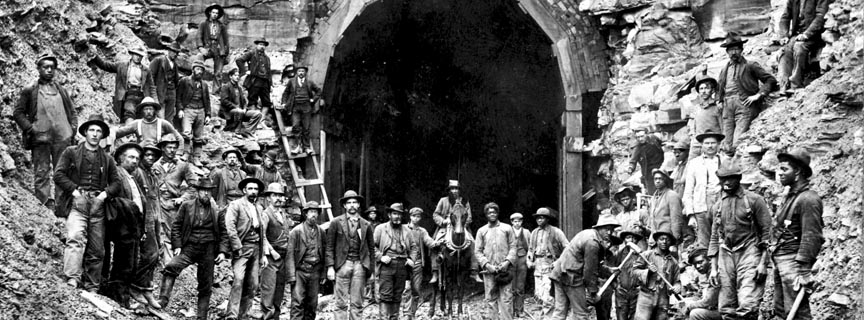 C&O Historical Society Wherever you may find yourself in the New River Gorge, take the time to quietly listen. Intertwined with the sounds of nature; birdsong, flowing water, and wind through the trees you will most likely also hear the whistle of a train. The original Chesapeake and Ohio railroad company line was constructed, following the New River through the Gorge, between 1869 and 1872. This line is very active today with dozens of daily runs by CSX railway corporation coal and freight trains, and Amtrak’s Cardinal passenger line. 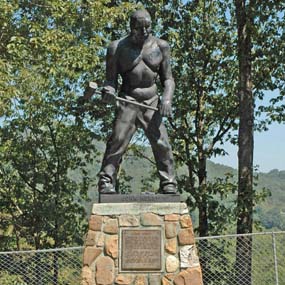 The coming of the railroad through New River Gorge and southern West Virginia was the key event in shaping the modern history of this region. It transformed an isolated and sparsely populated land of subsistence farmsteads into a booming area of company owned coal mining and logging towns that supplied the natural resources that were the base of our nation’s industrial revolution, and were melting pots for diverse groups of new peoples. The C&O railroad was built primarily by two groups of working men, thousands of African-Americans recently freed from enslavement, and recent Irish Catholic immigrants; both groups anxious to begin new lives for themselves and their families as American citizens. The construction of the Chesapeake and Ohio railroad from the Virginia border through the Appalachian Mountains of West Virginia to the Ohio River was a monumental undertaking. Working from both ends of the state the workers spent three years digging and grading the rail bed, hand drilling and blasting the tunnels, and building the bridges and laying the tracks. Using hand tools and explosives, with horses and mules helping with the heaviest loads, these men literally carved the pathway for the railroad through the rugged mountains by hand. 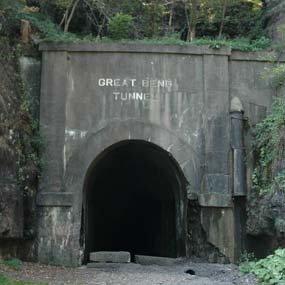 One of the greatest legends of world folklore was born from these workers and their enormous task; John Henry “The Steel Driving Man”. The John Henry of legend is more myth than man; a tragic, larger than life hero involved in an epic battle between man and machine, which was immortalized in a popular folk song the “Ballad of John Henry”. The song sings of a little boy born with a fateful vision of a “hammer in his hand”, who as a steel driver during the construction of the Great Bend Tunnel on the C&O railroad at Talcott, West Virginia takes a hammer in each hand crying “A man ain’t nothing but a man”, as he faces down a giant steam powered drilling machine with the promise “If I can’t beat this steam drill down I’ll die with this hammer in my hand!” John Henry was the working mans champion in a contest to defend the pride and livelihood of his co-workers as they faced the threat of competition from machines at their work. True to his boyhood vision, John Henry triumphs in a fierce race with the drilling machine, but he “dies with his hammer in his hand” from the exertion of his great feat of strength. 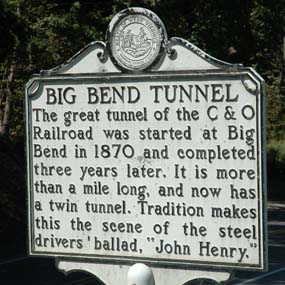 Historical research supports John Henry as a real person; one of thousands of African- American railroad workers, specifically a steel driver, half of a two man team specializing in the hand drilling of holes up to fourteen feet deep into solid rock for the setting of explosive charges. Steel drivers swung a nine pound hammer straight and strong, all day, everyday, pounding assorted lengths of steel drill bits held by their steady and trusting partners, called shakers, who placed and guided the drill bits , and after every strike of the hammer turned or “shook” the bits to remove the pulverized dust. Together these teams of perfectly choreographed industrial artists would with concentration and muscle lead the way, boring the mile long tunnel through Great Bend Mountain and onward along the pathway throughout the length of New River Gorge. Legend and history merged when to test the viability of purchasing steam powered drilling machines to replace the human drilling teams, the railroad staged a contest at the Great Bend Tunnel. Chosen for their skill and speed to compete against the machine, John Henry and his shaker (history does not record his name, although legend sometimes calls him “Little Bill”) faced off side by side with the steam drill and won, drilling farther and faster. Whatever version of the race you choose to believe, the result was the same. The construction of the Great Bend Tunnel and the entire C&O rail line was not a product of the modern machinery of the industrial age but the basic physical labor of thousands of now unknown workers in an everyday struggle to make a living for themselves and their families. Historians also believe that John Henry died at the Great Bend Tunnel, one of the estimated hundreds of workers dying in rock falls, malfunctioning explosions and “tunnel sickness(the excessive inhalation of dust), who now rest in unmarked graves at the tunnel entrance below the statue of John Henry, who still stands as their champion. John Henry was but one of the thousands of men whose strong backs, sweat, blood, and desire to build a new life for themselves and their families were the true foundation for the coming of the Chesapeake and Ohio railroad, the growth of our nation, and the whistle you still hear today. |
Performances, Workshops, Resources & Recordings
The American Folk Experience is dedicated to collecting and curating the most enduring songs from our musical heritage. Every performance and workshop is a celebration and exploration of the timeless songs and stories that have shaped and formed the musical history of America. John Fitzsimmons has been singing and performing these gems of the past for the past forty years, and he brings a folksy warmth, humor and massive repertoire of songs to any occasion.
Festivals & Celebrations
Coffeehouses
School Assemblies
Library Presentations
Songwriting Workshops
Artist in Residence
House Concerts
Pub Singing Irish & Celtic Performances
Poetry Readings
Campfires
Music Lessons
Senior Centers
Voiceovers & Recording
““Beneath the friendly charisma is the heart of a purist gently leading us from the songs of our lives to the timeless traditional songs he knows so well…”
Join Fitz at The Colonial Inn
“The Nobel Laureate of New England Pub Music…”
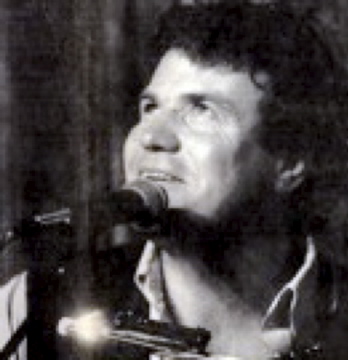
On the Green, in Concord, MA Every Thursday Night for over thirty years…
“A Song Singing, Word Slinging, Story Swapping, Ballad Mongering, Folksinger, Teacher, & Poet…”
Fitz’s Recordings
& Writings
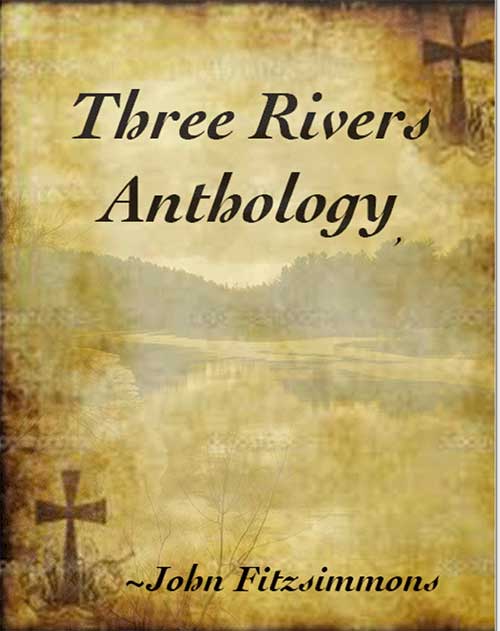
Songs, poems, essays, reflections and ramblings of a folksinger, traveler, teacher, poet and thinker…
Download for free from the iTunes Bookstore
“A Master of Folk…”
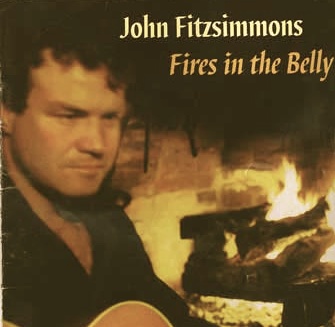
Fitz’s now classic recording of original songs and poetry…
Download from the iTunes Music Store
“A Masterful weaver of song whose deep, resonant voice rivals the best of his genre…”

“2003: Best Children’s Music Recording of the Year…”
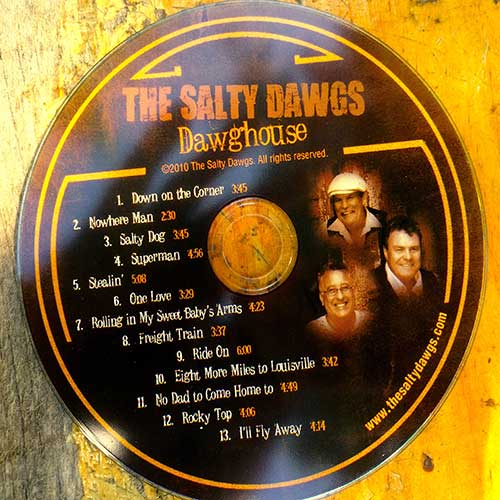
Fitz & The Salty Dawgs Amazing music, good times and good friends…
TheCraftedWord.org
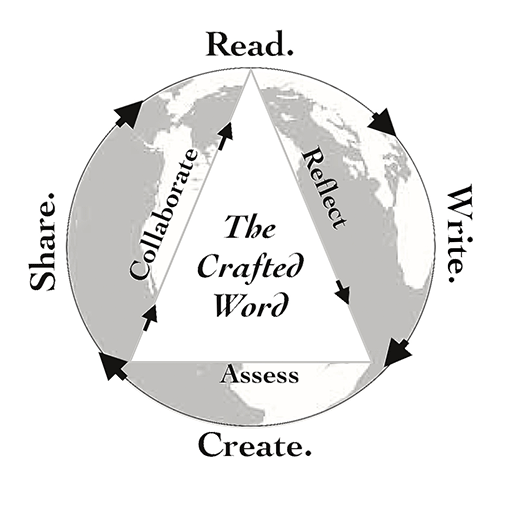
Writing help
when you need it…
“When the eyes rest on the soul…that’s Fitzy…”
0 Comments