Mum…

Very jealous today of all the folks I see spending time with their respective moms–and sad for those who can’t and for those whose wives were taken from their families too early in life…

This is my remmebrance of my “mum” who died several years ago.
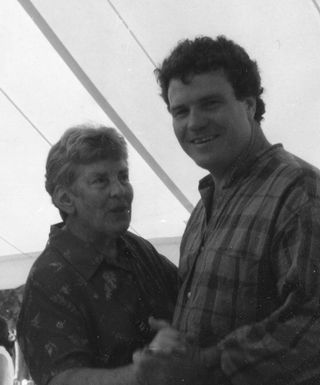
 me and mum     I ran into an old friend one day after visiting my mom, who was entering what we all knew were her last days or weeks. Struggling for words to express his sympathy for both myself and my mom’s condition, he said, “Mary is not the mother you knew.” I guess in a way, none of us are ever that person whom we knew. Every day is a new contract with a life that simply—and often painfully and poignantly—comes with new terms and conditions that we have no choice but to accept and embrace with dignity, grace, and wisdom. No matter what life threw at mom, she accepted the terms put before her; and the world—and especially our world—was always a better, more loving, and infinitely richer place because of her; and though at the end she was not the person we remembered, she was always the mother we had, and she somehow managed to make everyone around her feel “mothered” right up until the very end.

She hated whenever I called her “Ma,” but, still, she was always “Ma Fitz” to anyone whose own mother was displaced by time, fate or distance. Even the toughest kids in town knew that as soon as any one of them placed a foot on Fitz territory, the rules of Ma Fitz were all that mattered. But, along with those rules came a woman who accepted anyone, anytime into a house already crammed with kids. We learned early and often that it is not the size of the house that matters, but rather, the size of the door—and like loading a dishwasher—there’s always room for one more.

On a Sunday night, some months ago, I walked into my mother’s room at Concord Park, and without thinking, I went straight to the refrigerator. It’s the same mechanical motion I’ve made every day that I’ve walked into her kitchen since I was a little kid—no matter where she lived. I didn’t even know what it was I was looking for, but I knew that mom had to have something in there for me.

Maybe I am hungry to know that Ma will still feed me. The refrigerator from my childhood—bursting with unending trips to Stop and Shop, Triple A, and  Star Market is now a small countertop square in the corner of an uncluttered kitchenette. I open it and stare at the small bottle of ginger-ale, the pint of milk, the dainty plate of cookies and the half a sandwich, and drift back into the memories that persist and gnaw and flow out of that small space.

I still expect to see gobs of grapes, oranges, and apples; chocolate pudding, leftover tuna casseroles and Shepard’s pie, Appian way pizza, kool-aid, custard, baloney; and eggs: pickled, deviled, scrambled, and boiled; and potatoes: fried, mashed, hashed and rehashed in the unending evolution of necessity. But sometimes, when times were harder (times that were never actually mentioned but were full of green stamps and coupons) mom made potato buds: dry flakes with carnation instant milk and two tablespoons of butter, mixed into a pudding-like potato that was a perfect place to hide the peas, beets, boiled onions, liver, cod and other scourges of an Irish Catholic childhood; food that kept us at the table long after dinner, stubbornly poking and dabbing the edges with tears and a fork until someone—and rarely mum—relented in their stubbornness.  And when we were really young and the milkman came everyday, we pulled out the whole milk with cream tops in glass bottles with paper caps; EJ, our almost epic father,  would paw the top shut and shake the heavy cream back into the milk itself, exhorting us to imitate his practiced perfection—which none of us could do—and someone always spilled the milk on the cracked formica table and vinyl chairs, and he always screamed, “Every night! Somebody has to spill the milk every single night!”

And then after the mopping rags, dinner resumed in the chaotic recollections of the day; fights about whose night it was to do the dishes and who didn’t mow around the trees, who got seconds last night, and who got a C in penmanship, and who shouldn’t get two hydrox cookies for dessert because they weren’t smart enough to hide their peas in the potato buds!


And we sat in the same seats: I had little sister Annie on my right, always holding on to her waitress pad from Friendliest that she used to take our drink orders and would nod her head and say “thank you very much” and move on to the next of us; and little brother Tommy on my left who we could always get to laugh (and eventually spill his milk) even when he had no clue why he was laughing; and my big sisters staring across from me: Eileen, with her studious perfection and black and white perception of right and wrong, who for some reason Mum put in charge of making sure my bed was made and my room was clean—and who fined me a quarter when it wasn’t, but still I took her to Russo’s on my birthday when I could only bring my best friend; Mary Ellen with her CCHS sweatshirts and unending commentary on everything good, bad, cute or not under the sun—a gift she keeps to this day, and who came to every game I ever played and made the scrapbooks I would never make; and Patty, so old I hardly knew her, until she died so young that I can’t forget her….

And in the overstuffed kitchen, dad’s back was crunched almost against the basement door, and mom was pressed against the dining room wall—the room with the walnut table and eight matching chairs that we never seemed to use—like a museum stuffed with bone china and silverware that we polished every Christmas, bought, I’m sure with the green stamps and coupons.  We could live without the dining room; but we lived and grew in the kitchen. We gathered in that kitchen everyday like chattering birds drawn to a stubbled and time-worn field—and out of that space we were reborn each day.

Every morning mom poured the Wheaties, boiled the oatmeal and cut the grapefruit while we listened to Joe Green in the BZ copter mumbling unintelligible warnings about tie-ups at the Alewife circle and sang along to “Watch me wallabies feed, mates, watch me wallabies feed.” Dad would grab his briefcase and we’d all try to be the first one to scream “Bye dad!” in a cacophony of competition, and, as if on cue, mom would sneak behind me and hold my head while I jerked convulsively, and she’d rub a warm wet cloth across my face and straighten my clip on tie and try to force down my cowlick and pick at my ears until I was fit to be presented to Sister Jean Beatrice—and, by some sort of convoluted math, to God himself.  And then she’d sit in her chair, quietly, and write her own mother a letter.

Marion Fahey, 84 John St. Dalton MA. Every single day she’d write her mother a letter.

One of us could get the letter paper; and one of us could get the envelope; one of us would get to lick the stamp; one of us could put it on the letter; one of us could carry it to the mailbox, and the last one could lift up the metal flag. I never knew it was a ritual of perfection—a continual journey into the heart of the mystic love of family. You never know, but still, you remember.

Over the past few years, Alzheimer’s has slowly chipped away at the edges of her memory, but never to the point where she lost any of her true self.  One day she’d remind me that it’s my childhood friend Danny Gannon’s birthday, and on the next day she’d ask me who my pretty children are…and like polite grandkids they would dutifully tell her their names once again, except for Tommy:  “You know me Grandma, I’m Tommy!” and who’d crawl on her lap and ask for a kiss—“Not that kind of kiss—a chocolate kiss.” And she’d smile and say, “Of course, I know you. You’re Tommy.”

I’d go to see her and we’d look at ads for cars in the Boston Globe.  She wanted a Toyota. “Your father loved his Toyota.” I smile to her, “That’s because Toyotas were cheap, and dad loved cheap.” It didn’t matter that she would never drive again. It didn’t matter that we would have the same conversation the next day. It didn’t matter that soon she might slip into a cloud of unknowing. It only mattered that she was there and in the magic and mysterious majesty of memory, and she will always be here.

We all remember mom, Mary, Mrs Fitz, and Ma Fitz in our own ways, and I know all of you remember her for what she did “for” you. Maybe she knit you a sweater, or sewed a first communion dress for you, or showed you how to quilt or bake or fry or can, or freeze. Maybe she made you dinner, washed your clothes, gave you a room for a few days, weeks, or months or a place to come on Christmas, Easter, Thanksgiving, or any common night when you were hungry for love and acceptance. Maybe she played bridge with you, or took you to White’s Pond, Stinson Lake, Tenney, Waterville or Cannon, or took you to dinner at Russo’s, Friendlies or Jimmies, or drove one or two or three hundred miles to be with you on a special day—or on any given day—when life was too special to go uncelebrated or too crushing to be alone. Maybe she taught you how to be a mother, a friend, a wife, or simply a good person. Maybe she let you marry one of her children and then loved you more than her own kids. Maybe she taught you how to never yell, but just give you that look. (Only Patty seemed to have mastered that look…The rest of us find it easier to yell.) It is easier to remember Mrs. Fitz than to be like Mrs. Fitz.

Sometimes God takes one to touch and teach many. Today is that day. God has blessed us by putting mum into our lives, and though our memories grow from different soils in different gardens, we live today through a shared memory.


Nurture those memories. Hold them. Cherish them.


Thanks. Mum always loved a party.
New Ways

Time for a change. Feeling it in a lot of ways. After months of steady workouts, I’ve been finding too many convenient ways to let the day slip by. Still feel better than I have in years, but the days seem to have got the best of me. Excuses, procrastination and sometimes sheer lethargy and exhaustion got a foothold.

The next few days will be busy as hell, too. Got to get to school early and pay the piper and keep paying…

That means getting to bed here before 1:00 a.m. And that means this writing—which I have been avoiding too—has to put to bed before any real thoughts flow. Tomorrow is a new day.

The Right Side of the Inevitable


Like birds of a feather, we gather together,
‘Cuz they’re feeling exactly like you…
~John Prine


I am not afraid of being a white minority.

I had lunch today with a Jamaican drummer, a Ugandan farmer, and a Senagalese potter. I don’t say this out of pride, for we gathered together simply because we are the old guys working in a young persons’ place. Our conversation was far from noble (unless unpretentiousness is noble) but simply eating together was an experience of nobility–a subtle reminder of what is possible. I have lived long enough and broadly enough to recognize the essential principles of goodness–‘and that has been my continuing consolation. Sappy as it sounds: we are all practically the same. But, this fear of being a minority is the core of what is powering the republican campaign. It is a profound irony for a platform that cherishes individual freedom, but it is still a stunning reality. Our 350 years or so of democratic experience has revealed both the sublimity and baseness of majority rule, so much so that I am equally fearful if either party gains the upper hand, but it does not appear that any true and noble warrior will arrive on the battlefield to save us.

So we are left to ourselves and whatever core of nobility that is within us.

As a white American, I am not immune to the angst of possibility. White America has distorted and abused the inalienable rights of minority Peoples time and time again, and if life teaches us anything, it is that the day of reckoning will always come. I remember reading one day the words of some European philosopher who wrote, “that which is not sustainable cannot continue.” These words have lingered in my consciousness for many years. Ever the optimist, I used this sentence to deny and belittle the fatalists among us: the seas will not rise; the next apocalyptic war till not happen; famines will not engulf us, and change will not destroy us because I believed in the power of collective wisdom to act before the tipping point of inevitability.

I don’t believe that anymore.

As a teacher at a pricey independent school struggling to be inclusive, I have been forced to sit through dreary and pedantic seminars about our white privilege. At the time, I despised being lectured to and admonished by pathetic apologists for my race. In my mind (or at least my previous mind) the sins of our fathers and mothers is not passed on to the sons and daughters, most of whom are belly-full of optimism and are freshly bound by enlightenment to a new paradigm of equality and justice. My whiteness is not a blemish any more than a deformed branch is a tree. It is, however, a dark and menacing shade to any non-white who lives “beneath” it. To not see this, recognize this, and not be appalled by this is to be a sub-human dirt-bag.

It is the tribalism of race that makes us racist. To ignore this is fantasy and hyperbole. Moving beyond that tribalism is a monumental task, but also a necessary journey—an odyssey—that we must make to create a pure democracy in line with the original nobility of our Constitution. For the most part, the word “racist” is obsolete. No one really knows what it means, and we throw the word around with reckless and dangerous volleys of stinging venom. Racist has become more of a root word, a prefix we attach with casual abandon for the purposes of expediency to whatever suits our point of view and whatever belittles those who oppose us. Here and now, the loose and reckless “racist” word is being thrown about with righteous smugness by the left and attached to any person who expresses an inkling of solidarity with the republican platform. Incessant derision only widens the gaping maw between people and parties, and friends and communities until the very notion of free speech becomes a pathetic and gratuitous mockery of itself. Your life–and the way in which you live your life–needs to be your first, last, greatest and most memorable statement.

There is no race that can or should be proud of their history if that history is to be looked at in its totality. We are evolving creatures at odds with our instincts. We stubbornly preserve our own in the cycle of creation and we will try to overpower anything that stops that cycle. This instinct to survive and perpetuate our own is deeply embedded through the millennia of generations and is not easily undone. It seems to be our incessant folly to deny this, so we are now entwined and paralyzed in a sluggy mud of our own making. T.S. Eliot once wrote in “The Love Song of J. Alfred Prufrock:”: “Should I, after tea and cakes and ices,/ have the strength to force the moment to its crisis?”

If you’re not blind, you will see we are at the tipping point of our crisis. We cannot have our tea and cakes and blithely go about eradicating the narrowness of our tribalist thinking. What is real is not hard to see. We are now an enmeshed world of races that needs to act–for the sake of ourselves–as a single tribe of humans–a tribe that can still remember and sing the many songs of our many races that does not mistake and reword prejudice for pride. It is not an artificial globalism; it is a reality we have to embrace and breathe into the actions of our lives. Our melodies may start out discordant, but maybe, somehow, we will at least find a common rhythm to which we can march together. It will never happen if we sing in the narrow halls and conventions of our own minds or huddled within gossiping flocks of sameness, consoled by a common and dull conformity. It will only happen if everybody is in the bigger hall together, searching and floundering for a common key in which to start singing.

And if you don’t, fate has the upper hand, and you will get what you get, and, sadly, you will be left out of the right side of the inevitable.

”

The Litter in Concord

I have been following a Facebook thread about the movement in my beloved hometown of Concord to ban plastic water bottles, plastic bags and styrofoam cups. I am trying to discern whether or not my initial responses are pure and true and not simply reactionary and cynical, for I’ve often wondered where I stand on things like this. I am blessed and befuddled by my ornery nature. who can argue with arguments that are intrinsically true, but practically misplaced and reek of privilege and righteousness.
 
I applaud anything that is forward thinking, but I always have a visceral response to anyone who tells me what to do and how to live my life. Some of my initial responses are pretty narrow-minded, but maybe the new revolution is much more subtle and needs bold models to frame a new paradigm of thinking, but it is just very hard for me to see the economic excesses of the “new” Concord and to try to reconcile it with a greater sense of a world that is by and large just struggling to survive.
 
Perhaps, it is simple jealousy. I don’t want to call it hypocrisy because it is not: these are people who are sincerely arguing for a better approach to living in a sustainable way. Who can argue with that? The greater irony, however, is that economic privilege almost invariably distorts our views of what is truly essential and important. To live in a million home and lament plastic water bottles and styrofoam cups seems a bit disingenuous to any family that is simply trying to make ends meet and raise a family in a dignified–and sustainable–way.
 
This said, I do agree with what they are trying to do. We do need a sustainable planet and we certainly have to start somewhere, but that will only happen with a “sustainable” economy that floats the boats of the poor and lessens the excesses of the rich. Otherwise, this change is only gesture and not progress. Sell your second and third cars; sell your summer home; forgo your trips to exotic places; open your door and not merely your hearts, and then maybe your arguments will have a resonance that is pure and real and, most importantly, convincing because it may be it is you who is not living in an ecumenical and sustainable way.

The Shapes of Stories

While I have always been a storyteller of sorts, I am not much of a writer of stories–but I have always been intrigued by the relative simplicity at the core design level of most books and movies. A lot of it is tied to my love for Joseph Campbell’s work on the Heroic Cycle, which shapes so much of my teaching in 8th and 9th grade. I am also curious about ways to successfully “break” the common cycle of stories–and still produce a piece of worthy and memorable literature. When I read Jayber Crow, by Wendell Berry, I was simply in awe of the beauty of the language, imagery and simple exploration of a time and place.

In my own writing of Hallow’s Lake (unfinished of course) I am trying to create a novel that is a mosaic pieced together by a narrator and aside from the narrator no character greater or lesser than any others. Every chapter is a slice of life lived by some character tied to a remote community around a lake in New Hampshire. I only work on the novel sporadically.

At any rate, I only opened up this blog to post this Kurt Vonnegut video about the shapes of stories that I found in (of all places) The Daily Mail. It is a short, humorous, and not very academic video, but I thought my students might like to see it when we start our short story units.