by Fitz | Oct 29, 2026 | Essays, Journal
I am not sure what Christmas really is anymore. I am almost afraid to think of what Christians are going through in the lands of the original Christian faith. By dint of place and time, I grew up in the Catholic faith, and try as I might, I can’t ever escape the roots of my Christian faith—though I am never absolutely convinced it is faith. It is, however, my means to a more spiritual life. I cannot kneel down in a church and not feel humbled by my “humanness.” It is the only place where I am completely contrite and real and searching.
I would love for more certainty. I would love for my faith to rule out all others, if only to be sure of my way through the Skyllian straits of life where every decision is based on uncertainty. I live within the weakness and greyer shades of heart and intellect mixed with an enduring hope that God works beyond the limits of my understanding—for what I know is always overshadowed by what I do not know. It is my restless soul– a battle that does not rage, but simmers beneath my surface, and what simmers is an overflowing broth of searching and acceptance.
A true God could expect nothing less.
My kids—all seven of them—gathered on couches and chairs around the TV last night and watched “Elf” together. I stood (yes, stood) watching them sprawled amongst each other laughing and simply being the family they are and was astonished that they are the fruit of mine and Denise’s creation. I did not need a re-reading of Genesis or a prayerful recollection of the Gospel of Mathew to know that we are more than bits of atoms and amino acids. I did not need anything more than the tears that streamed out of the depth of a magnificent and overwhelming grace and gratitude to accept the paradigm of a continued rebirthing of life and purpose.
The paltry presents under our tree are simply seeds—reminders of an enduring commitment to what we started as a family some twenty or more years ago, a nano second and molecule of time, that makes everything—everything!—as real and palpable as faith can be. It is our faith, in all of its myopic and blessed beauty! It is not a refutation of other faiths or a stubborn clinging to tradition; it is just who we are and what we aspire to be embedded in the culture of our lives—an instrument of God playing out a unique and enduring song that we sing with whomever is close at hand, regardless of the chorus we sing with. It is our collective soul that sings and rings of possibility—and within that myriad of possibilities are those chances we can’t afford to let slip by.
But they do slip by.
The animosity of righteousness blurs the boundary of our universal human decency, and so the quest to be right overrules the common sense of enlightened acceptance of differences. Here it is a fairly benign bigotry and self-centric claims of higher understanding above a more common ignorance—though it seldom really is. In the Holy land it is a bitter dogfight won or lost in brutality, subjugation and indifference to the human cost. We drop bombs and calculate in the cruel calculus of war what is acceptable loss. The warring factions in the Middle East brings a closer look at an equal depravity that seemingly knows no bounds.
Watching “Elf,” a Hollywood movie by any measure, I was struck by the ending. Nothing survives without a common song sung in common spirit and a belief in the unbelievable. The “reality” of Santa Claus in our home is never a point of discussion. There is no finite point of belief or disbelief. There is no age for our children that demarcates the real from the unreal. Santa is not a bringer of toys. He is the clarion song of reason in a world that is losing its reason. In the panoply of faith, Santa is an adjunct of Christian faith enacted in an enduring way, and while manipulated, distorted and blasphemed by commercialism, he still retains a power that we cling to because we have to believe and any diminishing of that faith diminishes the promise of a humane humanity.
Perhaps Santa is showing us that the giving of gifts supersedes the receiving of gifts, and all any of us can do is to give what we are able to give, and the larger that circle of giving, the larger the effect on the world. There is no true resolution in the dropping of bombs, the massacres of people of a particular faith or self-styled recitations of myopic arrogance. Herds of people are culled from the planet by the innocuous circumstances of fate.
Christmas is an action more than a belief. It is not just some enduring tradition perpetuated by ignorance. It is a stoppage in time, a resetting of the clock to a more infinite time, one that only God seems to understand, and if we don’t stop, the current reality will not stop and the tailspins of history will spiral in devolution and degradation in a return to a baseness that deflates and kills the promise of free will, which, in the end, is all we really have.
If you do not believe in Christmas, at least believe in the promise.
It is a reasonable start…
by Fitz | Oct 29, 2026 | Essays, Journal, Teaching
“Classic’ – a book which people praise and don’t read.”
~Mark Twain
A note to my 8th grade class:
All of you are supposedly reading a classic book, but what Twain says is true: few of us go thirsty to the well and willingly read the greatest works of literature because…well, just because.
The dutiful among you are simply answering the call of an assignment. Some among you are skimming as much as possible to glean just enough to talk or write intelligently about the book, while the laziest among you are putting off reading as long as possible before I ask you to write something meaningful about what you are reading. And then: thank God for Sparks Notes. You might even get away with it.
But only for a while.
Life has a way of catching up with us in some karma-like way. Nobody I know willingly admits that he or she is a shallow shell of a person masquerading as a carrier of knowledge and wisdom. We need to believe that how we live is not only sustainable, but also healthy and vibrant. But how healthy can we be if our thoughts are only as wild and free as turkeys in a pen? How healthy can we be if the food of our mind is a mush of glutinous starch and sugar? Sooner or later the fat settles in, the muscle fades, and a simple walk down the street feels like an epic journey.
My hope is that whatever you are reading is both exhausting and energizing. I hope you sit down to read and forcefully pry the blinders away from your mind and open yourself to the possibility of a true and profound literary experience. I hope that you are sensing the eternal value of a transient experience. I hope that you are giving a damn and trying to figure out how and why the words you are reading are considered to be classic literature.
The book you are reading is considered a classic not because a coterie of fuddy-duddy English teachers have decided something is deemed to be “required” reading. What you are reading is a classic because the words, plot, and value of the book has been proved time and time again in and through the ravages of time and place. Your book is a mountaineer who has scaled some previously unscalable mountain peak.
You, too, are a mountaineer being led by your efforts to a higher peak than perhaps you have climbed before.
Good books do that. Great books do it over and over and over and over.
At this point you may be tempted to rest in a valley and be satisfied with a more narrow view. My youngest son, Tommy, is working on his 6th grade Explorer Project. His subject is George Mallory, the one who when asked why he climbed the highest mountains, simply said, “Because it’s there.” Mallory died on Mount Everest. He and his partner, Sandy Irvine were last seen in 1924 just 800 feet from the summit. Mallory’s body was found some seventy-five years later. No one knows whether they reached the summit or not.
Keep Mallory’s spirit alive. Read your classic. Keep climbing.
Because it’s there.
by Fitz | Oct 29, 2026 | Essays, Journal, Teaching
I
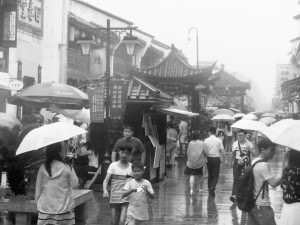 The dull staccato throb in light rain on a dark night. Unseen barges make their way up the QianTian River—concrete shores marked by the arch of the bridge, the spans of beam stretched on beam, the impeccable symmetry of the street-lights broken by a stream of impatient headlights—the bursting aorta of commerce and hope that is Hangzhou.
Or is it the torrent of humanity flowing east and west and north and south around the antiquities of West Lake? Lovers. Couples in every configuration and every intent. Families dragging or being dragged. Packs of friends so hip and cool and daring. So much unlike the China I remember. Soft wool coats: blue or gray. Mao buttons and short-visor caps. I fall just as easily into reverie as anticipation.
The grey fog and swirl of mist on West Lake outlines the rowing prams and party boats decked in imitation of palaces lost to time. On a far hillside—a bare shape of a gray palace on a gray background. Somewhere within: the lusty cries and plaintive words of crazy Li Po, drunk again and strewing words with a practiced and meticulous abandon—picked up by stooped bodies and weathered visages carried and thrown with feral joy—skipping stones stretched across still waters. Heavy, fluttering weight borne down by inescapable gravity.
Right now I am happy to my bones and as lonely and weak as a man can be. I scroll through pictures of my family and share them with the sky which seems heavy enough to fall—the dirt and smoke and smell of progress. Each picture tugs at my heart. I am not built to be away from home—Tommy scales a rock wall. Emma plays her ukulele. Margaret her guitar. EJ fixes his VW. Charlie juggles a soccer ball. Kaleigh collects seashells and beach glass. Pipo washes enormous pans in the camp kitchen. Denise sits in the backyard—our blessed perfect backyard—holding a chicken. I cling to them as wildly as wild can be. I will dare anyone. Any time. It is not a test I need to prepare for.
The craziness is in the contrast: this city of millions and millions and millions sprouting steel and glass and brick in every configuration of a weedy architect’s dream. I should be happy to be here, but I long for the simplicity of my back porch. Morning coffee with Denise. Kids busy. Friends who call. A slow jog. A bulb that needs to be changed. Only a fool would argue with me.
Jet lag wakes me in the middle of the night. I read Joyce for an hour. Is my head Dadelus or Bloom? It is too easy to confuse work of the head with work. Real work. Whatever it is that I need sleep for? Dave and Rob are still asleep. Long in jealous sleep. Or maybe like me—eyes wide-awake, curious if the sun ever shines in this city? Maybe stuck in fogged memories brushed in Song Dynasty waterstrokes. Rounded bellies surrounded by calligraphy’d words. China is not a country that etched its history on cave walls. Everything flows and dies and recreates itself in an unending cycle of births measured in massive ticks of time. For me and Dave and Rob at least: three days of incessant rain, mist and curiosity; still, I am a silent claw scuttling across the floors of a silent sea.
Yet we laugh as much as men have always laughed at the vagaries of fate in this country which seems to have created the word. We are ecstatic with our luck to be here. We scrounge like beggars for coffee in the morning. We force ourselves into taxis like hobo’s stuffing rucksacks. We teach the new elite of China: sons and daughters of scion and opportunity. Kids only, and no different, as if God only has three or four molds to work with: here is your intense child; here is your dreamy child; here is the child hobbled by a dull mind nurtured in like-minded fanaticism by parents deluded by assumptions of perfection, and here is the kid of the world—the ever-real world—the everywhere world: give me love; give me hope; give me joy; give me space. Save me from yourselves.
We work alongside the young and restless who are torn by conviction and inclination. The young who are prey to vanity, pretence, boldness and unplumbable magnanimity in equal measure. We call them by English names chosen in blithe randomness: this sounds good—I like this name—this is easy to remember—many famous people are named Richard. I want to scream and say that we are not so lost that we can’t remember the tongue-twisters of our youth. It is as easy for us to say to say that one sly snake slid up the stake and the other sly snake slid down as Liu Guo Ping or Ren Qi Wei or Sun Zhu. I like your name. I want your name. Your real name. There is no other way to begin.
Just tell us your name! and maybe the BBC won’t report every day on the gulf between us, on what our misunderstandings are, or on how we need to understand history. We are all ignorant, damn it, in every way, yet we are transcendent in every moment—if given the chance. I don’t want to meet another ex-pat who has been here for three years—or five years—or ten years, for they have nothing to tell me but their story, and as perfect and real as that story may be, I will measure that story against their own ignorance—and then we are surprisingly equal. I need to know that the wisdom of my backyard is as expansive as any unboundaried world. If not, why seek peace? It is unattainable. We do not need travel to suffocate bigotry. We only need to love and accept one thing that is not ours and build from there.
The young teachers from the school where we are working, Arvin, Angie, Addie and Ray, walked us around West Lake tonight—a quartet of twenty-somethings that seems to be the pillars of the new China: modern, ancient, vulnerable, and impertable. Arvin, in almost manic ecstasy, tells story after story of the history, the meaning, and the reality of every turn of the path in spontaneous bursts of every language he knew. Angie and Addie and Ray recreate the meaning, but not the ecstasy, blessed and cursed as they are by the temperance of defined lives.
We feast in some palace by the shore. Table after table full of men doing small shots of incredibly strong liquor—standing like warriors around a magnificent table. Sometimes a table of their wives locked in the chatter of tradition. Sometimes a table like us: a few friends; a few guests, and toasts and laughs in a broken dance of broken language cobbled into some kind of understanding. It almost felt like defiance, a changing of the guard. Sit with your wives, dammit! Yet, I was jealous of their camaraderie of tradition. We men barely change.
We watched a Chinese opera performed on the waters, sitting in the pouring rain surrounded within a sea of flimsy blue poncho’s. I loved my poncho, for it made me as Chinese as the rest of the crowd—my blue tarp like their blue tarp. My Mao jacket and their mao cap. I almost wanted to gasp like the crowd at every cool shift of scenery—of tens of feathers running across the water top—of lovers floating on ancient barges never quite touching prows—of ominous risings and fallings of girded columns of steel rising out of the waters of West Lake. Instead I squinted like an engineer to figure out the mechanism of reality that made people gasp. I regret that this always been my fallback to keep me from the lure of wonderment. I wanted to be lost in amazement, yet I was only gifted by the delight of engagement and deconstruction—the lost twin of faith.
Tonight, like everything, did not end: it was truncated by everything that truncates. It is absurd that I am still awake. Wisdom and experience plead with me to let go of the night, but I can’t, because louder than wisdom of experience is the voice of Li Po. The poet’s guttural cry croaked infinatum. Not unlike the barges—some conveyance I don’t see— a sound, merely, in a gray night, but I feel the dull, throbbing, staccato notes—the predictable heartbeat of a diesel reassurance lurching into the strong, moiling, and unceasing flow of tomorrow.
A tomorrow that is already here.
by Fitz | Oct 29, 2026 | Essays, Journal, Teaching
A literary reflection to my students…
The lowering for whales, the appearance of Fedallah’s crew, the vivid descriptions of the first chase in a sudden and unrelenting gale, the fatalistic joy of resigning oneself to fate, the awesome poetic intensity of Melville’s prose—the intermixing of the mundane with the profound and metaphysical, balancing historical accuracies with inner musings on motives and aspirations all make for a compelling read in chapters 42-51.
There is nothing to get but the sublimity of the experience. These are words that must be read–and perhaps reread many times–to appreciate the accumulating power. To become lost by and in the words of Moby Dick is to be lost in the briny mix of our own lives. I read and my mind wanders and seeps into my own life with its mix of romantic dreams lost in the colder harshness of everyday reality.
I have to let myself be pulled and borne by the power of the sea and the maniacal focus on desire, for somewhere in us is the monomania of Ahab equally balanced by the stoic sense of purpose of Starbuck, the self-abnegating and joyful acceptance of fate in Flask and Stubbs, the sheer wonderment and astonishment of Ishmael to simply be there, the visceral and primal wisdom of Queequeg, and the crazy interplay and intermixing of the crew in their universal worldliness and embrace of a common vision—and Moby Dick, the ubiquitous beast, dream, nightmare, and reality that courses through the pulsing aorta of the narrative.
This reading is not and should not be a chore. It is the adventure itself, and a hard and tasking adventure it is that you are tackling day and day out, no less than the crew itself, for the Pequod is, through better and worse, our classroom and our teacher, and we must all stand watch on the mastheads and scan for distant spouts on a vast horizon even, like the mysterious Fedullah, on nights lit only by the sliver of a moon–framed against the vastness of a cold and unforgiving sea and one man’s usurpation of a collective odyssey.
Keep reading.
by Fitz | Oct 29, 2026 | Essays, Journal
If we want to have the freedom to marry whom we want to marry, why is it so important that the state (government) recognise that marriage? Is it simply the expediency of dispensing the entitlements of a marriage certificate: tax benefits, employment benefits, or the other implicit and explicit benefits of being “married” or is it the validating recognition by an authority that a marriage is real? When Denise and I were married, we had no idea that the priest had not signed the “correct” form for our marriage certificate on the correct date (thereby nullifying within a few scant hours our marriage license from the town of Concord, Massachusetts). So with Denise now eight months pregnant—and because of a rather gleeful clerk in the town hall, we needed a new license–and we needed it quickly; hence, we needed a new reason to make our marriage valid and legal in the eyes of the state of Massachusetts.
For us, it was no big deal. We went to O’Hanlan’s Irish Pub in Ayer, Massachusetts where our good friend, John O’Hanlan—and a justice of the peace—married us with all due legality on the spot. It was an awesome footnote and one more fun ceremony. The bigger question, which I never even begged to consider, is what matters most: the civil license or the seal of the church? For us it was a no-brainer: all that really mattered was that we pledged our lives together before God. The state license procured for us all of the other “dignities of marriage” that the state grants to married couples. But we wanted it and we got it. Easy enough for us….
In the end, I could give a crap what the state thinks, but…and it is a huge BUT…I wanted the tax benefits and other perks that a “ recognised” marriage acquires, even though it all represented a simple spread of ink to us on an otherwise inconsequential piece of paper. At the time we were in our eyes and in every palpable way already married. Our daughter Margaret, chomping at the gills to be born was a gift of our faith in the God who made holy and sanctified our marriage and commitment to each other. No piece of bureaucratic parchment could change that. One could argue about the validity and sanctimony and basis of our catholic faith, but to us this was not a point of contention, argument or consideration: it simply was, and still is, the soil upon which we dug and intertwined the roots of our marriage to each other. It is, without any disparagement to opposing views, irrelevant to us. All that really mattered was that Denise and I were married in the eyes and actions of the God and faith and community of our choice and belief. The state document is a dull and imperfect mirror compared to the light of that faith and the dignity of our shared celebration.
The definition of marriage is changing. This is not something I or you or we can change without devolving into absurd semantics and characterisations. God does not ask us to love; God tells us to love, but nowhere in my experience of God have I been told in any immutable way what love is. It is to me a winding river of emotional connections constantly borne towards a greater sea–a continual opening of my heart and soul to the possibilities of every today and tomorrow. Love is simply and immutably “love.” The state and the machinations of the media can and will argue through the breadth and depth of time what defines marriage—but they cannot change the basis of a true marriage, which is “simply and immutably” love, connection, trust and faith, and a resolute and indissoluble devotion to the partner of our choice. Perhaps the myopia of my vision believes that marriage can only be between two persons—but maybe that is because the mosaic of the myriad possibilities is too numbing to consider. Perhaps marriage is a union of thought and dispositions; perhaps marriage is the unwavering connection between committed souls, communities and cultures; or perhaps marriage is too obtuse and ill-defined a word to even warrant a definition—a definition that will always be perversed by ignorant, self-righteous and irrelevant minds.
My fear is that we’ve let a word divide our souls. We’ve let rancour replace magnanimity. We’ve let a celebration become a rift in society.
Replace marriage with love and let it be the action it deserves to be.